


Temporary staff work best when every site follows the same operating rhythm.
To manage temporary staff across locations, businesses need more than a staffing order and a schedule. They need a repeatable workflow that tells each site manager what to prepare, what the staffing agency owns, how safety and training are confirmed, how shifts are approved, and how issues move before they become expensive.
This matters most when temporary workers support stores, warehouses, events, clinics, field teams, hospitality sites, production lines, customer support queues, or seasonal operations. The work may be short term, but the operating risk is real: missed coverage, uneven training, unclear supervision, late timesheets, inconsistent standards, and confused handoffs between the host employer and the staffing agency.
What’s in this article?
- Why temporary staff management breaks across locations.
- A practical workflow for requests, onboarding, scheduling, safety, and approvals.
- Role ownership for operations, site managers, staffing agencies, and finance.
- Common mistakes to avoid.
Why temporary staff management needs a system
Temporary staffing often fails in the gaps between teams. Operations knows why coverage is needed. The staffing agency knows who is available. The site manager knows the actual work. Finance sees the invoice later. HR or legal may only appear when something goes wrong.
That split creates avoidable friction. A site may request five workers without explaining required skills. A temporary worker may arrive before badge access is ready. A manager may approve hours without matching them to the shift plan.
Official safety guidance makes the ownership question even sharper. OSHA says temporary staffing agencies and host employers share responsibility for temporary worker safety and health. NIOSH and OSHA also recommend clear communication between the host employer and staffing agency before work begins, including worksite hazards, training, and responsibilities. That means temporary staffing should be run as an operating process, not a loose set of emails.
How to manage temporary staff across locations
The best way to manage temporary staff across locations is to standardize the lifecycle while allowing site-specific details. Every request should move through the same stages: demand forecast, staffing request, agency confirmation, site readiness, onboarding, shift execution, timesheet approval, issue handling, and closeout.
Start with a request form that captures the business reason, location, dates, shift times, required skills, safety requirements, supervisor, budget owner, and approval path.
Next, create a site-readiness check. Before a temporary worker arrives, the site should confirm equipment, access, manager coverage, required training, workspace, arrival instructions, and the first task. If a staffing agency is involved, confirm which training belongs to the agency and which belongs to the host employer.
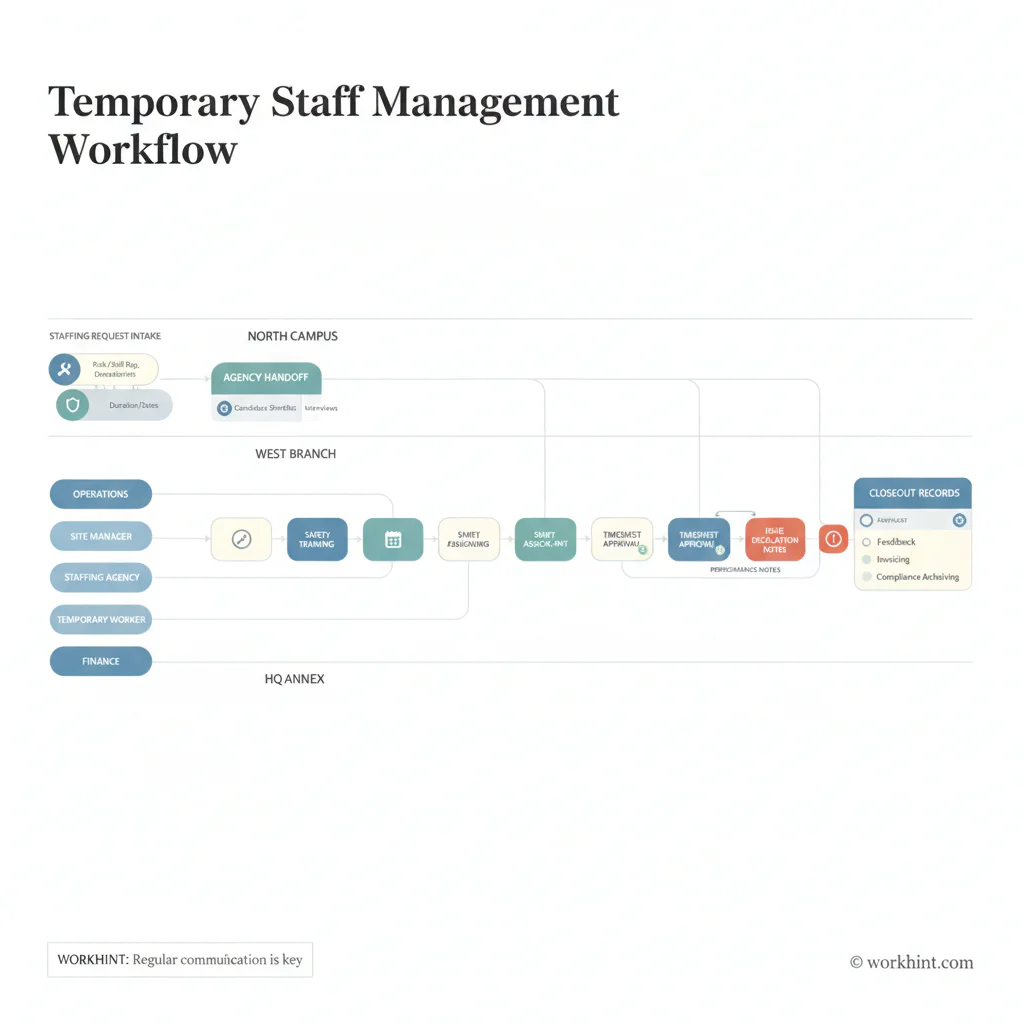
Temporary staff management workflow
A strong workflow keeps temporary staff visible without treating every short-term assignment like a permanent hire:
- Forecast demand: Identify the workload, location, shift, required skills, and duration before asking for workers.
- Approve the request: Route the request to the budget owner, operations lead, or location leader before the agency starts sourcing.
- Confirm assignment details: Share rate, role, shift, location, supervisor, safety requirements, and start instructions with the agency and site.
- Prepare the site: Confirm access, equipment, training materials, workspace, uniforms, tools, and manager coverage.
- Run first-shift onboarding: Cover site rules, safety, task expectations, reporting lines, break rules, and escalation contacts.
- Track shifts and issues: Capture attendance, shift changes, incidents, performance notes, and worker feedback while work is happening.
- Approve time and invoices: Match hours to scheduled shifts, manager approvals, exceptions, and agency invoices.
- Close out the assignment: Remove access, collect equipment, document performance, and decide whether to re-engage the worker or agency.
| Owner | What they own | What must be visible |
|---|---|---|
| Operations | Demand forecast, approval rules, staffing standards, location consistency | Open requests, filled shifts, gaps, costs, recurring issues |
| Site manager | Work instructions, daily supervision, attendance confirmation, shift feedback | Who is arriving, what they should do, what needs approval |
| Staffing agency | Worker sourcing, agency-side screening, assignment confirmation, replacement support | Role requirements, start details, safety expectations, performance feedback |
| HR, legal, or compliance | Policy, classification review, safety records, required documents | Worker type, control level, training evidence, incident records |
| Finance | Rate controls, purchase order alignment, invoice review, payment timing | Approved hours, exceptions, contract terms, invoice status |
Set rules before the first shift
Temporary staff should not discover the operating model on day one. Before the first shift, define the role, who supervises the work, who approves hours, which systems the worker can access, what good performance looks like, and how schedule changes are handled.
If the worker is provided through a staffing agency, document what the agency handles and what the host employer handles. For safety-sensitive work, keep proof of training and site orientation. For direct temporary hires, review employment status, wage and hour rules, tax handling, and local requirements. When classification is uncertain, consult counsel or official guidance; the Department of Labor explains that employment status depends on the actual relationship, not just labels.
Use metrics that help managers act
Temporary workforce management should use a short list of metrics that managers can actually improve. Track fill rate, late starts, no-shows, first-day readiness, training completion, shift acceptance, incidents, manager satisfaction, worker performance notes, invoice exceptions, and repeat-worker rate.
Do not bury the team in dashboards. A practical weekly review should answer four questions: Which locations are short? Which agencies or worker pools are reliable? Which managers are creating approval delays? Which process issue is repeating? Workforce management systems often support scheduling, time tracking, staffing planning, and labor-cost visibility, as NetSuite notes in workforce management best practices.
Common mistakes to avoid
- Letting every location improvise: Local flexibility is useful, but the core workflow should be consistent.
- Skipping site readiness: Temporary staff lose productive time when badges, tools, instructions, or supervisors are missing.
- Approving hours without context: Hours should connect to scheduled shifts, assigned work, exceptions, and manager approval.
- Treating agency handoffs casually: Agencies need clear role requirements, safety expectations, performance feedback, and replacement rules.
- Ignoring closeout: Access removal, equipment return, performance notes, and rehire decisions matter even for short assignments.
Where Workhint fits
Workhint fits when temporary staffing needs to become a repeatable operating system instead of spreadsheets, emails, and disconnected agency updates. A business can use Workhint to structure staffing requests, route approvals, assign site readiness tasks, collect documents, manage role-based access, track shifts, capture manager feedback, route invoice approvals, and keep records by location, agency, assignment, and worker type.
The goal is to make the temporary staffing workflow visible from request to closeout so operations, site managers, HR, finance, and staffing partners work from the same process.
FAQ
What is the best way to manage temporary staff?
Use a consistent workflow for requests, approvals, site readiness, onboarding, scheduling, safety, timesheet approval, issue escalation, and closeout. That gives each location room for local details while keeping standards consistent.
Who is responsible for temporary worker safety?
Responsibility can be shared. OSHA says temporary staffing agencies and host employers are jointly responsible for temporary worker safety and health. Document who provides general training, who provides site-specific training, who tracks incidents, and who confirms readiness.
How should businesses measure temporary staff performance?
Use simple operational metrics: attendance, shift completion, work quality, readiness, safety incidents, manager feedback, invoice exceptions, and repeat eligibility.
How do you manage temporary staff across multiple locations?
Use one central intake and approval process, then attach location-specific details such as shift times, supervisor, site instructions, safety requirements, access needs, and local escalation contacts. Review gaps weekly by location so patterns are visible.
Conclusion
Temporary staff can help a business handle demand spikes, vacancies, projects, and seasonal pressure, but only when the operating model is clear. Strong teams define the workflow, assign ownership, prepare each site, document safety and approvals, track exceptions, and close the loop after every assignment.
That discipline turns temporary staffing from a scramble into a repeatable workforce operation.
Leave a Reply