


A succession plan is useful only when it shows which roles are at risk, who can step in, and what must happen next.
A succession planning template helps a business protect critical work before a key person leaves, changes roles, takes leave, or becomes unavailable. The goal is not to name a favorite replacement. The goal is to identify business-critical roles, assess readiness honestly, close capability gaps, and keep continuity visible.
Succession planning is often treated as an executive HR exercise. That is too narrow. A growing company may have founder-dependent sales knowledge, one finance owner who understands billing, one operations lead who knows the vendor network, or one technical manager who holds the deployment process together. Those roles need practical succession planning too.
What’s included
- A copy-ready succession planning template.
- A checklist for identifying critical roles and successor readiness.
- A readiness table for emergency, short-term, and long-term coverage.
- Common mistakes that make succession plans weak.
- A workflow for turning the plan into a live operating process.
How to use this succession planning template
Use this template for roles where losing one person would slow revenue, delivery, compliance, customer support, finance, product execution, operations, or institutional knowledge. Start with the roles that would create the most disruption within 30 days if the current owner left tomorrow.
The U.S. Office of Personnel Management describes succession planning as a long-term approach to identifying growth potential, aligning skills with needs, and giving employees relevant development opportunities. The OPM succession planning guidance is written for public agencies, but the operating logic applies to business teams: plan before the vacancy happens.
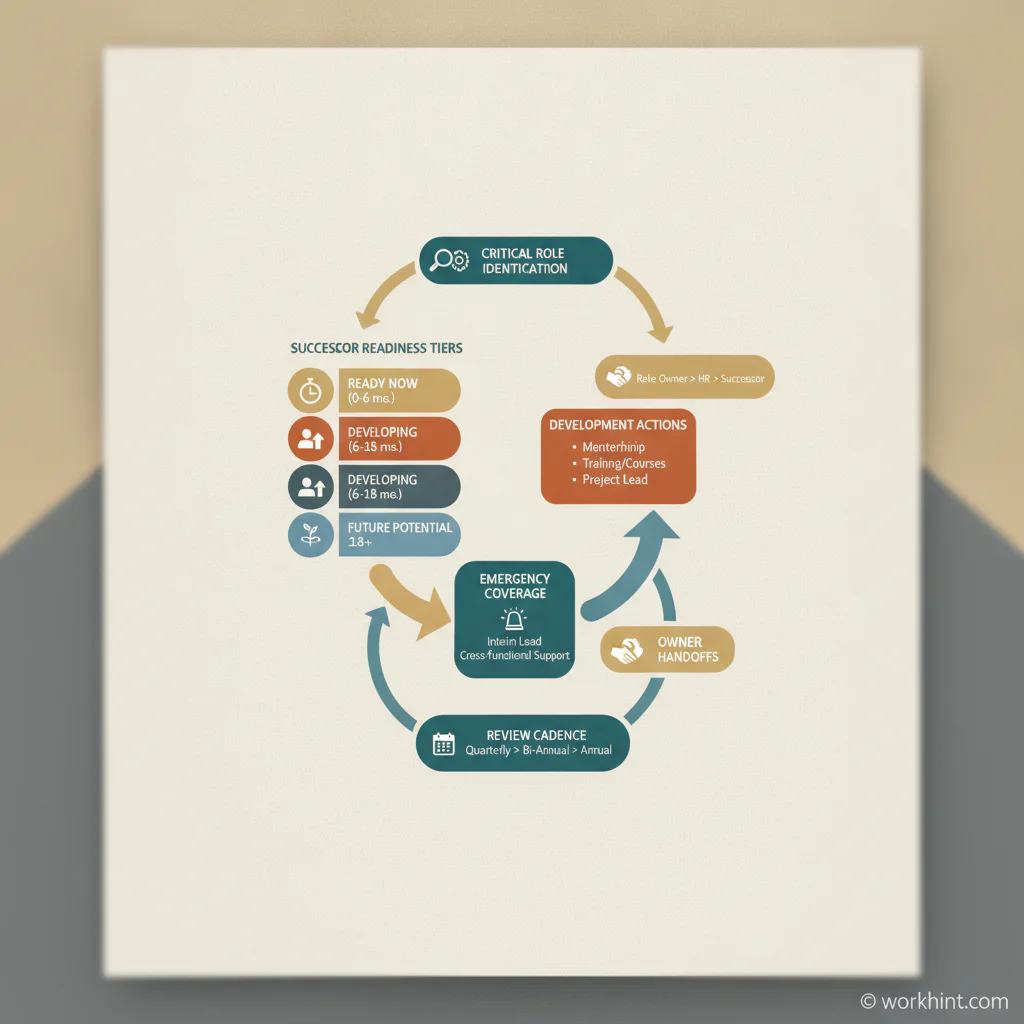
Succession planning template
Copy the structure below into your HR system, spreadsheet, planning document, or operating workflow. Review it quarterly for critical roles and immediately after major org changes, acquisitions, product launches, leadership exits, or new compliance obligations.
| Field | What to capture | Example |
|---|---|---|
| Critical role | The role, function, or owner whose absence creates risk. | Customer implementation lead |
| Current owner | The person or team currently accountable. | Director of Operations |
| Business impact | What breaks, slows, or becomes risky if the role is vacant. | New customers wait for launch planning and handoff. |
| Risk level | High, medium, or low based on urgency, scarcity, and dependency. | High |
| Successor candidates | Named people, internal pools, external options, or interim owners. | Implementation manager, senior customer success manager |
| Readiness | Ready now, ready in 3-6 months, ready in 6-12 months, or no coverage. | Ready in 3-6 months |
| Capability gaps | Skills, judgment, relationships, system access, or context still missing. | Enterprise launch sequencing and billing handoff |
| Development actions | Projects, mentoring, documentation, shadowing, training, or stretch work. | Lead two implementations with review by current owner |
| Emergency coverage | Who owns the work for the first 30 days of an unplanned vacancy. | COO handles customer escalation; PMO handles launch schedule |
| Review owner | The person accountable for updating the plan. | Head of People |
Succession planning checklist
- List critical roles first. Do not start with every role. Start with work that creates revenue, compliance, delivery, customer, operational, or knowledge risk.
- Define what success requires. Capture the decisions, relationships, systems, approvals, metrics, and judgment the role depends on.
- Identify coverage options. Name internal successors, interim owners, external recruiting paths, vendor support, or cross-trained teams.
- Rate readiness honestly. Separate emergency coverage from true readiness. Someone may keep work moving for 30 days without being ready to own the role permanently.
- Assign development actions. Every gap needs an owner, due date, and practical assignment.
- Document handoff knowledge. Store key accounts, processes, recurring decisions, approvals, tools, files, vendors, and exception rules.
- Review on a cadence. Update plans after role changes, performance reviews, restructures, hiring freezes, promotions, departures, or strategy shifts.
The USGS Succession Planning Desk Guide frames succession planning as a way to preserve knowledge, focus on workforce vulnerabilities, and build talent pools for essential positions. That is a useful standard for business teams: the plan should reduce specific vulnerabilities, not sit in a folder.
Readiness levels to use
| Readiness level | Meaning | Action |
|---|---|---|
| Ready now | The person can step into the role with normal transition support. | Keep engaged, give exposure, and confirm retention risk. |
| Ready in 3-6 months | The person has most capabilities but needs targeted experience. | Assign stretch projects, shadowing, and decision practice. |
| Ready in 6-12 months | The person has potential but meaningful gaps remain. | Create a development plan with milestones and coaching. |
| Emergency only | The person can keep operations stable for a short period. | Document escalation rules and limits of authority. |
| No coverage | No realistic internal or interim option exists. | Recruit, cross-train, redesign the role, or reduce dependency. |
What to include beyond names
A succession plan that only lists names is fragile. Add evidence and operating context. SHRM notes that strong succession plans include a clear assessment of leadership capabilities and recent performance. Its succession planning guidance reinforces the need for assessment rather than assumption.
For each successor, capture observed strengths, readiness evidence, missing experiences, manager feedback, retention risk, mobility constraints, and the next development assignment. For each role, capture critical systems, recurring decisions, approval authority, customer or vendor relationships, regulatory exposure, and the minimum handoff record.
Common mistakes
- Planning only for executives. Critical dependency often sits in operations, finance, customer delivery, field management, product, or technical administration.
- Confusing potential with readiness. A high-potential employee may still need context, judgment practice, or stakeholder exposure.
- Ignoring emergency coverage. Long-term succession does not solve the first 30 days after an unplanned absence.
- Letting the plan go stale. Succession data changes whenever people move, roles expand, processes change, or strategy shifts.
- Leaving knowledge transfer separate. Successors need access to the operating knowledge that makes the role work.
Where Workhint fits
Workhint fits when the succession planning template needs to become an active workflow instead of a static spreadsheet. A team can use Workhint to collect role risk inputs, assign review owners, route development actions, track readiness changes, connect knowledge transfer tasks, manage approvals, and keep evidence in one place.
That matters because succession planning depends on follow-through. Workhint can help turn critical roles, successor candidates, readiness reviews, development assignments, documents, reminders, and reporting into a repeatable operating system. The business still makes the judgment calls. Workhint keeps the process visible enough to manage.
FAQ
What is a succession planning template?
A succession planning template is a structured worksheet or workflow used to identify critical roles, possible successors, readiness levels, development actions, emergency coverage, and review owners.
Which roles should be included in a succession plan?
Include roles that create meaningful business risk if vacant. That may include executives, founders, finance owners, operations leads, technical specialists, customer owners, compliance roles, or field managers.
How often should a succession plan be reviewed?
Review critical-role plans at least quarterly and after major changes such as departures, promotions, reorganizations, strategy changes, acquisitions, or new business lines.
Should employees know they are succession candidates?
Use judgment and follow HR guidance. Some companies discuss development paths openly, while others avoid making implied promises. Either way, development actions should be clear and fair.
Is succession planning the same as knowledge transfer?
No. Succession planning identifies coverage and readiness for critical roles. Knowledge transfer captures the information, relationships, decisions, and processes needed for someone else to perform the work.
Conclusion
A practical succession planning template gives leaders a clearer view of continuity risk. It shows which roles matter most, who could step in, what readiness really means, where gaps remain, and which actions need follow-up. The value is not the document itself. The value is a business that can keep operating when important people move, grow, or leave.
Leave a Reply