


A strong operating rhythm makes execution predictable without turning every update, decision, and blocker into another meeting.
An operating rhythm is the repeatable cadence a business team uses to review priorities, share information, make decisions, remove blockers, and follow through. A weak rhythm creates recurring meetings with unclear purpose, scattered status updates, disappearing decisions, and teams that still need to chase context afterward.
The goal is not to create more meetings. The goal is to design a work system where information reaches the right people, decisions happen at the right level, and follow-up becomes visible. Asana’s Anatomy of Work research describes how knowledge workers lose time to work about work such as searching for information, switching tools, unnecessary meetings, and chasing status. A better operating rhythm should reduce that drag, not formalize it.
What’s in this article?
- What an operating rhythm should include
- How to choose the right cadence for different types of work
- A practical design matrix for business teams
- Common mistakes that turn cadence into calendar clutter
- Where Workhint fits when the rhythm needs to become a live system
Why an operating rhythm matters
Most teams already have a rhythm. It may be accidental, but it exists: weekly meetings, monthly reviews, quarterly planning, async updates, dashboards, executive check-ins, and urgent escalation threads. The question is whether those pieces work together.
McChrystal Group argues that teams should tune their operating rhythm to the speed of their environment, asking how fast the outside world is changing and how quickly the organization can adapt. A customer support operation, a field service team, a product launch team, and a finance approval process do not need the same cadence. The rhythm should follow the speed, risk, and decision load of the work.
Meeting overload is the warning signal that the rhythm is broken. Harvard Business Review summarized research showing that many meetings keep employees from productive work. Microsoft has described the modern “infinite workday,” where meetings, messages, and notifications fragment attention. An operating rhythm is useful only if it protects focus while improving decisions.
Start with the decisions the rhythm must support
Do not begin with the calendar. Begin with the decisions and actions the business must make repeatedly. Every meeting, report, or update should help a decision happen faster or help a workflow stay healthy.
Ask:
- What outcomes must this team keep on track?
- What decisions repeat every day, week, month, or quarter?
- What information must be available before those decisions?
- Who owns the decision, the follow-up, and the metric afterward?
If a meeting cannot answer those questions, it is probably a habit, not an operating mechanism. Replace it with an async update, dashboard review, shorter decision forum, or clearer escalation rule.
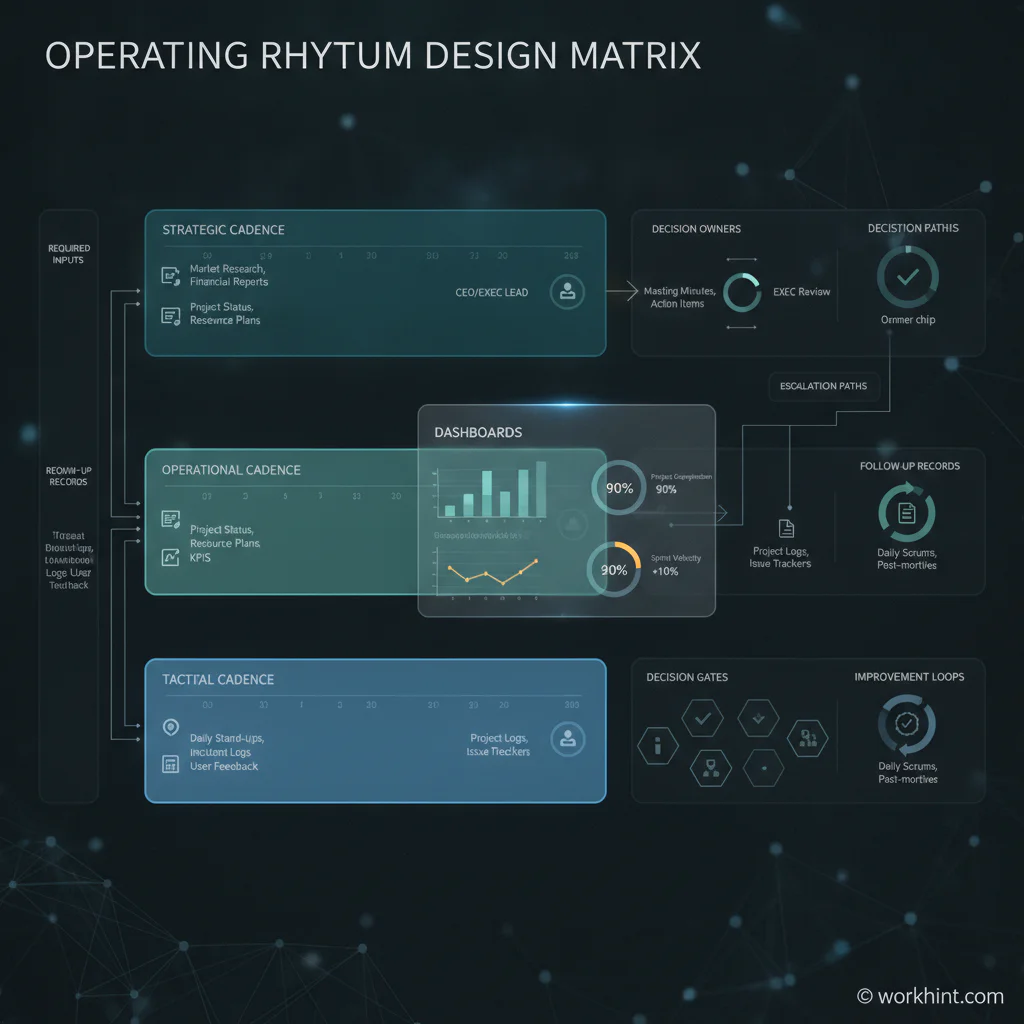
Operating rhythm design matrix
The cleanest way to design an operating rhythm is to map the cadence to the level of work. Strategic reviews should not do tactical triage. Daily check-ins should not reopen quarterly priorities.
| Cadence | Purpose | Required input | Output |
|---|---|---|---|
| Daily or real-time | Spot blockers, capacity issues, and urgent exceptions | Current work status, aging items, escalations | Owner assigned, blocker removed, or escalation opened |
| Weekly | Review execution against priorities | Team metrics, risks, decisions needed, commitments | Updated priorities, action owners, due dates |
| Monthly | Review process health and resource allocation | KPI trends, cycle time, backlog, quality, customer signals | Process changes, capacity decisions, improvement actions |
| Quarterly | Reset goals, operating constraints, and strategic bets | Business performance, market changes, lessons learned | Updated goals, decision rules, investment priorities |
This matrix keeps the rhythm from collapsing into one overloaded meeting. Tactical work gets fast attention, operational patterns get periodic review, and strategic decisions get context.
Build the rhythm as a workflow
Once the cadence is clear, turn it into a workflow. A useful operating rhythm has defined triggers, standard inputs, roles, decision rules, records, and follow-up.
1. Define the trigger
Every cadence should have a trigger. A daily standup may trigger on blocked work. A weekly review may trigger on commitment status. A monthly review may trigger on KPI movement, backlog growth, quality issues, or capacity pressure.
2. Standardize the input
Make updates structured. Require the same fields each time: priority, owner, status, decision needed, risk, dependency, next action, and due date. This prevents meetings from becoming storytelling sessions where every team reports differently.
3. Assign decision rights
Each rhythm needs a named decision owner. If everyone attends but no one can decide, the meeting becomes a delay mechanism. Separate contributors, reviewers, approvers, and escalation owners before the cadence begins.
4. Capture the output
The output should be visible after the review: decision, owner, deadline, status change, escalation, or process update. If the output lives only in conversation, the rhythm will leak accountability.
5. Review the rhythm itself
Every month or quarter, inspect whether the rhythm is still useful. Remove recurring meetings that no longer drive decisions. Add automation where updates are predictable. Shorten meetings where the pre-read can carry the context.
Use async updates before meetings
Many teams use meetings to discover information that should have been visible beforehand. Microsoft’s 2025 Work Trend Index follow-up describes how meetings, email, messages, and interruptions fracture focus across the workday. A healthier rhythm protects meetings for discussion, tradeoffs, and decisions.
Before any recurring review, ask participants to submit structured updates in advance. The meeting can then focus on exceptions: blocked items, decisions needed, risks, and priority changes. If there are no exceptions, cancel or shorten it.
Common operating rhythm mistakes
- Starting with meeting frequency instead of business outcomes. Cadence should follow the speed and risk of the work.
- Mixing strategy, operations, and tactical triage. Each level needs its own purpose and output.
- Letting status updates consume decision time. Status belongs in a structured pre-read or dashboard when possible.
- Failing to assign owners. Every decision and follow-up needs one accountable owner.
- Keeping recurring meetings forever. The rhythm should be reviewed and pruned like any other operating process.
Where Workhint fits
Workhint fits when the operating rhythm needs to become more than a meeting pattern. A team can describe the rhythm it wants to run, and Workhint can help turn it into a live work system: intake forms, roles, permissions, owner assignment, review cadences, approvals, escalation paths, dashboards, reminders, and decision records.
For example, a weekly operations review can collect owner updates, route exceptions, show priority and capacity signals, capture decisions, assign follow-up, and carry unresolved items into the next cadence. That is the difference between a meeting habit and an operating system.
FAQ
What is an operating rhythm?
An operating rhythm is the repeatable cadence a team uses to align priorities, review work, make decisions, remove blockers, and follow up. It includes meetings, async updates, dashboards, decision records, and escalation rules.
What is the difference between operating rhythm and operating cadence?
Operating cadence usually describes the timing of recurring touchpoints. Operating rhythm is broader. It includes the cadence plus the information, behaviors, decisions, ownership, and follow-up that make the cadence useful.
How often should business teams meet?
The frequency should match the speed and risk of the work. Fast-moving operational work may need daily or real-time review. Strategic priorities may need monthly or quarterly review. The test is whether the meeting improves decisions faster than an async update would.
How do you know an operating rhythm is working?
Look for fewer surprise escalations, clearer ownership, faster decisions, shorter status meetings, better follow-through, healthier cycle time, and more predictable progress against priorities.
Conclusion
An operating rhythm should make work easier to run, not harder to schedule. Start with the decisions the business needs to make, match cadence to the speed of the work, standardize inputs, assign owners, record outputs, and keep pruning the rhythm as conditions change.
The best rhythm gives teams structure to execute consistently and enough flexibility to adapt. That is what turns coordination into a scalable work system.
Leave a Reply