


Most operational plans fail when strategy stays abstract and daily work keeps running on habit.
An operational planning process is the system a business team uses to turn goals into coordinated work. It connects priorities, owners, resources, milestones, KPIs, review rhythms, and adjustment rules so the team knows what must happen, who owns it, and how progress will be managed.
The output is not only an operational plan document. The document matters, but the real value comes from the operating system around it. A useful plan changes how work is assigned, reviewed, escalated, measured, and improved.
What’s in this article?
- What an operational planning process should include.
- How to translate goals into workflows, owners, and milestones.
- A practical planning table for business teams.
- Common planning mistakes that create execution drift.
- Where Workhint fits when the plan needs to become a live work system.
What is an operational planning process?
An operational planning process translates strategy into the near-term work required to deliver it. Asana describes operational planning as a way to turn strategic goals into daily tasks, KPIs, and assigned ownership. That framing is useful because it separates aspiration from execution.
A strategy may say the company needs to improve customer retention, launch a new service line, reduce fulfillment delays, or expand into a new market. The operational plan answers the practical questions: which workflows change, who owns each workstream, what capacity is available, what milestones matter, what risks could block progress, and how leaders will know whether the plan is working.
Why operational planning matters
Operational planning matters because most execution problems are not caused by a lack of ambition. They are caused by unclear translation. Teams agree on the goal, then interpret the work differently across functions. Marketing launches before operations is ready. Customer success commits to timelines that delivery cannot support. Finance tracks spend after decisions have already been made.
Atlassian’s operational planning guide emphasizes clear objectives, priorities, resources, and expectations. Those elements create a shared operating baseline. Without them, the plan depends on memory, meetings, and individual judgment.
Planning also reduces execution risk. PMI’s review of planning and project success notes that stronger planning and analysis are associated with better outcomes, while inadequate planning raises failure risk. Business operations are not always formal projects, but the lesson carries over: complex work performs better when the team clarifies scope, resources, constraints, and measures before execution pressure builds.
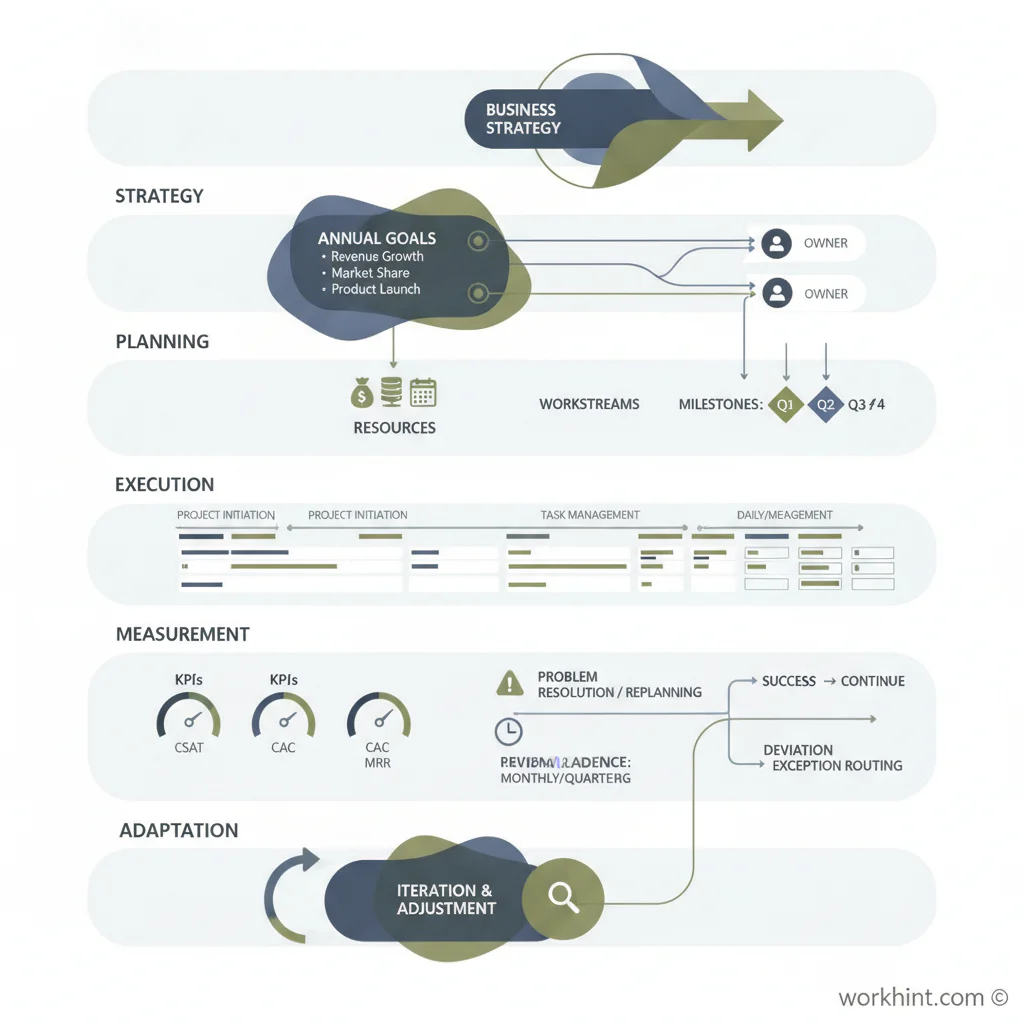
Build the operational planning workflow
A strong process moves through seven steps. Each step turns a vague plan into a more measurable work system.
- Define the business outcome. State the result the plan must produce, such as shorter onboarding time, higher service capacity, lower rework, faster request resolution, or improved margin.
- Identify the workstreams. Break the outcome into the workflows that must change: intake, assignment, approvals, delivery, staffing, customer communication, reporting, billing, or quality control.
- Assign accountable owners. Give each workstream one owner who can make decisions, coordinate dependencies, and report progress.
- Map resources and constraints. Define available people, budget, tools, data, vendor support, compliance needs, and capacity limits.
- Create milestones and decision points. Set checkpoints where the team confirms readiness, approves changes, or adjusts scope.
- Choose operational KPIs. Track leading and lagging indicators, such as cycle time, backlog age, SLA status, utilization, quality errors, cost variance, or customer impact.
- Set the review rhythm. Decide when the plan is reviewed, who attends, what data is used, and what happens when the plan is off track.
monday.com’s operational planning guide frames planning as the bridge between strategy, tasks, timelines, and resources. The bridge only works when each element is connected to a review habit and an action rule.
Operational planning process table
| Planning element | Question to answer | Common failure | Better operating standard |
|---|---|---|---|
| Outcome | What business result must change? | The plan lists activities but not the result. | Name one measurable outcome and the business reason behind it. |
| Workstreams | Which workflows create the outcome? | Teams plan by department instead of process. | Map the actual flow of work across teams and systems. |
| Owners | Who is accountable for each workstream? | Ownership is assigned to a group. | Assign one DRI and one backup for every critical workstream. |
| Resources | What capacity, budget, tools, and data are required? | The plan assumes capacity without checking it. | Match work to available capacity before committing timelines. |
| KPIs | How will progress and risk be measured? | Metrics are reviewed after work is already late. | Use leading signals that trigger action early. |
| Review rhythm | How will the plan adapt? | The plan is created once and forgotten. | Set weekly or monthly reviews with decision rules. |
Make the plan executable
The easiest way to improve an operational plan is to write each commitment as an executable sentence: owner, action, object, deadline, dependency, and success measure. For example, “Operations will reduce onboarding cycle time from ten days to six days by September 30 by redesigning intake, automating document collection, and reviewing cycle time weekly.”
That sentence is stronger than “improve onboarding” because it gives the team a target, owner, deadline, work system, and review measure. The same pattern works for internal requests, contractor onboarding, service delivery, project intake, field operations, compliance reviews, and customer implementation.
Common operational planning mistakes
- Planning by department instead of workflow: Customers, requests, approvals, and handoffs move across teams. Plan the flow, not just the org chart.
- Skipping capacity checks: A plan that ignores workload becomes a wish list. Confirm who can actually do the work before setting commitments.
- Using lagging metrics only: Revenue, satisfaction, and final delivery results matter, but teams also need early warnings such as backlog age, overdue approvals, and owner load.
- No exception path: Every plan needs rules for blocked work, missed milestones, scope changes, and resource conflicts.
- Confusing review meetings with governance: A meeting is useful only if it produces decisions, routing changes, owner changes, or process improvements.
Where Workhint fits
Workhint fits when an operational planning process needs to become a live work system instead of a static planning document. A team can describe the operating goal, then use Workhint to structure the roles, workflows, permissions, intake steps, approvals, assignments, dashboards, escalation rules, documents, and reporting around the plan.
That matters when the plan crosses functions or includes external contributors. For example, a service expansion plan may involve sales, operations, finance, delivery partners, customer support, and leadership. Workhint can help turn that plan into coordinated work where owners know what they control, approvals move through the right path, risks are visible, and performance signals are tied to the workflow itself.
FAQ
What should an operational planning process include?
It should include a business outcome, workstreams, owners, resources, milestones, dependencies, KPIs, review cadence, and exception rules for blocked or changing work.
How is operational planning different from strategic planning?
Strategic planning defines the direction and major goals. Operational planning translates those goals into near-term work, owners, timelines, resources, and execution measures.
Who should own operational planning?
An operations leader, department head, or business owner should own the process. Individual workstreams should still have named accountable owners.
How often should an operational plan be reviewed?
Review active operational plans weekly or monthly, depending on pace and risk. The review should focus on progress, capacity, blockers, KPI movement, and decisions needed.
Conclusion
An operational planning process works when it turns strategy into coordinated execution. Define the outcome, map the workflows, assign owners, match work to capacity, set milestones, choose useful KPIs, and create a review rhythm that changes the plan when reality changes. The result is a more scalable, repeatable, and measurable way to run the work that matters most.
Leave a Reply