


Partner issues get expensive when no one knows who can decide, who should act, or when escalation is overdue.
A partner escalation matrix gives business teams a clear path for routing partner issues before they turn into customer risk, missed revenue, broken service levels, payment disputes, or executive surprises. It defines which issues stay with the partner owner, which move to functional experts, which require leadership, and what evidence must be captured along the way.
The primary keyword is practical because the work is practical: a partner escalation matrix is not just a support document. It is an operating control for companies that work with referral partners, resellers, implementation partners, agencies, service providers, affiliates, staffing partners, and delivery partners.
What’s in this article?
- Why partner escalations break down across business teams.
- The core elements of a useful partner escalation matrix.
- A copy-ready template with severity levels, owners, timing, and records.
- A workflow for running escalations without creating noise.
- Where Workhint fits when partner operations need a live system.
Why a partner escalation matrix matters
Partner work sits outside the normal org chart. A channel partner may need sales support. An agency may be blocked by missing access. An implementation partner may be waiting on product guidance. A referral partner may have a commission question. A service partner may be handling a customer issue that can no longer stay at the front line.
Generic escalation guidance usually defines levels and response times. For example, Smartsheet’s escalation matrix templates show the common structure of levels, roles, issues, and contacts. That structure is useful, but partner operations need more specificity because the issue crosses company boundaries.
A good matrix answers five questions: what triggered the escalation, who owns the next action, who has authority to decide, how fast the response is due, and what record proves the issue was closed. Without those rules, the partner owner becomes a human router, leaders get pulled in too early or too late, and partners learn that escalation means bypassing the process.
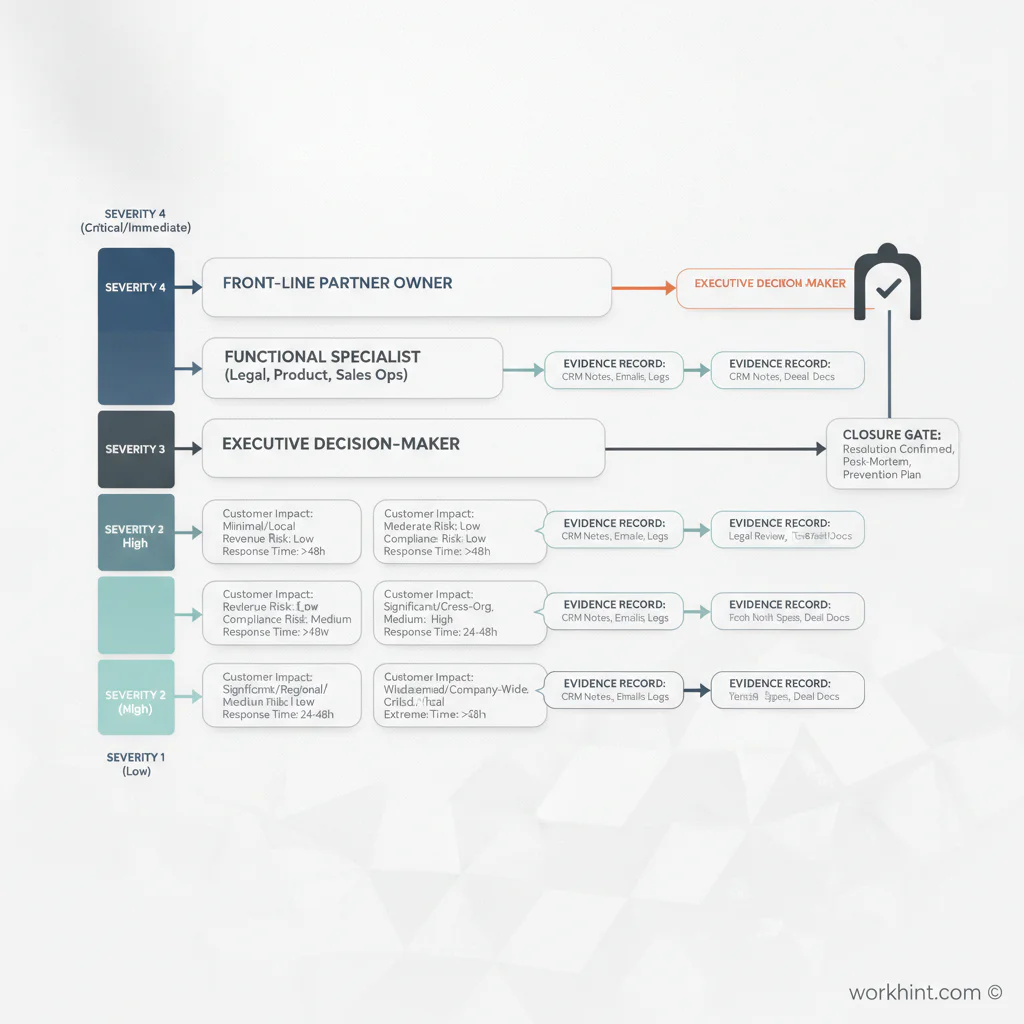
Partner escalation matrix template
Use this template as a starting point. Adapt the timing, authority, and owner names to your partner model and customer risk.
| Level | Trigger | Primary owner | Response target | Record to keep |
|---|---|---|---|---|
| Level 1 | Routine partner question, missing asset, minor task delay, unclear process | Partner owner or partner operations | One business day | Question, answer, owner, and follow-up date |
| Level 2 | Blocked delivery, customer-facing delay, repeated missed update, access issue | Functional owner in sales, support, operations, IT, or finance | Four to eight business hours | Issue summary, impact, decision needed, and action owner |
| Level 3 | Revenue risk, contractual dispute, compliance concern, customer escalation | Department lead or accountable executive | Same business day | Risk, options, decision, conditions, and communication plan |
| Level 4 | Legal exposure, security incident, strategic partner breakdown, public risk | Executive sponsor with legal, security, or finance | Immediate triage | Incident record, executive decision, external message, and closure review |
How to build the escalation process
1. Define partner types first
Do not use one vague process for every partner. Referral partners, resellers, agency partners, delivery partners, technology partners, staffing suppliers, and service providers create different risks. Start by listing the partner types and the issues each one can create.
2. Separate urgency from seniority
A senior partner contact does not automatically make an issue severe. A small support ticket can stay at Level 1. A lower-value partner with a customer-impacting security issue may need Level 4. Monday.com’s escalation matrix examples frame escalation around triggers, authority, and response timing. Use the same principle for partner operations.
3. Assign functional owners
The partner owner should not personally solve legal, finance, IT, support, sales, and product problems. The matrix should name the function that owns each decision type. That keeps escalation from becoming a forwarding exercise and makes response expectations visible.
4. Require evidence before escalation
Every escalation should include enough context to act: partner name, customer or project affected, timeline, business impact, decision needed, previous attempts, and deadline. Partner-led support models often rely on the partner to triage first. PartnerStack defines partner-led support escalation as a model where certified partners handle the first line before issues move to the vendor. That only works when the escalation package is clear.
5. Close the loop
Escalation is not finished when someone replies. It is finished when the decision is recorded, the partner is updated, the customer or internal stakeholder is informed if needed, and the next prevention step is assigned. A process that never closes becomes a backlog of anxiety.
Common partner escalation mistakes
- No severity definitions: People escalate based on frustration instead of business impact.
- Unclear decision rights: Everyone discusses the issue, but nobody can approve the exception, refund, timeline change, access request, or customer message.
- Skipping partner triage: Talkative’s partner escalation guidance, for example, expects partners to gather diagnostic detail before escalating platform issues. Your process should also define what the partner must check first.
- Using private messages as the record: Escalations need searchable records, not scattered direct messages.
- No prevention review: If the same partner issue repeats, the matrix is revealing a workflow problem, not just a difficult incident.
Where Workhint fits
Workhint fits when a partner escalation matrix needs to become a working process instead of a document. A team can use Workhint to define partner intake, escalation triggers, severity rules, owner routing, required fields, role-based access, response timers, approval steps, partner updates, customer impact notes, and closure reviews.
That matters because partner escalations often cross several teams. Sales may own the relationship, support may own the customer issue, finance may own payment or commission approval, IT may own access, and legal may own contract exceptions. Workhint helps turn those handoffs into a connected workflow with clear ownership and records.
FAQ
What is a partner escalation matrix?
A partner escalation matrix is a structured guide that defines when partner issues should move to higher support, functional, or leadership levels. It usually includes triggers, owners, response targets, authority, and required records.
Who should own partner escalations?
One partner owner should coordinate the relationship, but functional owners should handle decisions in their area. Sales, support, operations, finance, legal, IT, and executives may each own specific escalation types.
What should trigger a partner escalation?
Common triggers include customer impact, missed response targets, blocked delivery, revenue risk, compliance concerns, access issues, payment disputes, repeated partner underperformance, or executive relationship risk.
How do you keep partners from bypassing the matrix?
Make the process faster than bypassing it. Give partners a clear entry point, define urgent paths, respond within the promised window, and record decisions so repeated issues are easier to resolve next time.
Conclusion
A partner escalation matrix gives external partner work a reliable decision path. Define the levels, triggers, owners, timing, records, and closure rules before an issue becomes political. The goal is not bureaucracy. The goal is a partner operation where the right person acts at the right moment with enough context to make the right decision.
Leave a Reply