


Use this scorecard before renewal risk becomes a surprise buried across usage data, support notes, and account updates.
A customer health scorecard template gives customer success, account management, implementation, and operations teams one shared way to judge whether an account is healthy, drifting, or at risk. The point is to combine the signals that matter, make risk visible early, and trigger the right follow-up before the account goes quiet.
Most teams already have the raw ingredients: product usage, support tickets, onboarding progress, stakeholder engagement, renewal date, invoice status, open issues, and manager judgment. The problem is that those signals sit in different tools. A health scorecard turns them into an operating view.
What’s included
- A copy-ready customer health scorecard template.
- A scoring model for usage, support, relationship, commercial, and workflow signals.
- Green, yellow, and red thresholds with recommended actions.
- An example account score so the model is easy to adapt.
- Common mistakes that make health scores misleading.
How to use this customer health scorecard template
Start by deciding what “healthy” means for the customer segment you are scoring. A strategic enterprise account, a self-serve subscription customer, a managed services client, and a marketplace participant may all need different signals. A good scorecard should reflect the promise your team made to the customer and the behavior that shows whether that promise is being realized.
Gainsight’s customer health score guidance recommends answering practical design questions before building a scorecard: which metrics matter, how often they update, whether they are weighted equally, and whether they come from data or judgment. That is the right starting point. Do not score everything just because the data exists.
Use the template in four steps. Choose five to eight signals, assign each signal a weight, define the evidence for green, yellow, and red, then connect every score range to a specific action owner.
Customer health scorecard template
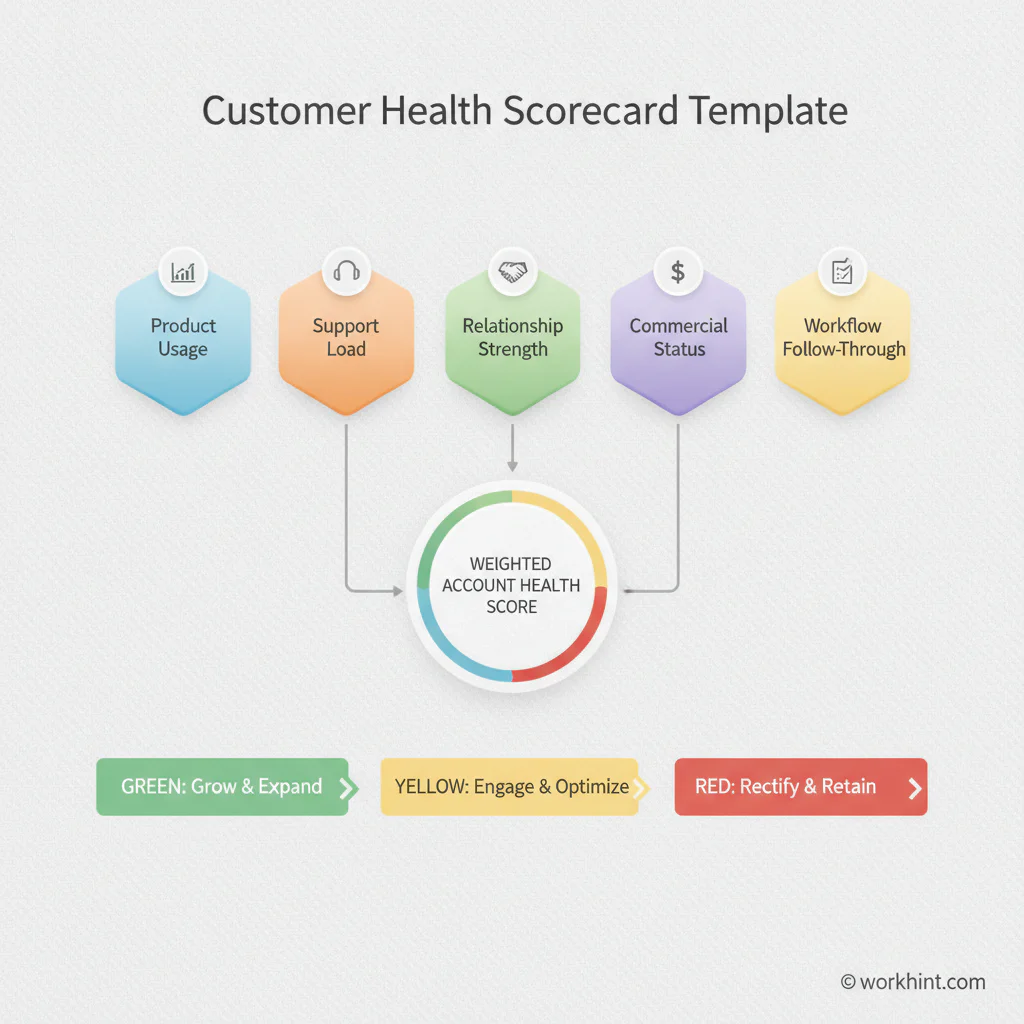
| Signal | Weight | Green | Yellow | Red | Owner |
|---|---|---|---|---|---|
| Product or service usage | 25% | Core workflows used consistently | Usage is uneven or limited to one team | Usage has dropped or never started | Customer success |
| Onboarding or implementation progress | 15% | Milestones complete on schedule | One milestone delayed or unclear | Launch blocked with no recovery owner | Implementation |
| Support and issue load | 15% | Issues resolved within expected time | Repeat questions or slow resolution | Critical unresolved issue or frustration | Support lead |
| Stakeholder engagement | 15% | Decision maker and users are active | Champion engaged but executives absent | Champion silent or decision maker changed | Account owner |
| Business outcome evidence | 15% | Clear value, adoption, or savings evidence | Value is assumed but not documented | No value story before renewal | Customer success |
| Commercial and renewal status | 10% | Renewal path, budget, and terms are clear | Renewal date close with open questions | Budget risk, late payment, or cancellation signal | Account owner |
| Workflow follow-through | 5% | Next steps assigned and completed | Open tasks need reminders | No owner for key follow-up | Operations |
Score each signal from 0 to 100, multiply by the weight, and add the weighted scores. Then apply a simple threshold: 80 to 100 is green, 60 to 79 is yellow, and below 60 is red. If one signal is mission-critical, add an override rule.
Example customer health score
Imagine a customer with strong usage, moderate support friction, weak executive engagement, and a renewal date in 75 days. The score might look healthy at first because users are active, but the account is not renewal-ready. The scorecard should expose that gap.
| Signal | Score | Weight | Weighted result |
|---|---|---|---|
| Usage | 90 | 25% | 22.5 |
| Implementation progress | 85 | 15% | 12.75 |
| Support and issue load | 65 | 15% | 9.75 |
| Stakeholder engagement | 45 | 15% | 6.75 |
| Business outcome evidence | 55 | 15% | 8.25 |
| Commercial and renewal status | 60 | 10% | 6 |
| Workflow follow-through | 70 | 5% | 3.5 |
The total score is 69.5, which should trigger a yellow account review. The next action is not a vague “check in.” The account owner should schedule executive alignment, customer success should document value, and support should close the recurring issue pattern before renewal.
Turn score ranges into actions
A scorecard only helps if each range has a defined response. Paddle describes customer health scores as indicators of churn risk and expansion potential, but the operating value comes from what the team does next.
- Green: Confirm value, ask for advocacy, identify expansion, and keep the customer on the normal success cadence.
- Yellow: Review the account within one week, assign a recovery owner, confirm the customer goal, and remove the biggest adoption or relationship blocker.
- Red: Escalate to the account owner and executive sponsor, create a written save plan, document the customer’s concern, and review progress until the risk changes.
If your team uses a customer success platform, map these actions into workflows rather than leaving them as notes. HubSpot’s health score documentation shows how health scores can be configured by segment and tested before activation. If you use a spreadsheet first, test the model against known healthy and at-risk accounts before relying on it.
Common mistakes
The first mistake is building one global score for every customer. Different segments often need different weights. A high-touch implementation account may need onboarding and stakeholder signals, while a mature self-serve account may depend more on usage and support behavior.
The second mistake is treating missing data as neutral. If no one has logged an executive contact, renewal date, support status, or implementation milestone, the scorecard should show that as an operational gap. Unknown is not the same as healthy.
The third mistake is changing the formula too often. Improve the model when evidence shows it is wrong, but do not rewrite weights every time a single customer surprises the team. Keep a version history so people know what changed and why.
The fourth mistake is ignoring ownership. A red score without an assigned owner is just a dashboard color. Every unhealthy signal needs a person, deadline, and next action.
Where Workhint fits
Workhint fits when the customer health scorecard needs to become a live workflow instead of a spreadsheet reviewed once a month. A team can describe the account health process, then use Workhint to structure the signals, roles, intake fields, review cadence, escalation rules, customer documents, renewal tasks, approvals, and reporting around it.
That matters when health depends on more than product usage. Many customer risks sit in handoffs: implementation did not confirm launch, support closed a ticket without solving the root issue, finance sees payment risk, or the account owner knows the champion left but no one updated the renewal plan. Workhint helps turn those signals into routed work with visible ownership.
FAQ
What should a customer health scorecard include?
It should include the signals that best predict customer risk or value for your business. Common signals include usage, onboarding progress, support issues, stakeholder engagement, business outcomes, renewal status, payment risk, and open follow-up work.
How often should customer health scores be updated?
Update operational signals as close to real time as possible, then review the score on a regular cadence. Weekly reviews work well for high-touch accounts. Monthly reviews may be enough for lower-risk or mature accounts.
What is a good customer health score?
A common model uses 80 to 100 as healthy, 60 to 79 as watchlist, and below 60 as at risk. The thresholds should be tested against real accounts so the score reflects actual renewal, adoption, support, and relationship patterns.
Should customer health scores be automated?
Automate the data collection and routing where possible, but keep human review for relationship context, executive changes, unresolved frustration, and unusual account situations. The best scorecards combine measurable signals with accountable judgment.
Conclusion
A customer health scorecard template gives teams a shared way to see account risk before it becomes a renewal problem. Keep the model simple, weight the signals that matter, define clear thresholds, and connect every score to an action. The goal is earlier intervention, clearer ownership, and healthier customer relationships.
Leave a Reply