


Partner work breaks when ownership, access, and expectations live in different places.
A strong partner management process gives business teams a repeatable way to work with external partners without turning every relationship into a chain of status meetings, spreadsheet updates, and private Slack threads. This matters for channel partners, implementation partners, service partners, referral partners, marketplace operators, and any company that relies on outside organizations to help deliver work.
The problem is not usually that partners lack talent. It is that the operating model is vague. A partner is approved by one team, briefed by another, paid by finance, reviewed by operations, and escalated only after something has already gone wrong. That creates slow approvals, unclear promises, duplicated work, security risk, and weak performance data.
What’s in this article?
- A practical partner management process for external teams
- The roles, approvals, records, and metrics each relationship needs
- A workflow table you can adapt for channel, service, and delivery partners
- Common failure points that make partner programs harder to scale
- Where Workhint fits when you need to operationalize the process
Why partner management matters
Partners sit outside the org chart but still affect customer experience, delivery quality, revenue, data security, and cash flow. That makes partner management a workforce operations issue, not just a sales or procurement activity.
External relationships also create third-party risk. NIST’s supply chain risk guidance emphasizes governance, roles, monitoring, and risk response across supplier and third-party relationships. CISA’s supply chain resources make the same operational point: external parties need structured oversight because their work can affect your systems, customers, and continuity.
For teams handling sensitive customer, financial, or operational information, partner access is also a controls issue. The FTC’s Safeguards Rule guidance is industry-specific, but the underlying lesson is broader: businesses should define safeguards, limit access, and maintain accountability when outside service providers touch protected information.
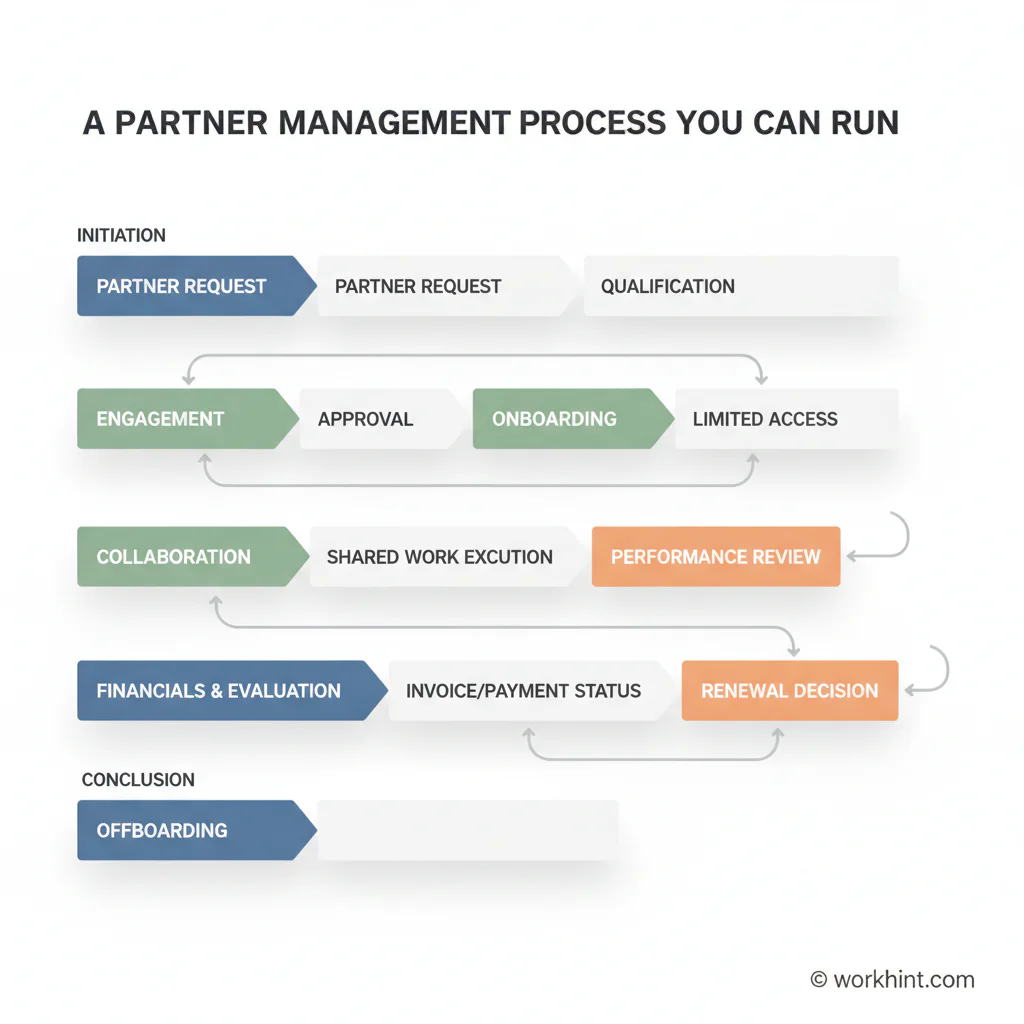
A partner management process you can run
The best process is simple enough to follow but structured enough to prevent ambiguity. It should answer five questions before work starts: why do we need this partner, who owns the relationship, what is the partner allowed to do, how will performance be measured, and what happens when the relationship changes?
| Stage | Primary owner | Required output | Control point |
|---|---|---|---|
| Partner request | Business owner | Business need, scope, budget, and expected outcome | No partner work starts from an informal request |
| Qualification | Operations or partner manager | Fit review, capability notes, risk tier, references | Partner tier determines approval depth |
| Approval | Finance, legal, security, or leadership | Signed approval record and relationship owner | Approval rules match spend, data access, and customer impact |
| Onboarding | Partner manager | Agreement, contacts, access, documents, kickoff plan | Access is limited to the work actually required |
| Execution | Internal owner and partner lead | Shared plan, cadence, tasks, deliverables, decisions | Work status is visible to both sides |
| Performance review | Operations or account owner | Scorecard, issue log, improvement actions | Review cadence is scheduled before problems appear |
| Renewal or offboarding | Relationship owner | Renewal decision, access review, payment closeout | No expired partner keeps stale access or open obligations |
Define ownership before defining tools
Most partner programs get too tool-focused too early. A portal, CRM field, shared board, or reporting dashboard will not fix unclear ownership. Start with the operating roles.
Every partner relationship needs an internal business owner, a day-to-day partner manager, a finance contact, an escalation owner, and a named partner-side lead. For channel partners, add deal-registration ownership and rules of engagement. For service partners, add delivery ownership and quality review. For partners with system or data access, add security or compliance review.
The goal is not bureaucracy. The goal is to stop decisions from floating. When a partner asks for a discount exception, new access, revised scope, payment status, or escalation meeting, the team should know who decides and where that decision is recorded.
Set partner expectations in writing
A partner management process should make expectations explicit before the first project, referral, implementation, or co-sell motion begins. At minimum, document the scope, approved activities, communication cadence, response expectations, deliverable standards, payment terms, renewal date, and escalation path.
For revenue partners, define deal registration rules, protection windows, duplicate-account handling, lead handoff requirements, attribution, and commission timing. For delivery partners, define acceptance criteria, quality checks, customer communication boundaries, and issue response times. For operational partners, define request routing, invoice approval, data handling, and who can change the scope.
Use metrics that show relationship health
Partner metrics should help managers decide what to improve. Track a small set rather than a dashboard full of activity noise.
- Approval cycle time: How long it takes to move from request to approved partner.
- Onboarding completion rate: Whether agreements, documents, access, and kickoff tasks are complete before work begins.
- Response and handoff reliability: Whether both sides meet agreed communication expectations.
- Delivery quality: Whether partner work passes review without repeated rework.
- Escalation frequency: Whether the same issues repeat across partners or workstreams.
- Payment and renewal accuracy: Whether invoices, commissions, renewals, and closeouts happen on schedule.
Common partner management mistakes
The first mistake is approving the relationship but not the operating model. A partner can be commercially attractive and still fail if there is no process for scope, access, status, and escalation.
The second mistake is treating partners like internal employees. Partners need context and standards, but they should not receive unlimited access, open-ended instructions, or employee-style control that blurs accountability.
The third mistake is reviewing performance only when renewal is due. By then, the useful correction window has passed. Review important partners monthly or quarterly, depending on risk and volume, and keep a lightweight issue log throughout the relationship.
Where Workhint fits
Workhint fits when partner management needs to become a live operating system instead of a collection of forms, spreadsheets, and follow-up messages. A team can use Workhint to structure partner intake, assign role-based approvals, collect documents, define permissions, route onboarding tasks, track shared work, monitor payment status, and keep partner reviews in one place.
For example, a business could describe its partner program and use Workhint to generate the roles, approval paths, onboarding steps, partner records, task flows, review cadence, reporting views, and payment checkpoints needed to run it. That keeps the article’s process practical: partner work becomes visible, auditable, and easier to improve without turning every relationship into manual coordination.
FAQ
What is a partner management process?
A partner management process is the repeatable workflow a company uses to approve, onboard, coordinate, measure, pay, renew, or offboard external partners. It turns the relationship into a managed operating model rather than an informal contact list.
Who should own partner management?
Ownership depends on the partner type. Channel partners may sit with partnerships or revenue operations. Service partners may sit with operations or delivery. Strategic partners may need an executive sponsor. The important part is assigning one clear internal owner for each relationship.
What should be included in partner onboarding?
Partner onboarding should include the agreement, business contacts, approved scope, access permissions, communication channels, escalation path, performance expectations, invoice or commission process, and first review date.
How often should partners be reviewed?
High-impact or high-risk partners should be reviewed monthly or quarterly. Lower-risk partners can be reviewed at renewal or after major work cycles. The review should cover quality, responsiveness, business value, open issues, access, and next actions.
Conclusion
A useful partner management process gives external teams enough structure to move quickly without hiding risk. Start with ownership, approvals, access, communication, performance, and renewal controls. Then put the process somewhere the whole business can actually run it. That is how partner relationships become scalable operating capacity instead of scattered external work.
Leave a Reply