


Contractor scope creep usually starts as a small favor, then becomes an unapproved operating cost.
Learning how to prevent scope creep when working with contractors is not about saying no to every change. It is about making sure new work is visible, priced, approved, and connected to the original business outcome.
That matters because contractor work sits outside the normal employee management structure. A freelancer, consultant, agency, subcontractor, or specialist vendor may not attend every internal meeting or know every unstated expectation. If the scope is vague, the contractor guesses. If internal stakeholders keep adding requests informally, the company loses control of budget, timing, quality, and accountability.
What’s in this article?
- Why contractor scope creep happens
- How to define scope before work starts
- A contractor scope control workflow
- A table of scope controls by project stage
- Common mistakes to avoid
- Where Workhint fits
Why contractor scope creep matters
Scope creep is the uncontrolled expansion of work after a project starts. PMI’s scope management guidance explains that scope management begins with defining the work content, end products, and resources consumed by a project. In contractor work, that definition needs to be especially clear because the contractor is usually paid against deliverables, hours, milestones, retainers, or a statement of work.
The problem is rarely one dramatic change. It is usually a series of small additions: one extra revision, one unplanned integration, one new stakeholder review, one additional location, one urgent reporting request, or one “can you also handle this?” message. Each request may feel reasonable on its own. Together, they change the economics of the work.
PMI also notes that scope creep is often tied to weak scope or requirements management. For external work, weak management shows up as missing exclusions, unclear acceptance criteria, informal change approval, disconnected invoices, and no single record of what changed.
Start with a scope that can be operated
A contractor scope should be more than a paragraph in an agreement. It should be specific enough that a project owner, finance reviewer, legal or procurement reviewer, and contractor can all answer the same questions.
- What result is the contractor responsible for?
- Which deliverables are included?
- Which tasks, revisions, channels, geographies, tools, or service levels are excluded?
- What assumptions affect price or timeline?
- What evidence proves a milestone is complete?
- Who can approve a change?
- How will extra work affect budget, timeline, and payment?
For services work, PMI’s guidance on statements of work emphasizes that a SOW should describe the products or services to be supplied and the requirements the provider needs to perform the work. CIPS similarly describes procurement specifications as documents that detail requirements for a product or service and are often attached to contracts. The practical point is simple: scope should be detailed enough to guide execution, not just procurement.
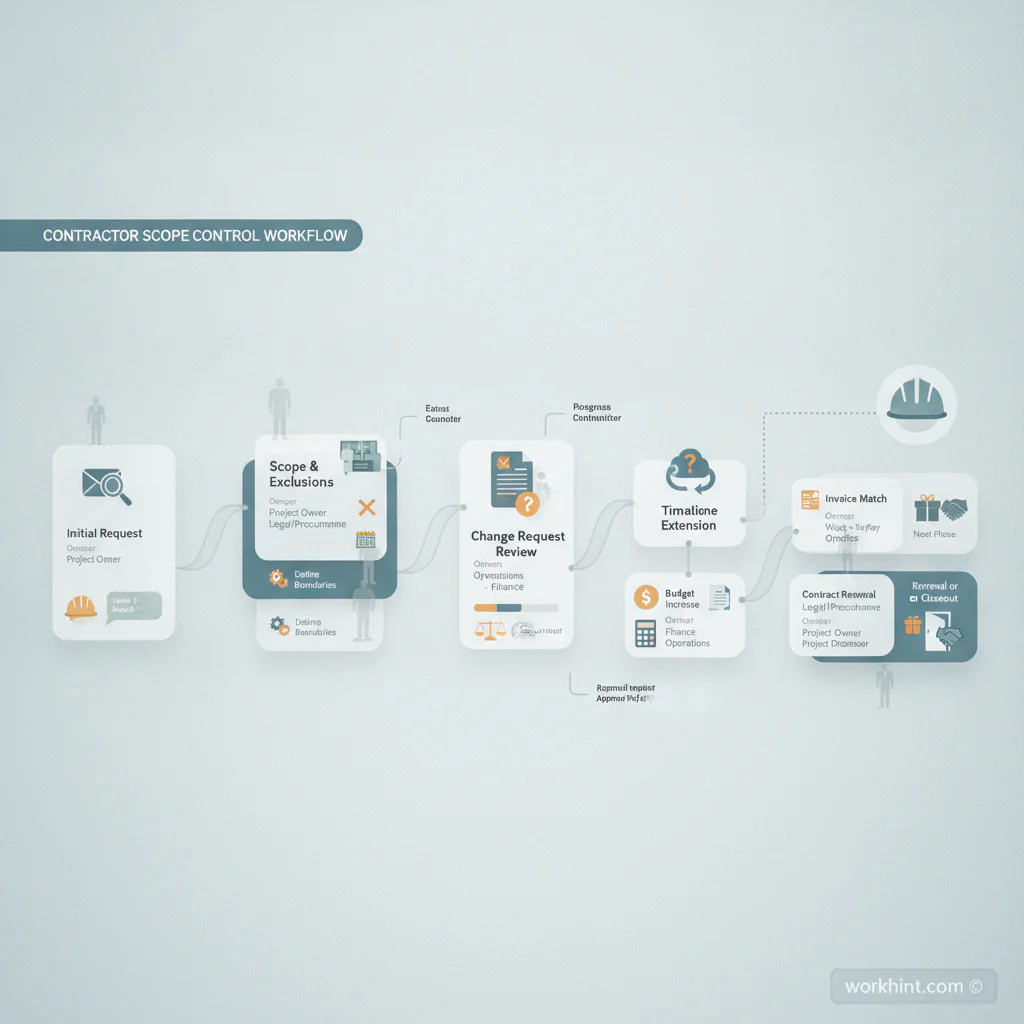
A contractor scope control workflow
The best way to prevent contractor scope creep is to turn scope into a workflow. That workflow should start before the contractor is engaged and continue through invoice approval and closeout.
- Create the work request. Capture the business goal, requester, budget owner, urgency, expected outcome, and type of contractor relationship.
- Draft the scope. Define deliverables, assumptions, exclusions, milestone dates, acceptance criteria, and required evidence.
- Review the relationship risk. Confirm whether the work is project-based, whether the contractor controls how the work is done, and whether the scope avoids employee-style direction.
- Approve the SOW. Route the scope to the right owner for budget, legal, procurement, compliance, or finance review.
- Start work with milestone visibility. Track progress against milestones, not scattered status messages.
- Route change requests. Any new deliverable, timeline shift, extra revision, added audience, or changed service level becomes a change request.
- Decide impact before work continues. Approve, reject, defer, or trade off the change with clear impact on price, timeline, and deliverables.
- Match invoices to accepted work. Finance should see the original scope, approved changes, accepted milestones, and payment terms before approving payment.
- Close out or renew deliberately. Decide whether to extend, amend, renew, or offboard based on the actual work record.
Scope controls by project stage
| Stage | Control | Owner | What it prevents |
|---|---|---|---|
| Before engagement | Written scope, exclusions, assumptions, and acceptance criteria | Project owner | Vague expectations and hidden work |
| Contracting | SOW review tied to budget, payment terms, and change process | Legal or procurement | Unpriced obligations and unclear authority |
| Execution | Milestone status, evidence, and written approvals | Operations | Informal approvals and missed dependencies |
| Change | Change request with cost, time, and scope impact | Budget owner | Small requests becoming free work |
| Payment | Invoice matched to accepted milestones and approved changes | Finance | Paying for unapproved or incomplete work |
Common scope creep mistakes
Using a broad SOW because the project is moving fast. A loose scope feels efficient at the start, but it creates delay later when people disagree about what was included.
Letting anyone request contractor work. Internal stakeholders can share context, but only named owners should approve new work, extra revisions, budget changes, or timeline changes.
Skipping exclusions. Exclusions are not hostile. They are how both sides avoid misunderstanding. If weekend support, source files, extra locations, rush revisions, implementation help, or stakeholder training is not included, say so.
Approving invoices without the work record. Invoice approval should not depend on memory. It should connect the invoice to the SOW, milestone acceptance, change requests, and payment terms.
Managing contractors like employees. Scope control should focus on outcomes, deliverables, access, approvals, and payment. It should not become day-to-day employee supervision unless the relationship has been reviewed appropriately.
Where Workhint fits
Workhint fits when contractor scope control needs to become an operating system instead of a collection of emails, files, and finance approvals. A team can use Workhint to turn the request, SOW, approval path, document collection, milestone evidence, change request, invoice review, and closeout decision into one connected workflow.
That is useful because scope creep is usually a visibility problem before it is a contractor problem. Workhint can help define who submits the request, who approves scope, who reviews risk, who accepts the milestone, who approves a change, and who sees payment status. The contractor gets a clearer path to accepted work, while the business keeps control of scope, budget, access, and payment without turning the engagement into employee-style management.
FAQ
What is contractor scope creep?
Contractor scope creep is the expansion of contractor work beyond the approved scope without a matching update to budget, timeline, deliverables, acceptance criteria, or payment terms.
How do you prevent scope creep with freelancers?
Use a written scope, define exclusions, set revision limits, require milestone approval, and route any new deliverable or extra work through a change request before the freelancer starts it.
Should every contractor change require a new contract?
Not always. Small changes may be handled through an approved change request or SOW amendment, depending on the contract terms and company policy. Material changes should be reviewed by the right legal, procurement, or finance owner.
Who should approve contractor scope changes?
The budget owner or designated project owner should approve business impact. Legal, procurement, finance, compliance, or security may need to review changes that affect contract terms, payment, risk, data access, or regulated work.
Can scope control hurt the contractor relationship?
Good scope control usually helps the relationship. It gives contractors clearer expectations, protects them from unpaid extra work, and gives the business a fair way to approve useful changes.
Conclusion
The practical way to prevent scope creep when working with contractors is to make scope operational. Define the work clearly, record exclusions, set acceptance criteria, name approval owners, require change requests, and match invoices to accepted work. Changes will still happen, and sometimes they should. The difference is that they become business decisions instead of quiet cost leaks.
Leave a Reply