


Permits are confusing, slow, and local. That makes permit expediting a strong service business to launch before hiring a team.
If you want to start a permit expediting business, you do not need to begin with an office, employees, or a large construction operation. The leaner path is to launch a branded permit support platform, focus on one local market or niche, and coordinate a small network of independent permit specialists, runners, code consultants, and document reviewers.
Permit expediting is valuable because contractors, architects, property owners, and small businesses often lose time navigating city portals, forms, plan checks, agency comments, and resubmissions. Your job is not to promise shortcuts. Your job is to make the process organized, complete, trackable, and easier for the client to understand.
What’s in this article?
- Why permit expediting can work as a low-overhead service business
- What you need before taking the first client
- How to price simple, complex, and recurring permit support
- How to find the first contractor, architect, and property owner customers
- How Workhint can become the branded operating platform behind the business
- A 7-day launch plan, final checklist, and FAQ
Why this business works
Permit expediting sits at the intersection of construction, local government, paperwork, and project timing. That creates demand from people who are willing to pay for clarity. A remodeler wants fewer delays. A restaurant owner wants to open faster. An architect wants fewer administrative interruptions. A homeowner may simply want someone who knows what to submit and when to follow up.
The business also works because the first offer can be narrow. You might start with residential renovation permits, commercial tenant improvements, sign permits, restaurant openings, solar permits, or contractor licensing support. A focused niche makes it easier to learn local requirements, create repeatable checklists, and build relationships with the right independent specialists.
The low-risk model is not to become every city’s permitting expert on day one. Start in one jurisdiction, document the process, recruit experienced independent help where needed, and validate demand with paid projects before expanding.
What you need to launch
The core requirement is operational credibility. Clients will trust you if your intake is clear, your document requests are organized, your status updates are consistent, and your pricing is understandable. You should also check local rules before selling. Some cities require registration, licensing, insurance, or tax clearance for permit expediters. Others do not have a formal expediter license but still have rules about who can submit documents or represent a project.
Start with the essentials: a business entity, insurance guidance from a broker, a branded customer portal, intake forms, document upload, quote approval, payment collection, status tracking, and a process for assigning work to independent specialists. Do not lease an office or hire full-time staff before proving that customers in your market will pay for the service.
| Launch item | Lean starting point | Why it matters |
|---|---|---|
| Business setup | Entity, tax ID, bank account, local tax registration | Lets you contract, invoice, and operate professionally |
| Insurance | General liability and professional guidance | Protects the business when handling project documents and advice |
| Branded platform | Customer portal, intake, document upload, payment, updates | Creates a professional experience without custom software |
| Provider network | Independent permit specialists, runners, reviewers, code consultants | Lets you fulfill work without hiring employees immediately |
| Market research | One city, one permit type, one customer segment | Keeps the first offer specific and learnable |
| Marketing | Local landing page, outreach list, referral partners | Creates demand before heavy investment |
How to price it
Pricing should reflect complexity, risk, and follow-up effort. Simple permits can be priced as fixed packages. Complex commercial projects may need a discovery fee, milestone billing, or a custom quote. Avoid charging only for time if the client is really buying reduced confusion, better coordination, and faster movement through the process.
| Offer | Example pricing model | Best fit |
|---|---|---|
| Permit readiness review | $150 to $500 fixed fee | Clients who need to know what is missing before filing |
| Simple residential permit support | $400 to $1,200 per permit | Small remodels, trade permits, repeat contractor work |
| Commercial tenant improvement support | $1,500 to $5,000+ per project | Restaurants, retail, offices, clinics, and build-outs |
| Monthly contractor support | $750 to $3,000 per month | Contractors with recurring permit volume |
| Specialist pass-through work | Cost plus margin or quoted subcontract fee | Code review, plan corrections, zoning research, runner tasks |
Use these ranges as planning examples, not universal rates. Permit markets vary widely by city, project type, and professional requirements. The practical move is to publish a simple starting package, then quote complex work after intake.
How to get first customers
The fastest customers usually come from people who already feel permitting pain. Build a list of remodelers, architects, interior designers, sign companies, restaurant consultants, franchise operators, small commercial landlords, and real estate investors in your first market. Send a concise offer: you help organize permit submissions, track requirements, coordinate follow-up, and keep clients informed.
Partnerships matter more than ads at the beginning. A single contractor with steady jobs can become more valuable than a broad social media audience. Offer a simple readiness review for their next project, then route the work through your platform so they experience the customer portal, document collection, status updates, and payment flow.
How Workhint helps launch it
Workhint lets you launch the business as a branded permit support platform instead of stitching together forms, email, spreadsheets, payment links, and manual status updates. A client can submit a permit request through your branded portal, upload drawings and project details, approve a quote, pay online, and track status from one customer dashboard.
Behind the scenes, Workhint can route the request to the right independent specialist based on city, permit type, and complexity. A residential permit runner might handle simple submissions. A code consultant might review a commercial build-out. A local specialist might manage agency follow-up. Each provider can receive assignments, checklists, deadlines, document requests, and payout details without becoming your employee.
This is the operational foundation of the business. You can manage intake, quotes, approvals, document collection, scheduling, client messages, invoices, provider payouts, reviews, and reporting from one branded system. That makes the company feel real before you invest in custom software or full-time staff.
First 7-day launch plan
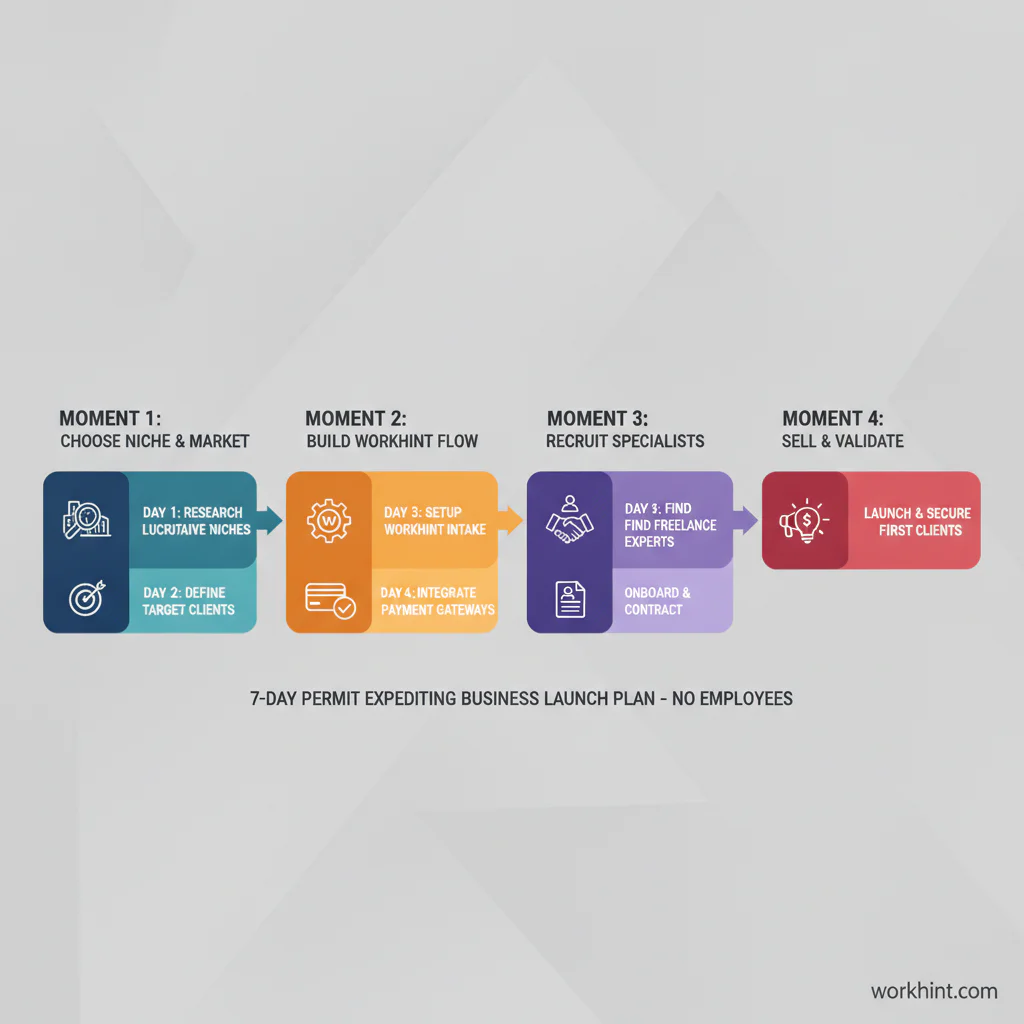
- Day 1: Choose one market, one customer type, and one permit niche. Avoid trying to cover every city immediately.
- Day 2: Set up the branded Workhint platform with customer intake, document upload, and status stages.
- Day 3: Create pricing packages, quote approval, payment, provider assignment, and payout workflows.
- Day 4: Recruit three to five independent specialists, runners, reviewers, or local permit contacts.
- Day 5: Contact contractors, architects, designers, and property operators with a focused first offer.
- Day 6: Route any interested prospects through the platform and complete a paid readiness review or pilot permit.
- Day 7: Review demand, bottlenecks, provider readiness, pricing, and local compliance before expanding.
Final launch checklist
- Choose a specific permit niche and launch market
- Check local expediter registration, licensing, insurance, and submission rules
- Create the business entity, bank account, and basic contract language
- Build a branded Workhint customer portal for intake, documents, quotes, updates, payments, and reviews
- Recruit independent specialists for local submissions, review, research, and follow-up
- Create a simple starter package and a custom quote process for complex projects
- Build a list of contractors, architects, designers, landlords, and small business owners
- Sell one narrow service before investing in employees, an office, or broad expansion
FAQ
Is permit expediting a good business to start?
It can be, especially in markets where permitting is slow, complex, or highly local. The opportunity is strongest when you understand a specific jurisdiction or customer niche and can create a reliable process for intake, documents, submissions, updates, and follow-up.
Do I need a license to start a permit expediting business?
It depends on the jurisdiction. Some cities require permit expediters to register or hold a local license. Others may not have a specific expediter license but still restrict who can sign, submit, or represent certain applications. Check local rules before selling the service.
Can I start without employees?
Yes, if you design the business around a platform-first model and use properly structured independent specialists where appropriate. Be careful with worker classification and avoid treating contractors like employees. Get legal guidance for your market and operating model.
How much does it cost to start?
A lean launch can focus on business setup, insurance, a branded platform, basic marketing, and provider onboarding. The larger cost is learning the market and building trust. Avoid offices, full-time staff, and broad expansion until paid demand is clear.
Who are the best first customers?
Start with contractors, architects, interior designers, small commercial landlords, restaurant owners, franchise operators, and real estate investors. These customers often feel permitting delays directly and may have repeat work if you perform well.
How should I price permit expediting?
Use fixed packages for simple permit support and custom quotes for complex projects. You can also sell readiness reviews, monthly contractor support, or milestone-based commercial project support. Pricing should reflect complexity, follow-up effort, and local risk.
What should I avoid when launching?
Avoid promising guaranteed approvals, working outside local rules, taking every project type, hiring too early, or relying on email and spreadsheets for client communication. The business depends on trust, documentation, and consistent follow-through.
Conclusion
A permit expediting business is not about beating the system. It is about making a confusing local process easier to manage. Start with one market, one clear offer, a branded customer platform, and a small network of independent specialists. Validate demand first, then expand your services as the work becomes repeatable.
Leave a Reply