


Processes scale when one owner has the authority, evidence, and cadence to keep the work improving.
A process owner is the person accountable for the performance of an end-to-end business process. That process might be client onboarding, issue resolution, vendor approval, order fulfillment, invoice review, hiring, service delivery, or any recurring workflow that crosses people, tools, and teams.
The mistake many companies make is treating process ownership as a name in a document. Real process ownership is an operating system: a clear owner, defined decision rights, performance metrics, escalation rules, documentation, improvement cadence, and authority to fix the work when it breaks.
What’s in this article?
- What a process owner does in business operations
- How process owner responsibilities differ from process manager responsibilities
- A practical process ownership model you can use
- How to assign process ownership without creating confusion
- Where Workhint fits when ownership needs to become a live work system
Why process ownership matters
Most operational problems are not caused by one careless person. They are caused by processes that nobody truly owns. A workflow gets documented once, then tools change, customers ask for exceptions, approvals move to email, dashboards fall out of date, and every department optimizes its own piece.
APQC describes business process owners as people responsible for the end-to-end success of a process and for making sure it meets business objectives. SAP Signavio similarly defines a business process owner as accountable for the success of processes such as order-to-cash, procure-to-pay, or hire-to-retire. The important phrase is end-to-end. A process owner is not only responsible for one task or one department. The owner is accountable for how the full workflow performs.
Process owner roles and responsibilities
A useful process owner does not need to personally do every step. The owner needs enough visibility and authority to keep the process healthy. In practical terms, the role usually includes these responsibilities:
- Define the process outcome. Make clear what the process exists to produce, for whom, and by when.
- Set performance metrics. Choose the few KPIs that show whether the process is fast, accurate, compliant, cost-effective, and useful.
- Own the process design. Approve the major steps, handoffs, decision points, roles, systems, and exception paths.
- Maintain documentation. Keep SOPs, work instructions, intake forms, approval rules, and templates current.
- Assign operating roles. Clarify who submits work, reviews it, approves it, fulfills it, escalates issues, and updates records.
- Review performance. Use dashboards, queue data, issue logs, customer feedback, and team input to spot bottlenecks.
- Drive improvement. Decide what changes, who implements the change, and how success will be checked after rollout.
Process owner vs. process manager
The process owner is accountable for the design and performance of the process. The process manager is usually responsible for day-to-day operation. In smaller companies, one person may do both. In larger operations, separating the roles prevents the person managing daily work from being the only person expected to redesign the system.
ServiceNow’s guidance on process owner and process manager differences draws a similar line: owners focus on objectives, stakeholders, and performance targets, while managers focus more on execution and coordination. The exact titles matter less than the split between accountability and daily management.
| Role | Primary accountability | Typical decisions |
|---|---|---|
| Executive sponsor | Business priority, funding, and conflict resolution | Which process matters, what tradeoffs are acceptable, when leadership must intervene |
| Process owner | End-to-end process outcome and improvement | Process design, KPIs, policy, approval rules, change priorities |
| Process manager | Daily execution and coordination | Queue management, staffing, handoffs, status checks, issue routing |
| Contributors | Completing assigned steps correctly | Task-level decisions within defined rules |
| Systems or data owner | Tools, access, integrations, and reporting accuracy | System changes, data definitions, permissions, dashboard logic |
How to assign process ownership
Assigning process ownership works best when the business starts with the workflow, not the org chart. Follow this sequence:
- Name the process clearly. Use an end-to-end name such as client onboarding, purchase approval, incident resolution, or contractor onboarding.
- Define the outcome. State what good performance means in business terms: speed, accuracy, compliance, customer experience, margin, risk reduction, or readiness.
- Map the boundaries. Identify where the process starts, where it ends, what is included, and what is out of scope.
- Choose the owner closest to the outcome. The owner should have influence over the teams, policies, systems, and decisions that shape the process.
- Give the owner real authority. Ownership without authority creates frustration. Define what the owner can change, approve, escalate, and prioritize.
- Assign supporting roles. Name the process manager, contributors, approvers, system owners, and executive sponsor.
- Create a review cadence. Set a monthly or quarterly review for KPIs, exceptions, bottlenecks, improvement work, and unresolved risks.
Process owner responsibility model
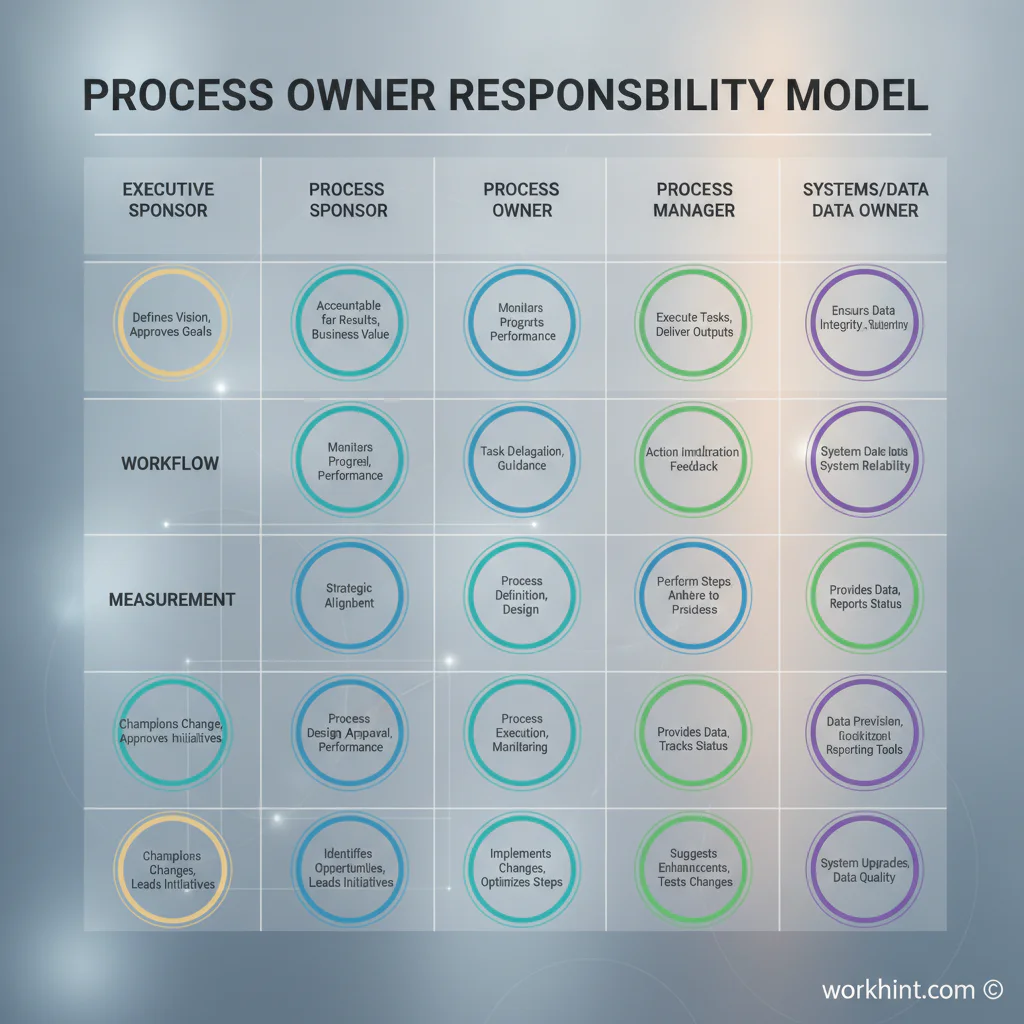
Use this simple model when a process crosses teams:
| Area | Question to answer | Owner artifact |
|---|---|---|
| Outcome | What result must this process produce? | Process charter |
| Authority | What decisions can the owner make? | Decision rights matrix |
| Workflow | What steps, handoffs, and exceptions exist? | Process map and SOP |
| Measurement | How will performance be reviewed? | KPI dashboard |
| Improvement | How will problems become changes? | Improvement backlog |
The review cycle matters. ASQ’s overview of the Plan-Do-Check-Act cycle frames improvement as a loop: plan a change, test it, study the result, and act on what was learned. Process owners need that same rhythm. Otherwise, ownership becomes static documentation instead of continuous management.
Common mistakes
- Assigning ownership to a committee. Teams can support the process, but one accountable owner must make final calls.
- Choosing the loudest stakeholder. The owner should be closest to the outcome, not simply the person most frustrated by the process.
- Ignoring decision rights. If the owner cannot change rules, tools, staffing, or escalation paths, they are only a commentator.
- Measuring too much. Start with a few metrics that expose speed, quality, risk, and customer impact.
- Separating ownership from systems. A process owner needs visibility into the tools, data, dashboards, forms, and automations that shape the work.
Where Workhint fits
Workhint fits when process ownership needs to become a live operating system instead of a static responsibility chart. An operations team can use Workhint to turn a process charter into roles, permissions, intake forms, assignments, approval steps, dashboards, escalation rules, document collection, reminders, and improvement workflows.
That is useful when work crosses functions or includes external contributors, clients, vendors, contractors, or field teams. The process owner can see open work, aging items, blocked approvals, exception volume, handoff issues, and completion evidence. The process manager can run the daily queue. Leaders can review performance from the same system the work actually runs through.
FAQ
What is a process owner?
A process owner is the person accountable for the end-to-end performance, design, documentation, measurement, and improvement of a business process.
Who should be the process owner?
The process owner should be the person closest to the business outcome with enough authority to influence teams, systems, policies, metrics, and improvement priorities.
Is a process owner the same as a process manager?
Not always. The process owner is accountable for overall process success. The process manager usually handles daily execution, coordination, queue management, and issue routing.
How many processes should one owner have?
It depends on complexity. One person can own several simple processes, but complex cross-functional workflows often need a dedicated owner or a small portfolio with clear supporting managers.
What metrics should a process owner track?
Common metrics include cycle time, backlog, error rate, rework, completion rate, SLA performance, exception volume, approval aging, customer satisfaction, cost, and compliance issues.
Conclusion
A process owner gives recurring work a clear point of accountability. The role works when ownership includes outcome, authority, metrics, documentation, review cadence, and improvement responsibility. Start with one important workflow, assign a real owner, define the supporting roles, and review the process with evidence. That is how ownership becomes a system that makes work more scalable, repeatable, and measurable.
Leave a Reply