


Use this template to capture critical role knowledge before it disappears during a handover.
A knowledge transfer plan template helps managers, HR teams, operations leaders, and project owners move important role knowledge from one person to another before a transition creates gaps. It is useful when someone resigns, changes roles, takes leave, gets promoted, rotates off a project, or hands over a key account.
This resource is designed for business teams that need a practical plan they can copy into a document, spreadsheet, HR workspace, project hub, or operating system. It is not a substitute for legal, compliance, security, or HR review when sensitive information, regulated work, or employment decisions are involved.
What is included
- A copy-ready knowledge transfer plan structure
- A checklist for deciding what knowledge matters most
- A session plan for documentation, shadowing, walkthroughs, and validation
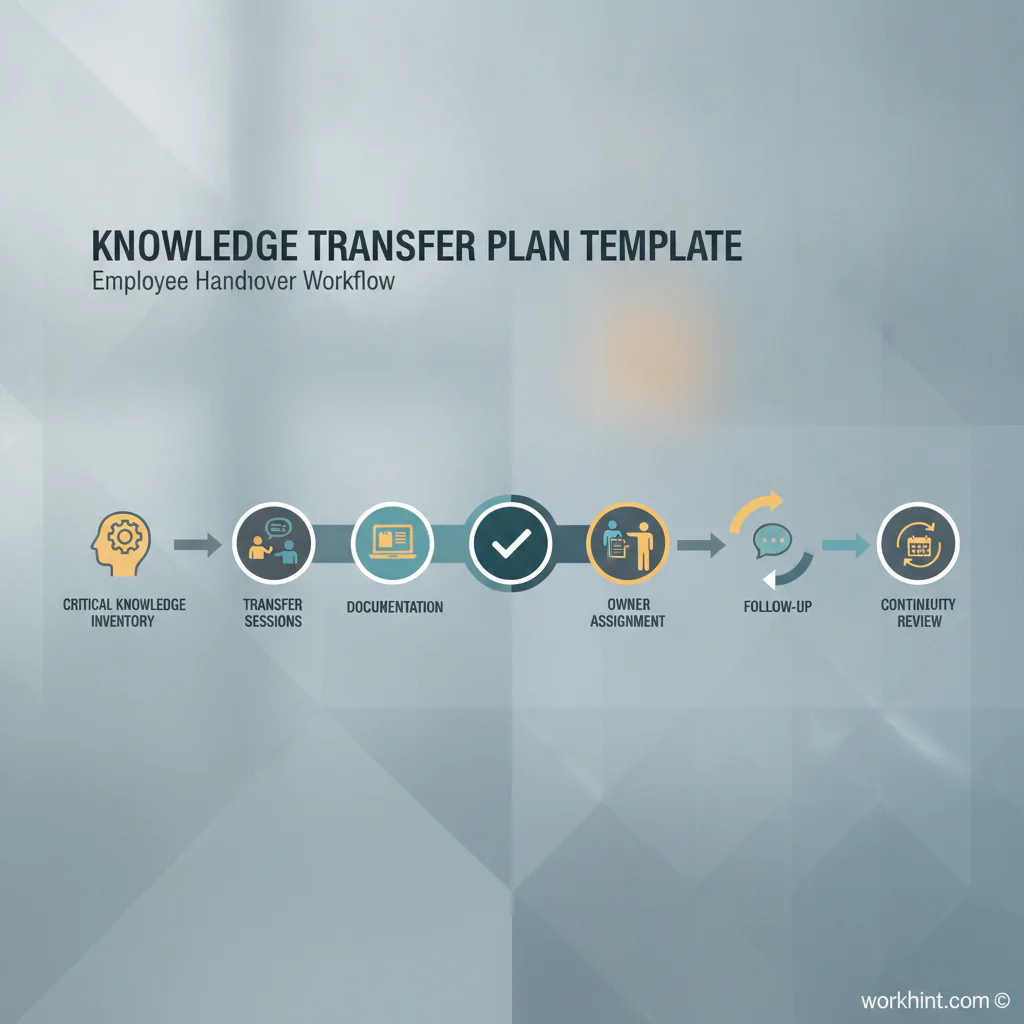
- An example employee handover workflow
- Common mistakes that cause continuity gaps
How to use this knowledge transfer plan
Start as early as possible. A good handover is not a final-day document dump. It is a short operating project with a scope, owner, timeline, recipient, transfer methods, evidence, and follow-up. If the transition is urgent, focus first on the knowledge that would disrupt customers, payments, compliance, delivery, access, or critical decisions.
The U.S. Office of Personnel Management describes succession planning as a way to identify future leaders and support knowledge transfer. The same principle applies outside government: continuity improves when the organization deliberately identifies important knowledge and moves it before the handoff is forced by timing.
Use the plan with both the departing or transitioning employee and the person receiving the work. Managers should facilitate the process, but the knowledge holder and recipient need dedicated time to walk through actual work, not just file locations.
Knowledge transfer plan template
Use this table as the core worksheet. Add or remove fields based on role complexity, risk, and the time available before transition.
| Section | What to capture | Owner |
|---|---|---|
| Role summary | What the person actually owns, including informal responsibilities | Manager |
| Critical processes | Recurring workflows, approvals, reports, deadlines, and decisions | Knowledge holder |
| Active work | Open projects, next steps, blockers, risks, and due dates | Knowledge holder |
| Systems and files | Tools, dashboards, folders, templates, records, and access needs | Manager and recipient |
| Contacts | Internal stakeholders, customers, vendors, partners, and relationship context | Knowledge holder |
| Decision rules | How tradeoffs are made, when to escalate, and what approvals are required | Manager |
| Transfer method | Document, walkthrough, recording, shadowing, checklist, or live practice | Manager |
| Validation | How the recipient proves they can perform the work | Recipient and manager |
| Follow-up | Review date, open questions, owner, and remaining gaps | Manager |
Prioritize critical knowledge
Not all knowledge deserves the same transfer effort. Prioritize anything that affects customers, revenue, compliance, payroll, vendor commitments, security access, reporting, executive decisions, or delivery deadlines. Then capture the undocumented context: why things are done a certain way, which exceptions happen often, who needs to be consulted, and what mistakes have caused issues before.
University handover resources often separate role responsibilities, projects, tools, records, key contacts, and communications. For example, the University of Iowa describes a knowledge transfer document that covers roles, responsibilities, processes, projects, tools, resources, records, contacts, stakeholders, and communications. That structure is a useful starting point because it covers both work content and relationship context.
Choose the right transfer method
Documentation is necessary, but it is rarely enough. A new owner may need a walkthrough to understand how a dashboard is used, shadowing to see judgment calls, practice to handle a live case, or a recorded session to revisit later. Match the method to the kind of knowledge being transferred.
- Document: Use for stable facts, checklists, links, policies, and step-by-step processes.
- Walkthrough: Use for tools, dashboards, reports, systems, and recurring workflows.
- Shadowing: Use for customer calls, stakeholder management, field work, or judgment-heavy tasks.
- Practice: Use when the recipient needs to perform the task before the handover is complete.
- Validation: Use when mistakes would create operational, compliance, customer, or financial risk.
Example employee handover workflow
Here is a simple workflow for a two-week transition. On day one, the manager defines the transition scope, confirms the recipient, and creates the knowledge transfer plan. During days two through five, the knowledge holder documents active work, recurring processes, key contacts, tools, file locations, deadlines, and known risks.
During the second week, the recipient joins walkthroughs, asks questions, performs selected tasks with review, and confirms what is still unclear. Before the transition closes, the manager reviews open risks, updates owners, confirms system access, and schedules a follow-up check after the recipient has used the knowledge in real work.
Cal Poly’s offboarding knowledge transfer plan frames the purpose as retaining critical organizational knowledge as employees exit so operations and service quality can continue. That is the right standard for a business handover: the plan is successful only if the receiving person can keep the work moving.
Validation checklist
- The recipient can explain the role’s top priorities and current risks.
- All active projects have next steps, owners, due dates, and file locations.
- Critical contacts include relationship context, not just names.
- System access has been transferred, removed, or requested as appropriate.
- Recurring reports, approvals, payments, or customer commitments have backup owners.
- The recipient has completed at least one walkthrough or practice task for high-risk work.
- Open questions have an owner and follow-up date.
Common mistakes
The first mistake is treating knowledge transfer as offboarding paperwork. If the plan is completed after the person has mentally moved on, the organization loses the chance to ask better questions, observe real work, and test the handover.
The second mistake is capturing only documents. Important context often lives in judgment, history, stakeholder relationships, exception handling, and tradeoffs. Ask what the person knows that is not written anywhere.
The third mistake is skipping validation. A folder full of files does not prove continuity. The recipient should be able to run a meeting, complete a report, find a document, make a routine decision, or explain the escalation path before the handover closes.
Where Workhint fits
Workhint helps organizations turn a knowledge transfer plan into a managed workflow. A team can define the handover intake form, required sections, knowledge holder tasks, recipient tasks, access requests, approval steps, reminder cadence, validation checklist, and manager review in one connected work system.
That matters because handovers touch many moving parts. Workhint can route transfer tasks to the right people, collect files and notes, assign walkthroughs, track open risks, trigger follow-up reviews, and keep reporting visible. The template captures what needs to move. Workhint helps ensure the move actually happens.
FAQ
What should a knowledge transfer plan include?
A knowledge transfer plan should include role responsibilities, critical processes, active projects, key contacts, systems and files, decision rules, transfer methods, timeline, validation steps, open risks, owners, and follow-up dates.
When should knowledge transfer start?
Start as soon as the transition is known. For planned departures, promotions, or role changes, two to four weeks is useful. For urgent transitions, start with the highest-risk knowledge first.
Who owns the knowledge transfer plan?
The manager should usually own the plan. The knowledge holder contributes content, the recipient validates understanding, and HR or operations may own the template and process standards.
What is the difference between knowledge transfer and documentation?
Documentation captures information. Knowledge transfer moves understanding and capability to another person. A strong plan uses documentation, walkthroughs, practice, and validation.
Conclusion
A practical knowledge transfer plan protects continuity during role changes, departures, promotions, leave, and project handoffs. Keep the template focused on critical knowledge, real work, key contacts, decisions, tools, and validation. The goal is not to preserve every detail. The goal is to make sure the next owner can keep important work moving without guessing, chasing context, or rebuilding knowledge after it is gone.
Leave a Reply