


A shift handover checklist protects field work from missed updates, unclear ownership, and avoidable mistakes between outgoing and incoming teams.
A shift handover checklist is a structured way to transfer job status, risks, equipment notes, customer updates, and next actions when one field team hands responsibility to another. It matters most when work is mobile, time-sensitive, safety-sensitive, or spread across employees, contractors, subcontractors, and partner crews.
Without a standard handover, the incoming team starts by reconstructing what happened. They read old messages, call the previous lead, inspect the site again, and make assumptions about what is finished. That delay is expensive. In field operations, it can also create safety issues, duplicated work, missed customer commitments, and payment disputes.
What’s in this article?
- What a good field team handover needs to cover
- A practical checklist for shift-to-shift continuity
- Who should own each handover item
- How to handle risks, exceptions, and unfinished work
- Where Workhint fits when handovers need to become trackable
Why shift handovers matter
Shift handover is a workforce coordination problem, not just a communication problem. The outgoing team has context. The incoming team has responsibility. The business needs proof that important information moved from one side to the other.
The UK Health and Safety Executive says shift handover should be face-to-face, two-way, and supported by both verbal and written information. That advice is written for safety-sensitive operations, but the logic applies broadly: a rushed one-way update is not enough when the next team needs to make decisions in the field.
Structured handoff principles show up in healthcare as well. AHRQ describes a handoff as a standardized method for transferring information along with authority and responsibility. Field teams may not be transferring patient care, but they often transfer live operational risk: incomplete jobs, locked sites, equipment issues, customer commitments, hazards, and approvals that affect the next shift.
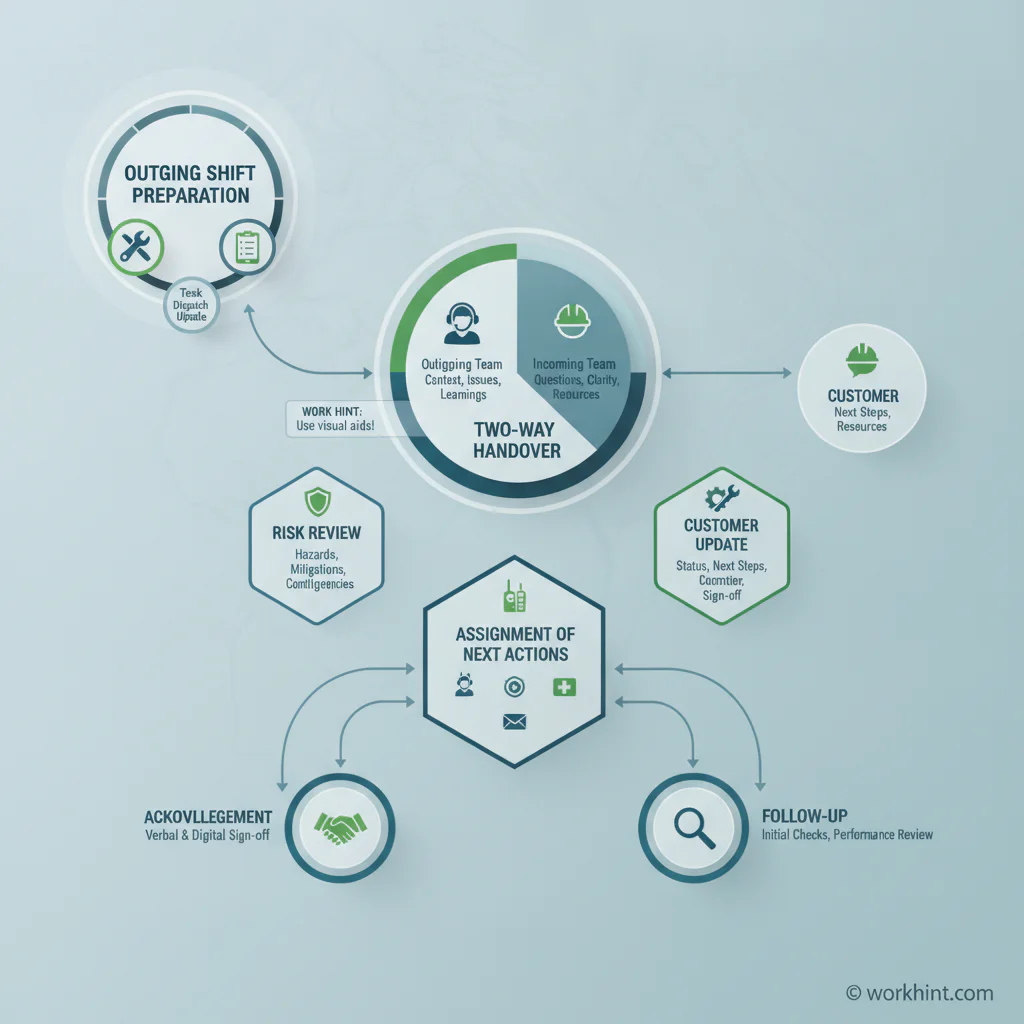
Shift handover checklist
The best checklist is short enough to use every day and specific enough to prevent ambiguity. Each line should tell the incoming team what happened, what changed, what is still open, and who owns the next step.
| Checklist item | Owner | What to capture | Failure it prevents |
|---|---|---|---|
| Job status | Outgoing shift lead | Completed work, unfinished work, blocked tasks, and percent complete | Duplicate work or missed work |
| Safety and site risks | Shift lead or safety owner | Hazards, incidents, controls, permits, weather, fatigue concerns, and restricted areas | Unsafe starts and unreported exposure |
| Customer or site updates | Field coordinator | Customer promises, access instructions, complaints, change requests, and contact notes | Broken commitments and avoidable escalations |
| Equipment and materials | Crew lead or asset owner | Tools used, equipment condition, missing parts, inventory gaps, vehicle notes, and photos | Idle crews and preventable return visits |
| Next actions | Incoming shift lead | Priority tasks, responsible person, deadline, approval needed, and escalation path | No clear owner after the handover |
How to run the handover
Start before the shift ends. The outgoing lead should update job status while the details are still fresh, attach photos where helpful, and flag anything that could change the next team’s plan. Waiting until everyone is tired and leaving usually produces vague notes.
Use a fixed format. A good handover form should ask the same core questions every time: what changed, what is complete, what is blocked, what is unsafe, what the customer expects, what assets are affected, and what must happen next. The format can vary by industry, but the logic should stay consistent.
Make the handover two-way. The incoming lead should be able to ask questions, reject unclear notes, and confirm the next priority. This is especially important for field teams moving across sites, where one missing access code, lockout instruction, or equipment note can waste hours.
Close the loop after the next shift starts. A handover is not finished when the outgoing team submits the form. It is finished when the incoming team acknowledges responsibility and the first critical next action is either completed, scheduled, or escalated.
What to include for field teams
Field teams need more context than office teams because the work environment changes. Include site conditions, location-specific access details, customer contacts, work order numbers, crew composition, subcontractor or partner involvement, photos, permits, safety controls, equipment availability, material shortages, and open approvals.
Fatigue also matters. OSHA warns that extended or unusual shifts can disrupt normal schedules and increase fatigue, stress, and lack of concentration. CDC/NIOSH materials similarly connect shiftwork and long hours with fatigue and other health or safety effects. A practical handover should make fatigue-related risk visible without turning the checklist into a medical form.
For example, if an emergency repair ran late, the handover should not simply say “job incomplete.” It should state what was completed, which valve or panel remains open, which permit applies, which customer contact has been informed, which photos were taken, what equipment is still on site, and who has authority to approve the next step.
Common mistakes
- Relying only on chat. Messages are useful, but they do not create a dependable record unless the required details are structured and easy to find.
- Skipping acknowledgement. The incoming team should confirm that it received and understood the handover.
- Writing status without ownership. “Still waiting” is not enough. The checklist should name who is waiting, for what, and by when.
- Forgetting external crews. Contractors, subcontractors, and partner teams need the same continuity rules as internal staff.
- Letting unresolved issues disappear. Blockers, customer complaints, safety risks, and payment-affecting approvals need escalation rules.
Where Workhint fits
Workhint helps businesses turn shift handover from a note into a live workflow. A team can define required handover fields, assign outgoing and incoming owners, collect photos or documents, route safety issues, trigger follow-up tasks, control access by role, and show supervisors which handovers are incomplete. For shift-based teams, staff scheduling software can connect availability, open shifts, assignments, swaps, coverage rules, and schedule changes.
That becomes important when field work spans locations, shifts, contractors, and partner crews. Workhint can connect the handover to the work order, assignment, schedule, approval, incident note, customer update, and payment or closeout record. The checklist still stays simple for the field team, but operations gets visibility into what changed and what needs attention.
FAQ
What should be included in a shift handover checklist?
A shift handover checklist should include job status, unfinished work, safety risks, site conditions, equipment notes, material needs, customer updates, photos, next actions, responsible owners, deadlines, and acknowledgement from the incoming team.
Who should complete the shift handover?
The outgoing shift lead should prepare the handover, but the incoming shift lead should review and acknowledge it. Supervisors, dispatch, safety, or operations may need to review exceptions.
Should shift handovers be written or verbal?
Use both when the work is important or risky. A verbal handover allows questions, while a written record preserves status, evidence, decisions, and accountability after the teams separate.
How do you improve handovers across contractors or partner crews?
Use one shared process, standard fields, clear ownership, role-based access, required evidence, and escalation rules. Do not rely on each company or crew to use its own informal format.
Conclusion
A strong shift handover checklist gives field teams continuity. It turns end-of-shift memory into a clear operating record: what happened, what matters, what is risky, what is next, and who owns it.
The checklist does not need to be long. It needs to be consistent, visible, acknowledged, and connected to the work. When those pieces are in place, field teams spend less time reconstructing context and more time finishing the right work safely.
Leave a Reply