


A staffing agency workflow should move every placement from request to payment without losing ownership, compliance, or margin.
A staffing agency workflow moves a client request through intake, matching, screening, compliance, placement, timesheets, billing, payroll, and review. When the workflow is clear, recruiters, account managers, operations, finance, clients, and workers know what must happen next.
This matters because staffing work breaks when speed and control are treated as opposites. Agencies need to fill roles quickly, but they also need accurate requirements, worker records, onboarding steps, pay rules, invoice data, and client approvals.
What’s in this article?
- Why staffing agency workflow design matters
- The core stages of a practical staffing workflow
- A workflow table for ownership and evidence
- How to improve the workflow
- Common staffing workflow mistakes
- Where Workhint fits for staffing and external workforce operations
- FAQ
Why staffing agency workflow design matters
Staffing agencies operate across multiple relationships at once. The client wants coverage, the worker wants clear expectations and timely pay, recruiters need qualified candidates, operations needs onboarding complete, and finance needs approved time for billing. If those pieces live in separate inboxes, spreadsheets, portals, and payroll exports, the agency may look busy while the workflow is fragile.
Search results around staffing agency operations, software, recruitment workflow, and 2026 staffing trends show that buyers are asking how to run the business with less manual handoff. The American Staffing Association points to AI, automation, workforce planning, and service delivery as major forces shaping staffing in 2026.
Compliance belongs inside the workflow. The U.S. Department of Labor explains that joint employment can exist when a temporary employment agency supplies workers to a second employer under the FMLA. OSHA also states that staffing agencies and host employers share responsibility for safe work environments for temporary workers. This article is not legal advice, but staffing workflows should make compliance, safety, and documentation visible before work starts.
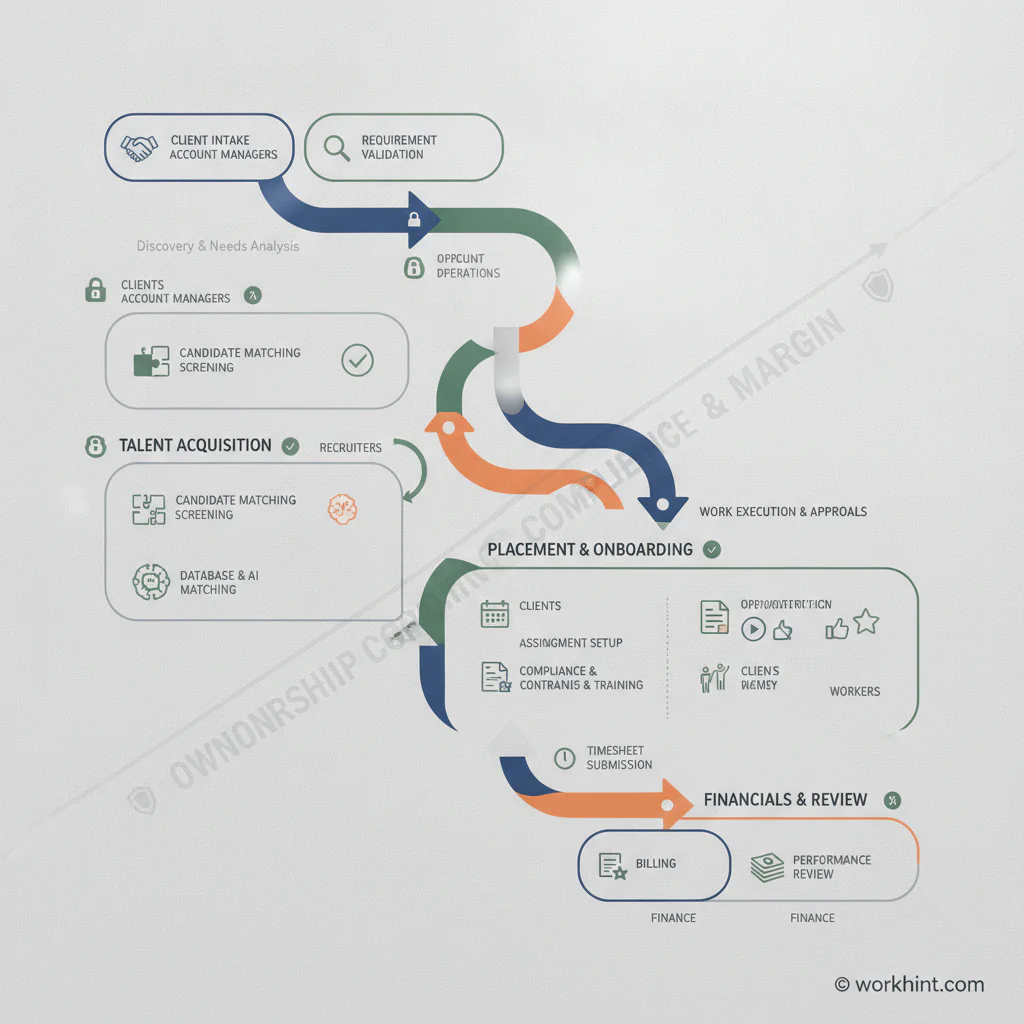
The staffing agency workflow
A strong staffing agency workflow has seven stages.
- Client intake. Capture role, location, shift, rate range, required credentials, start date, reporting manager, workplace requirements, safety conditions, and approval authority.
- Job and requirement validation. Confirm that the role can be filled, the pay and bill rates make sense, the client has approved the request, and any required contract terms are in place.
- Candidate matching and screening. Match workers by skills, availability, location, credentials, prior performance, pay expectations, and eligibility.
- Offer and assignment setup. Confirm the assignment, pay rate, start time, supervisor, site instructions, required documents, and acceptance record.
- Onboarding and compliance. Collect required forms, verify credentials, share safety or workplace instructions, grant only necessary access, and document readiness.
- Work execution and approvals. Track attendance, timesheets, deliverables, client approvals, issues, no-shows, schedule changes, and extension requests.
- Billing, payroll, and review. Reconcile approved time or milestones, bill the client, pay the worker, review performance, and decide whether to reuse, extend, replace, or close the assignment.
Staffing workflow ownership table
The workflow should show who owns each stage and what evidence must be captured.
| Stage | Primary owner | Decision or action | Evidence to capture |
|---|---|---|---|
| Client intake | Account manager | Confirm demand, rate, timing, and hiring criteria | Approved request, client contact, role details |
| Requirement validation | Operations or delivery lead | Decide whether the request is ready to fill | Contract status, margin check, risk notes |
| Candidate matching | Recruiter | Shortlist available and qualified workers | Match reason, availability, screening notes |
| Assignment setup | Recruiter and coordinator | Confirm acceptance and start details | Offer record, schedule, rate, instructions |
| Compliance readiness | Compliance, HR, or operations | Clear the worker before the assignment starts | Forms, credentials, safety steps, eligibility records |
| Work approval | Client manager and agency coordinator | Approve time, work, changes, and issues | Timesheet, approval log, incident notes |
| Billing and payroll | Finance | Invoice client and pay worker from approved records | Approved hours, invoice, payment status |
How to improve a staffing agency workflow
Start by mapping one recent placement from client request to worker payment. List every handoff, spreadsheet, approval, duplicate data entry point, and status chase.
Then improve the workflow in this order.
- Standardize intake. Do not let requests arrive as half-complete emails. Use a structured request that captures rate, location, skill, schedule, start date, reporting line, safety notes, and approval owner.
- Separate ready from not ready. A job should not enter active recruiting until rate, scope, approval, and compliance requirements are clear.
- Make worker readiness visible. Recruiters should see who is eligible, credentialed, available, and previously successful before outreach begins.
- Connect time approval to billing and payroll. If approved time must be rekeyed into finance systems, errors and margin leakage are almost guaranteed.
- Track exceptions. No-shows, late approvals, expired credentials, client changes, and disputed hours should have owners and resolution paths.
- Review margin and performance together. A placement is not successful if it fills quickly but creates payroll delays, client disputes, or poor retention.
The American Staffing Association’s BLS employment situation dashboard reported temporary help employment at 1.57 percent of total nonfarm employment in June 2026. For agencies, even small workflow improvements can matter across large assignment volumes.
Common staffing workflow mistakes
- Recruiting before the client request is ready. This wastes recruiter time and frustrates candidates when pay, schedule, or requirements change later.
- Treating compliance as a final checklist. Required forms, credentials, safety steps, and site rules should be visible before the worker arrives.
- Using different status definitions by team. “Submitted,” “cleared,” “placed,” and “active” need precise meanings across recruiting, operations, and finance.
- Letting timesheets float outside the workflow. Time approval is not admin cleanup. It is the bridge between service delivery, payroll, and client billing.
- Automating unclear handoffs. Automation helps only after owners, required fields, decision rules, and exception paths are defined.
Where Workhint fits
Workhint fits when a staffing agency or workforce team needs one operating system for external work instead of disconnected request forms, candidate notes, onboarding checklists, time approvals, and payment follow-ups. The staffing workflow can be built in Workhint as role-based intake, approval routing, worker onboarding, assignment tracking, document collection, client approvals, payment status, and reporting. For shift-based teams, staff scheduling software can connect availability, open shifts, assignments, swaps, coverage rules, and schedule changes.
That does not replace recruiting judgment or compliance review. It gives the agency a clearer structure for running the work. A client request becomes a live workflow, a worker record connects to assignments and readiness, and a timesheet can flow into approval and payment status.
FAQ
What is a staffing agency workflow?
A staffing agency workflow is the end-to-end process a staffing business uses to receive client requests, match workers, screen candidates, complete onboarding, manage assignments, approve time, bill clients, pay workers, and review performance.
What are the most important staffing workflow stages?
The most important stages are client intake, requirement validation, candidate matching, assignment setup, onboarding and compliance, work approval, billing, payroll, and performance review.
Who should own staffing agency workflow design?
Workflow design should be owned by operations, with input from recruiters, account managers, finance, compliance, and client-facing leaders. One owner should be accountable for keeping status definitions, handoffs, and reporting consistent.
How can staffing agencies reduce manual work?
Start with structured intake, consistent worker readiness records, clear approval gates, connected timesheet approvals, and exception tracking. Automate only after the workflow rules are clear.
What metrics should staffing agencies track?
Track time to submit, time to fill, fill rate, worker readiness, onboarding completion, no-show rate, assignment completion, timesheet approval time, invoice aging, payroll issues, gross margin, client satisfaction, and rehire quality.
Conclusion
A staffing agency workflow is not just an internal process diagram. It is how the business protects speed, margin, worker experience, client trust, and compliance at the same time. The strongest workflows make each placement visible from request to payment: who owns the next action, what evidence is missing, what risk needs review, and what outcome the agency is trying to deliver. Once that structure is clear, automation reinforces a workflow the agency already understands.
Leave a Reply