


You do not need a payroll-heavy training company to sell serious corporate learning programs.
If you want to start a corporate training business, the fastest path is not building a huge course catalog or hiring full-time facilitators. It is choosing one valuable workplace problem, validating demand with a few real buyers, and delivering through a branded platform backed by a small network of independent trainers.
Corporate training works because companies pay for outcomes: safer teams, faster onboarding, better managers, stronger sales conversations, cleaner compliance, and higher adoption of new tools. The mistake is acting like a traditional training firm too early. Before you lease space, hire staff, or build a library of courses, prove that companies will buy one focused offer.
What’s in this article?
- Why corporate training is a practical service business
- What you need before the first client
- Startup costs and pricing models
- How to find the first corporate buyers
- How Workhint can power the business from day one
- A 7-day launch plan and checklist
Why this business works
Corporate training is attractive because the buyer is usually solving a business problem, not buying education for fun. HR leaders, operations teams, sales leaders, compliance managers, and department heads invest when training can reduce risk, improve performance, or help employees use a process correctly.
The best first offer is narrow. Instead of selling general leadership training, sell a workshop for new frontline managers. Instead of offering all technology training, sell AI workflow training for operations teams or CRM adoption training for sales teams. Specific problems are easier to price, explain, and validate.
A platform-first model also changes the economics. You can launch the brand, intake process, booking flow, participant registration, facilitator onboarding, and payment process before you have a full-time team. Independent trainers can deliver sessions when demand appears, while you control the customer experience, quality standards, scheduling, and follow-up.
What you need to launch
You need less than most people think, but you do need a real operating foundation. Start with one buyer, one problem, one training format, and one repeatable delivery workflow.
| Launch item | Lean starting approach | Typical early budget |
|---|---|---|
| Business setup | LLC or local equivalent, EIN, bank account, basic contract templates | $100 to $800 |
| Insurance | General liability and professional liability where appropriate | $400 to $1,200 per year |
| Brand and website | Simple niche page with one offer and inquiry form | $100 to $1,000 |
| Training materials | Pilot deck, exercises, workbook, feedback survey | $0 to $2,000 |
| Branded platform | Customer intake, booking, facilitator onboarding, schedules, invoices, payouts | Start lean, expand after demand |
| Provider network | Independent trainers recruited by niche, geography, or expertise | Mostly time at first |
Do not build ten courses before anyone buys. Create a clear pilot offer, sell it to a real company, then improve the curriculum based on live delivery. For many founders, the first version can be a half-day workshop, a two-session manager program, or a small cohort delivered virtually.
How to price it
Price corporate training around the business value and delivery format, not only your hours. A workshop that helps a sales team improve discovery calls or helps managers avoid compliance mistakes is more valuable than a generic presentation.
| Offer | Best use | Example price |
|---|---|---|
| Pilot workshop | First clients, proof, testimonials, feedback | $1,500 to $4,000 |
| Half-day team session | Focused skill or process training | $3,000 to $8,000 |
| Multi-session program | Manager, sales, compliance, onboarding, or software adoption programs | $8,000 to $30,000+ |
| Annual training partner | Recurring programs across teams or locations | Monthly retainer or annual contract |
Start with a pilot rate if you need proof, but make the discount intentional. Ask for feedback, a testimonial, a case study, or a referral in return. Once the offer works, move toward multi-session programs and recurring training calendars.
How to get first customers
Your first customers should come from trust, not broad advertising. Make a list of companies where the problem is visible and urgent. Then identify the buyer who owns the pain: Head of People, VP of Operations, Director of Learning, Safety Manager, Sales Enablement Lead, or department leader.
Use a simple message: name the problem, describe the workshop outcome, and offer a short diagnostic call. Warm introductions, former colleagues, local business networks, LinkedIn posts, industry groups, chambers of commerce, HR communities, and partner referrals can all work before paid ads are necessary.
Validation is the goal. If five qualified buyers will not discuss the offer, change the niche, audience, or outcome before spending more money.
How Workhint helps launch it
Workhint helps you launch the training business as a branded operating platform instead of a loose collection of forms, calendars, payment links, spreadsheets, and email threads.
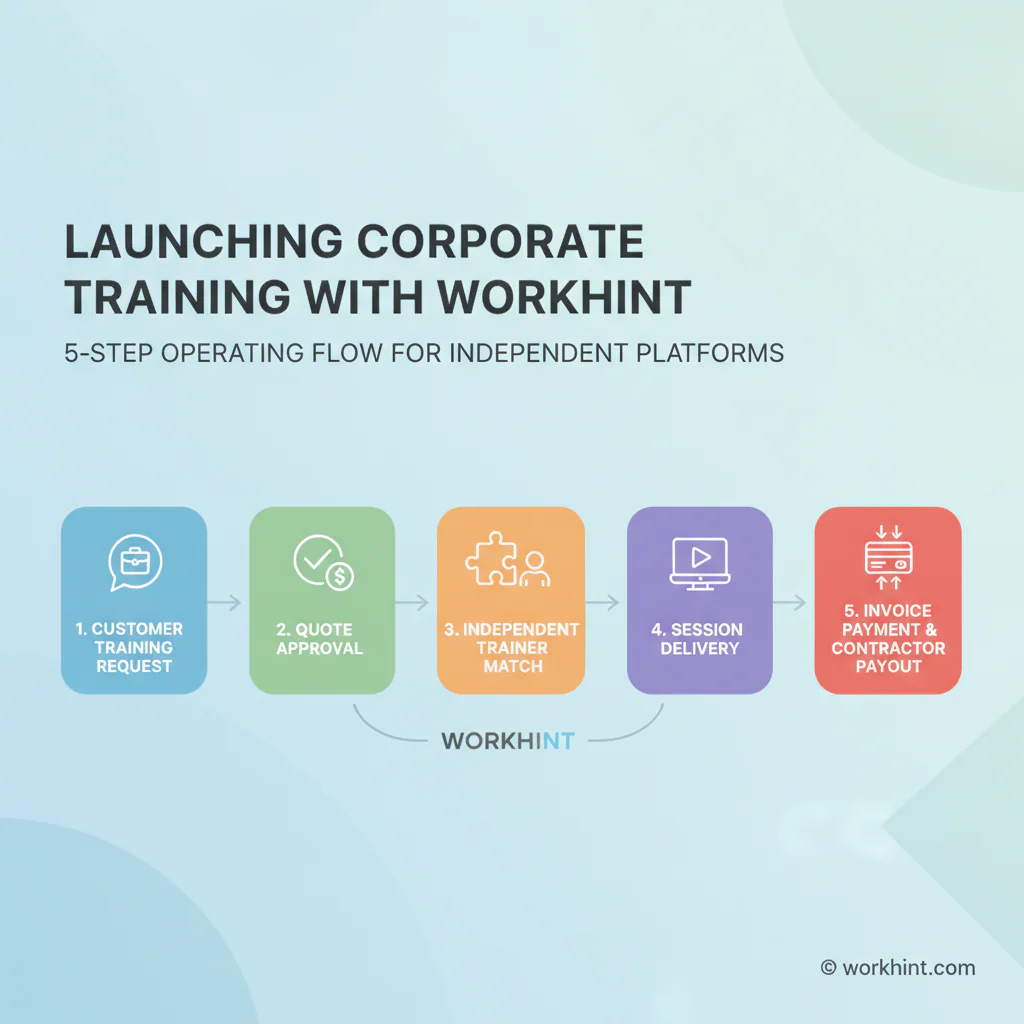
A customer can request a corporate training session through your branded portal, share team size and goals, upload context, review a proposed program, approve a quote, and book dates. Behind the scenes, you can invite independent trainers into a private provider network, collect their credentials, assign sessions, share materials, track delivery tasks, gather feedback, issue invoices, collect payments, and manage contractor payouts.
That matters because a training company becomes hard to run when every client has different dates, participants, instructors, materials, approvals, and follow-up needs. Workhint gives the business an operational backbone before you invest in custom software or hire a coordination team.
First 7-day launch plan
- Day 1: Choose one niche, one buyer, one painful problem, and one city or remote market.
- Day 2: Set up the basic branded Workhint platform with customer intake, inquiry routing, and a simple dashboard.
- Day 3: Define the pilot package, pricing, quote approval flow, scheduling steps, payment process, and contractor payout rules.
- Day 4: Recruit three to five independent trainers or subject experts who can deliver the first sessions.
- Day 5: Contact warm prospects, local companies, HR leaders, operations teams, and relevant partner organizations.
- Day 6: Route interested buyers through the platform, schedule calls, and test whether the offer is clear enough to sell.
- Day 7: Review demand, instructor readiness, pricing objections, and delivery risks before investing more.
A good first week does not need to end with a perfect course catalog. It should end with a clear buyer, a real offer, early provider capacity, and evidence that companies want the result.
Final launch checklist
- Choose a narrow training niche and buyer.
- Write one measurable training outcome.
- Create a pilot workshop outline and simple materials.
- Register the business and confirm insurance needs.
- Configure the branded Workhint customer portal and intake flow.
- Recruit the first independent trainers or subject experts.
- Create quote approval, scheduling, invoice, payment, and payout workflows.
- Contact the first 25 qualified prospects.
- Book a pilot before building a full course library.
- Use feedback to standardize the next version.
FAQ
How much does it cost to start a corporate training business?
A lean launch can often start with a few hundred to a few thousand dollars for business setup, insurance, a simple brand presence, training materials, and a platform for intake, scheduling, payments, and delivery coordination.
Do I need employees to start?
No. You can begin with independent trainers, facilitators, or subject experts. The key is having clear onboarding, quality standards, scheduling, and payout workflows so customers still receive a consistent experience.
What kind of training should I sell first?
Start with a problem companies already pay to solve, such as manager training, sales enablement, compliance, onboarding, safety, software adoption, customer service, or AI workflow training.
Do I need a license to run corporate training?
Usually not for general business training, but regulated topics may require credentials, certifications, or licensed instructors. Always check the rules for your subject area, state, and target industry.
How do corporate training businesses find clients?
The strongest early channels are warm networks, LinkedIn authority content, referrals, HR and operations communities, local business groups, industry associations, and direct outreach to leaders with a visible training problem.
Can corporate training be recurring revenue?
Yes. Recurring revenue can come from annual compliance calendars, quarterly manager programs, onboarding cohorts, subscription access, certification renewals, or ongoing training partnerships.
Conclusion
The easiest way to start a corporate training business is to stay narrow, validate demand early, and build the operating model before building a large company. Pick one painful workplace problem, sell a pilot, recruit independent providers, and use Workhint to create the branded platform that handles requests, scheduling, delivery, payments, and provider payouts from the beginning.
Leave a Reply