


External workforce management breaks down when requests, approvals, documents, work, and payments live in separate places.
External workforce management is the operating discipline for engaging contractors, freelancers, staffing suppliers, agencies, vendors, consultants, and partners without losing control of work, risk, cost, or payment. It matters because outside work now touches core operations, not just overflow tasks. A company may use one supplier for field labor, direct freelancers for creative work, consultants for implementation, and vendors for customer delivery. If each group is managed differently, the business ends up with fragmented records and unclear accountability.
The goal is to give each relationship the right intake path, approval rules, documentation, work tracking, and payment process while keeping leadership visibility across the full program.
What’s in this article?
- The external workforce lifecycle.
- Best practices for intake, compliance, payment, and reporting.
- Common mistakes that create risk and slow delivery.
- Where Workhint fits when the process needs to become a live system.
Why external workforce management matters
External workforce management becomes important when outside contributors stop being occasional help and start becoming part of how the business delivers work. At that point, informal coordination through email, spreadsheets, shared drives, and one-off payment approvals creates avoidable risk.
The risk is partly compliance. The IRS says worker classification depends on the facts of the relationship, including behavioral control, financial control, and the nature of the relationship. The U.S. Department of Labor warns that misclassification can affect wages, protections, and employer obligations. For legal, tax, and labor decisions, businesses should use official guidance and qualified advisors.
The risk is also operational. If work starts before classification, contracts, access, scope, insurance, or payment terms are approved, the company may have no reliable audit trail. If Finance sees invoices but not accepted work, payment approvals slow down. If Legal sees contracts but not renewals, expired agreements can continue in practice.
External workforce management best practices
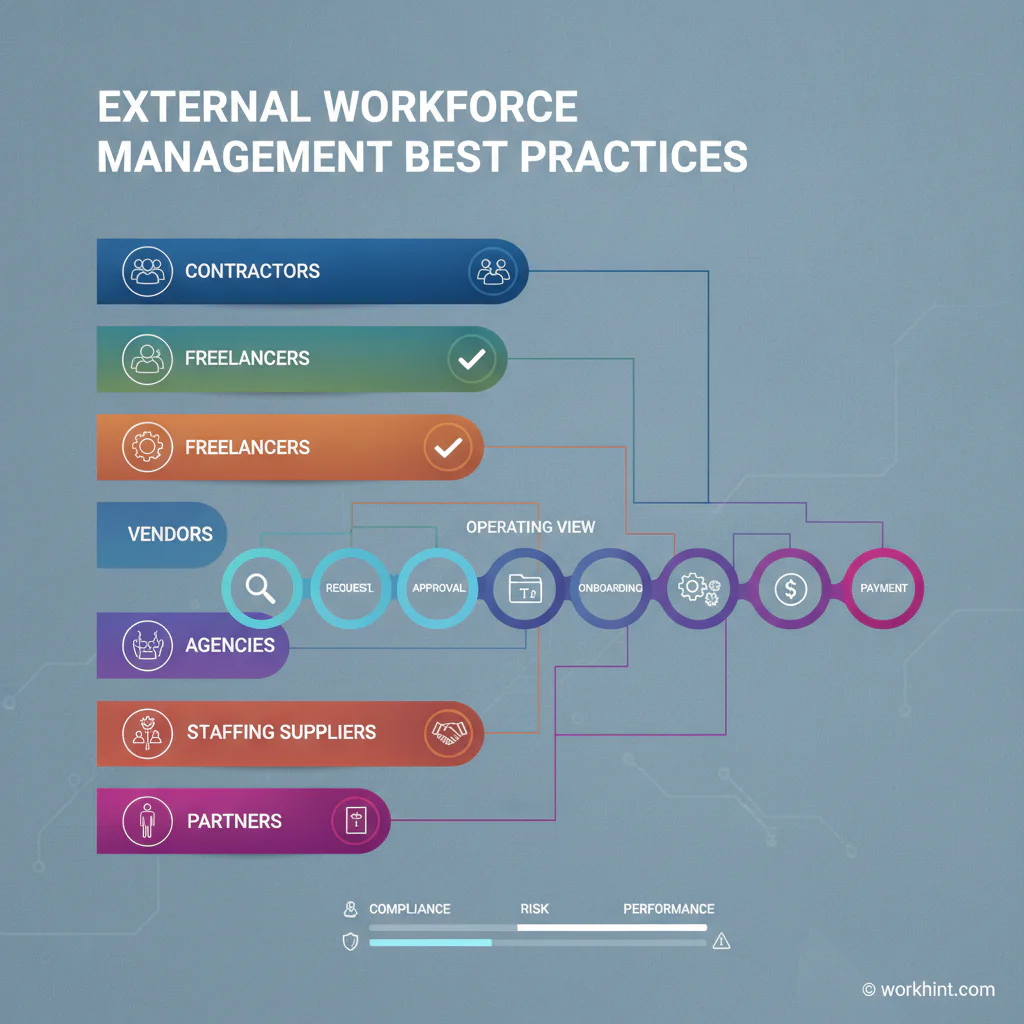
The strongest programs are built around a clear lifecycle that managers can follow and HR, Legal, Procurement, Finance, and Operations can trust.
| Lifecycle stage | Key decision | Required control |
|---|---|---|
| Request | What outside work is needed and why? | Standard intake with budget, scope, owner, location, and worker type. |
| Approval | Can this work be engaged externally? | Routing to business owner, Finance, Legal, Procurement, HR, or security as needed. |
| Classification | Is the relationship employee-like, contractor-like, supplier-led, or partner-led? | Documented review before work starts, with rechecks when scope changes. |
| Onboarding | What must be collected before access is granted? | Contracts, tax forms, NDAs, insurance, credentials, and system access controls. |
| Execution | How will work be assigned, accepted, and measured? | Milestones, deliverables, ownership, communication rules, and change approvals. |
| Payment | What evidence releases payment? | Invoice matching against approved scope, accepted work, tax records, and payment terms. |
| Offboarding | What must close when the work ends? | Final acceptance, payment closure, access removal, document retention, and performance notes. |
Start with one intake process
A good intake process prevents the most expensive external workforce problems before they happen. Every request should capture the business need, worker category, location, scope, estimated spend, proposed supplier or person, duration, access needs, and approval owner.
This is where many programs fail. Managers describe the work in a message, send it to someone they know, and clean up the paperwork later. That feels fast, but it creates downstream work. Intake does not need to be heavy. It needs to make the important questions unavoidable before a person, vendor, or agency starts work.
Separate relationship types without splitting visibility
External workforce management should recognize that different relationships need different controls. A staffing supplier is not the same as a freelance designer, consulting firm, subcontractor, local service vendor, or cross-border contractor.
The mistake is creating a separate spreadsheet, inbox, or approval habit for each model. Instead, define tracks inside one operating view: contractor classification, freelancer milestones, staffing supplier requisitions, agency or vendor statements of work, and partner handoffs.
Build compliance into the workflow
Compliance should not sit outside the work process as a folder of documents. It should shape what can happen next. If classification is incomplete, onboarding should not advance. If the contract is unsigned, access should not be granted. If insurance has expired, new assignments should pause. If work is not accepted, payment should not be released.
This is especially important for cross-border or multi-state programs. Rules can vary by jurisdiction and engagement model. Scope changes, longer duration, exclusivity, new reporting relationships, or new work methods can change the risk profile and should trigger review.
Connect work acceptance to payment
External workforce programs often slow down at payment because approval evidence is incomplete. Finance may receive an invoice without knowing whether the work was approved, the milestone was accepted, the contract covered the invoice, or tax records were collected.
The fix is to define payment readiness before the invoice arrives. Each engagement should specify the payment method, invoice requirements, approver, payment terms, accepted-work evidence, cost center, and exception process. For U.S. tax reporting, the IRS Form W-9 is commonly used to request taxpayer identification information from U.S. persons. Other forms may apply in international contexts.
Track the metrics that reveal program health
External workforce management should give leaders a clear view of what is happening, not just a place to store records. Useful metrics include request-to-approval time, onboarding completion rate, active external workers by type, contract expiry dates, spend by department, supplier performance, invoice cycle time, late payments, access removal after offboarding, and exception volume.
These metrics reveal where the operating model is breaking. Long onboarding times may point to unclear ownership. High exception volume may show that intake is missing a real business path.
Common mistakes
- Letting work start before approval: This creates documentation gaps and makes later controls harder to enforce.
- Using one contractor process for every relationship: Vendors, agencies, direct contractors, and partners need different tracks.
- Managing documents separately from work: Contracts, tax forms, insurance, access, assignments, and payments need to stay connected.
- Skipping offboarding: Access removal, final payment, record retention, and performance notes are part of the lifecycle.
- Reporting only spend: Spend matters, but risk, cycle time, renewal exposure, and work acceptance matter too.
Where Workhint fits
Workhint fits when external workforce management needs to move from policy into daily execution. A business can use Workhint to turn the lifecycle into a working system: intake forms for different relationship types, role-based approvals, onboarding document collection, classification review checkpoints, assignment workflows, milestone acceptance, payment status, renewal reminders, access tasks, and reporting.
That helps teams manage mixed external workforces without forcing contractors, freelancers, staffing suppliers, agencies, vendors, and partners into one rigid process.
FAQ
What is external workforce management?
External workforce management is the process of engaging, coordinating, tracking, and paying non-employee workers and organizations, including contractors, freelancers, agencies, staffing suppliers, vendors, consultants, and partners.
Who should own external workforce management?
Ownership is usually cross-functional. Operations often owns the workflow, while HR, Legal, Procurement, Finance, IT, and business leaders own specific approval, compliance, access, vendor, and payment controls.
What software is used for external workforce management?
Companies may use vendor management systems, freelance management systems, contractor management software, procurement tools, HR systems, finance tools, or a work orchestration platform. The right system depends on the relationship types and workflow complexity.
How do you reduce external workforce risk?
Start with structured intake, document worker classification decisions, require approved contracts before work begins, connect onboarding to access, review scope changes, tie payment to accepted work, and keep audit-ready records.
Conclusion
External workforce management is not just a procurement process or an HR process. It is the operating system for how outside work enters the business, gets approved, starts, gets completed, gets paid, and closes. The best programs give each relationship type the right controls while keeping requests, documents, approvals, work evidence, payments, and reporting connected.
Leave a Reply