

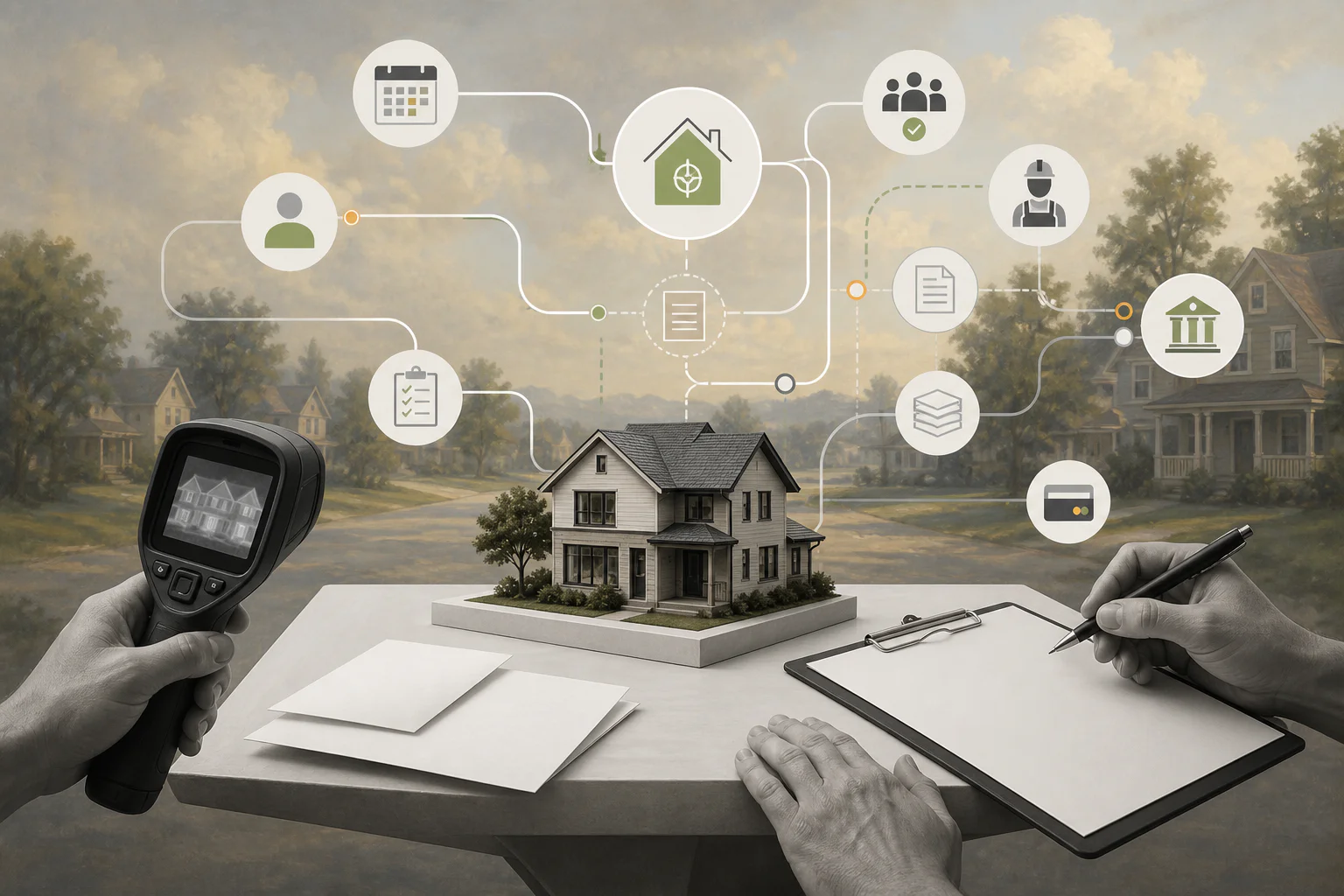
A home energy audit business can launch before you build a big inspection company if the provider network is ready.
If you are researching how to start a home energy audit business, the first decision is not which thermal camera to buy. The first decision is whether you can find homeowners who want lower utility bills, clearer upgrade plans, and help understanding incentives before you invest heavily.
A home energy audit business can launch with a lean model: a branded customer platform, a simple first offer, certified independent auditors, and clear referral partners for insulation, HVAC, windows, solar, and weatherization work. That lets you validate demand without hiring a full staff or buying every advanced tool on day one.
What’s in this article?
- Why home energy audits are a practical local service business
- What you need to launch with no employees
- How to price audits and related packages
- How to get the first customers and referral partners
- How Workhint helps run the business from intake to payout
- A first 7-day launch plan, checklist, and FAQ
Why a home energy audit business works
Homeowners are paying attention to energy use because utility bills, comfort problems, aging HVAC systems, and home-efficiency incentives all create practical reasons to act. A good audit gives them a prioritized plan instead of a pile of disconnected contractor opinions.
The business works because the first offer is easy to understand. A homeowner submits utility bills and home details, books an audit, receives a written report, and decides which improvements to make first. The value is not only the inspection. It is the confidence to spend money in the right order.
You do not need to start as a traditional inspection company with employees in every neighborhood. You can build a private network of BPI, RESNET, or similarly qualified independent auditors and home-performance specialists, then route work through your branded platform as demand appears.
What you need to launch
Start with the operating system, not the office. Your first version needs a brand, a service area, a customer intake process, insurance, a certification strategy, and a small group of qualified auditors or partners who can perform the work responsibly.
Certification requirements vary by service type and market. For audits connected to federal tax-credit claims, homeowners generally need a qualified home energy auditor and a written report that identifies cost-effective improvements. Check current IRS, DOE, state, utility, and local requirements before selling tax-credit-ready audits.
| Launch item | Lean approach | Estimated first-month cost |
|---|---|---|
| Business setup | LLC, EIN, basic bookkeeping, local permits if required | $150 to $800 |
| Insurance | General liability and professional liability | $100 to $400 monthly |
| Platform | Branded intake, scheduling, report workflow, payments, payouts | $300 to $1,000 |
| Certification path | Founder certification or contracted certified auditors | $500 to $2,000+ |
| Starter tools | Use partner-owned tools first; buy thermal camera or blower-door gear after demand is proven | $300 to $1,500 |
| Marketing | Local landing page, referral outreach, flyers, neighborhood ads | $200 to $1,000 |
The most important cost decision is whether to buy diagnostic equipment immediately or recruit certified auditors who already own it. If your title promise is no staff, the second path is usually smarter: build the demand engine first, then invest in owned equipment when job volume justifies it.
How to price it
Pricing should be simple enough for homeowners to buy and flexible enough for partners to deliver profitably. Start with one core audit package, then add higher-value options for larger homes, detailed reports, rebate guidance, and post-audit project coordination.
| Offer | What it includes | Example price |
|---|---|---|
| Basic home energy review | Utility-bill review, walkthrough, simple improvement plan | $199 to $349 |
| Diagnostic audit | Thermal scan, blower-door or air-leak testing where available, written report | $399 to $699 |
| Tax-credit-ready audit | Qualified auditor, required written report, improvement estimates | $450 to $750 |
| Upgrade coordination | Referral matching, quote collection, follow-up checklists | 10% to 15% referral or coordination fee where allowed |
A good first target is gross margin after contractor payout. If you sell a $499 diagnostic audit and pay a certified independent auditor $300, the remaining margin must cover customer acquisition, platform costs, support, insurance, and profit. Track that from the first job.
How to get first customers
Start with homeowners who already feel the pain: high utility bills, uncomfortable rooms, older homes, recent HVAC quotes, insulation concerns, or interest in rebates. The first customers usually come from local trust channels, not broad paid ads.
- Partner with HVAC, insulation, window, solar, roofing, and remodeling contractors who need better diagnostic reports before quoting.
- Build referral relationships with real estate agents, home inspectors, property managers, and neighborhood associations.
- Create local pages for searches like home energy audit in your city, high electric bill help, and attic insulation audit.
- Offer a limited founding-customer package to validate pricing and report quality.
- Ask every customer for before-and-after feedback, review permission, and referral introductions.
Your first goal is not to look like a national company. It is to prove that homeowners will submit information, book an audit, receive a useful report, and trust your network enough to take the next step.
How Workhint helps launch it
Workhint helps you launch the home energy audit business as a branded operating platform before you build custom software or hire a back office. The customer sees your brand, your service request flow, your dashboard, and your communication experience from the first visit.
A homeowner can request an audit through your branded portal, upload utility bills and home photos, choose a package, approve the price, and book a time. Workhint routes the request to a qualified independent auditor in your network, confirms availability, collects required documents, and tracks the audit from scheduled visit to completed report.
After the audit, Workhint can help deliver the report, collect payment, route follow-up questions, invite contractors to submit quotes, track approvals, and pay the auditor or provider. The business owner manages service areas, provider onboarding, schedules, job status, customer communication, payouts, and reporting in one place.
That matters because the real barrier is not writing a business plan. It is coordinating homeowners, auditors, documents, reports, referrals, payments, and follow-up without dropping details. Workhint gives you the operational foundation while you focus on proving demand and building the partner network.
First 7-day launch plan
- Day 1: Choose your first market, target customer, and audit package. Avoid broad promises until you know local certification and utility requirements.
- Day 2: Set up the branded Workhint platform basics: intake form, customer portal, audit request fields, service area, and status workflow.
- Day 3: Configure pricing, quote approval, scheduling, report delivery, payment, and independent auditor payout steps.
- Day 4: Recruit three to five certified auditors, home inspectors, or home-performance partners and collect credentials, insurance, availability, and service areas.
- Day 5: Contact first demand sources: HVAC companies, insulation contractors, real estate agents, neighborhood groups, and homeowners with high-bill complaints.
- Day 6: Route every lead through the platform, even if it is manual behind the scenes. This tests intake quality and fulfillment timing.
- Day 7: Review demand, provider readiness, pricing, report quality, and customer objections before buying more equipment or expanding the offer.
Final launch checklist
- Choose a business name, service area, and first customer segment.
- Confirm certification, tax-credit, state, utility, and insurance requirements.
- Create one simple audit package and one premium diagnostic package.
- Configure the branded Workhint intake, scheduling, payment, report, and payout workflow.
- Recruit certified independent auditors or home-performance partners.
- Create report templates, photo requirements, and customer follow-up steps.
- Launch a local landing page and referral outreach list.
- Book first audits before investing in a full equipment stack or employee team.
FAQ
How much does it cost to start a home energy audit business?
A lean launch can often start in the low thousands if you use a branded platform, recruit qualified independent auditors, and delay major equipment purchases. Costs rise when you buy blower-door equipment, thermal cameras, vehicles, and advanced software upfront.
Do I need certification to offer home energy audits?
Certification rules depend on the audit type, customer promise, state, utility program, and tax-credit requirements. BPI, RESNET, and DOE-recognized credentials are commonly relevant. Verify requirements before marketing audits as tax-credit-ready or rebate-ready.
Can I start a home energy audit business with no employees?
Yes, if you build around independent certified auditors and partners instead of hiring employees first. You still need clear contracts, insurance, credential checks, quality standards, and customer communication.
What equipment is required at the beginning?
For a platform-first launch, the required equipment may belong to certified partners. If you perform audits yourself, common tools include a thermal camera, blower-door kit, combustion safety tools where relevant, ladders, PPE, and reporting software.
How do home energy audit businesses make money?
Revenue usually comes from audit fees, diagnostic packages, report upgrades, follow-up consultations, and referral or coordination revenue where allowed. Keep referral practices transparent and compliant.
Who are the best first customers?
Good early customers include owners of older homes, people with high utility bills, homeowners planning HVAC or insulation upgrades, real estate clients, and households trying to understand incentives before making improvements.
What is the biggest beginner mistake?
The biggest mistake is buying equipment and chasing certifications before testing whether local homeowners and referral partners will book audits at profitable prices. Validate demand first.
Conclusion
A home energy audit business is attractive because it solves a practical household problem: people want lower bills, better comfort, and clearer improvement decisions. The lean path is to launch the branded platform, recruit qualified providers, sell a simple first package, and prove demand before expanding.
With Workhint as the operating foundation, you can coordinate the customer request, auditor network, scheduling, report delivery, payment, and payout from the beginning. That gives you a faster way to test the market without building a traditional inspection company first.
Leave a Reply