


A practical contractor process keeps outside work moving without turning every project into a compliance, access, or payment scramble.
A contractor management process is the operating rhythm a business uses to request contractor help, approve the engagement, onboard the worker, coordinate delivery, approve invoices, and close the relationship cleanly. The process matters because contractors sit outside the employee structure, but they still touch deadlines, systems, customers, budgets, intellectual property, and sometimes regulated work.
Many teams treat contractor management as disconnected tasks: legal sends an agreement, IT grants access, a manager shares work in chat, finance waits for an invoice, and operations chases updates after something slips. That breaks when multiple departments, agencies, specialists, subcontractors, and remote contributors are working at once.
What’s in this article?
- The core stages of a contractor management process
- A checklist for intake, onboarding, work control, approvals, and offboarding
- Common mistakes that create compliance, payment, and delivery problems
Why contractor management needs a process
Contractors are not employees, but the business still has to manage the work. The company needs clarity on scope, access, deliverables, quality, safety, payment, and handoff, while avoiding a level of control that makes the relationship look like employment. For U.S. tax purposes, the IRS looks at behavioral control, financial control, and the relationship of the parties when evaluating whether a worker is an employee or independent contractor.
Contractor management is also an operational risk issue. The UK Health and Safety Executive’s guide on managing contractors is written for safety-sensitive work, but its lesson applies broadly: plan the job, choose the right contractor, coordinate the work, monitor performance, and review the result. The same lifecycle works for marketing freelancers, implementation partners, field contractors, technical specialists, agencies, and service vendors.
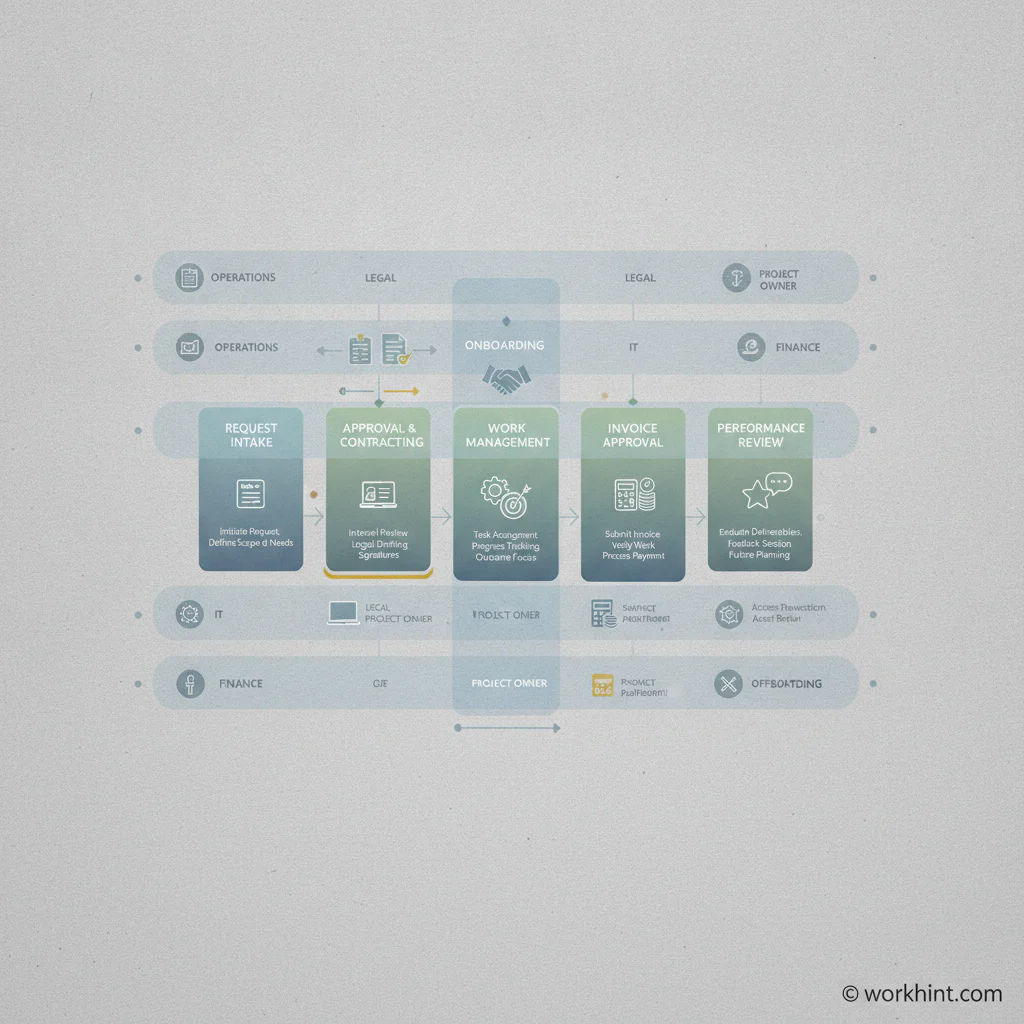
Contractor management process checklist
The strongest process is simple enough for managers to follow and structured enough for legal, finance, IT, security, and operations to trust.
| Stage | Purpose | Key owner | Required output |
|---|---|---|---|
| Request | Confirm why outside help is needed | Hiring manager | Business need, budget, scope, timeline |
| Approval | Check budget, risk, classification, and policy fit | Operations or procurement | Approved engagement record |
| Contracting | Set commercial, legal, and delivery terms | Legal or business owner | Signed agreement or statement of work |
| Onboarding | Collect documents and grant only needed access | Operations and IT | Completed onboarding checklist |
| Work management | Track milestones without micromanaging method | Project owner | Status, deliverables, risks, decisions |
| Invoice approval | Match payment to approved work | Finance and project owner | Approved invoice and payment status |
| Review and offboarding | Capture performance, remove access, close records | Operations | Final review and closed engagement |
Step 1: start with a contractor request
Every engagement should begin with a request, not an informal message asking someone to “bring in a contractor.” Capture the business problem, work outcome, expected duration, budget, remote or on-site status, systems or data access needed, and who will approve deliverables.
This stops teams from hiring outside help before they know what success looks like and gives finance, legal, security, and operations enough context to review the engagement early.
Step 2: approve classification, budget, and risk
Before work starts, route the request through the right approvals. For independent contractors, classification review should happen before the manager promises terms or directs work. For safety-sensitive, regulated, customer-facing, or data-sensitive work, risk review should also happen before onboarding.
The U.S. Department of Labor’s Fair Labor Standards Act guidance uses an economic reality test to evaluate employment relationships. The process should flag control, exclusivity, permanence, investment, skill, and profit-or-loss questions early enough for the right reviewer to weigh in.
Step 3: define the agreement and work package
A contractor agreement or statement of work should connect commercial terms to operational reality. Define the work outcome, milestones, acceptance criteria, payment terms, confidentiality, intellectual property, required insurance if applicable, tool access, expense rules, and termination path.
Avoid signing a broad agreement and managing the real work somewhere else. If the contract says one thing, the project board says another, and the invoice reflects a third version, the team has created avoidable disputes.
Step 4: onboard contractors with controlled access
Contractor onboarding should be role-based. A finance consultant, field technician, designer, and implementation partner do not need the same systems, documents, policies, or permissions.
- Signed agreement or SOW
- Tax, payment, and vendor records
- Confidentiality and data handling requirements
- System access with start and end dates
- Project owner and escalation contact
- Deliverable acceptance process
- Invoice submission and approval instructions
For operationally risky contractor programs, the Campbell Institute’s contractor management research emphasizes a lifecycle that includes prequalification, orientation, monitoring, and post-work evaluation. The lifecycle mindset helps teams avoid treating onboarding as a one-time paperwork task.
Step 5: manage work by outcomes, not constant control
Good contractor management makes work visible without blurring the relationship. Managers should track outcomes, milestones, decisions, blockers, and acceptance criteria. They should be careful with detailed direction over how, when, and where an independent contractor performs the work unless the role and jurisdiction support that structure.
A practical cadence is enough for most engagements: kickoff, weekly status, milestone review, acceptance review, invoice approval, and final retrospective.
Step 6: connect invoices to approved work
Contractor payment problems usually come from weak upstream process. If the team cannot see the approved scope, rate, milestone, timesheet, or deliverable acceptance, finance has to choose between delaying payment and approving an invoice with incomplete evidence.
Set the invoice rule before work starts. Some contractors should invoice against milestones. Others should submit hours, sessions, work orders, or accepted deliverables. The project owner approves the business side, while finance verifies payment details, tax records, purchase order rules, and duplicate invoice risk.
Step 7: review performance and close the engagement
Offboarding is part of the contractor management process, not an afterthought. When work ends, remove system access, collect final deliverables, confirm IP or file transfer, close payment items, record performance notes, and mark whether the contractor is approved for future work.
Common contractor management mistakes
- Starting work before approval: The business creates classification, budget, and payment risk before the engagement is visible.
- Managing contractors like employees: Excessive control can create legal and operational confusion.
- Separating work records from invoice records: Finance cannot verify what was approved, accepted, or changed.
- Skipping offboarding: Access, data, documents, and payment questions stay open after the work is finished.
Where Workhint fits
Workhint fits when contractor management needs to move from scattered checklists into a live work system. A business can use Workhint to turn the contractor request into structured intake, route approvals by role and risk, collect onboarding documents, assign work packages, track deliverables, manage access reminders, coordinate invoice approvals, and keep payment status visible.
The value is that external work usually crosses teams. Workhint helps connect the people, permissions, steps, documents, approvals, schedules, payments, and reporting around the contractor relationship so managers do not have to rebuild the process for every engagement.
FAQ
What is a contractor management process?
It is the structured workflow a business uses to request, approve, onboard, coordinate, pay, review, and offboard contractors.
Who should own contractor management?
Ownership depends on company size. Operations often owns the workflow, while procurement, HR, legal, finance, security, and department managers own specific gates.
How is contractor management different from employee management?
Employee management usually includes deeper direction, training, supervision, and ongoing employment obligations. Contractor management should focus on scope, deliverables, access, compliance, payment, and performance.
Conclusion
A strong contractor management process gives the business speed without losing control of risk. Start with a clear request, approve the engagement before work begins, onboard by role, manage outcomes, connect invoices to accepted work, and close the relationship cleanly. The process does not need to be heavy. It needs to be visible, consistent, and complete enough that outside work can scale without creating hidden operational debt.
Leave a Reply