

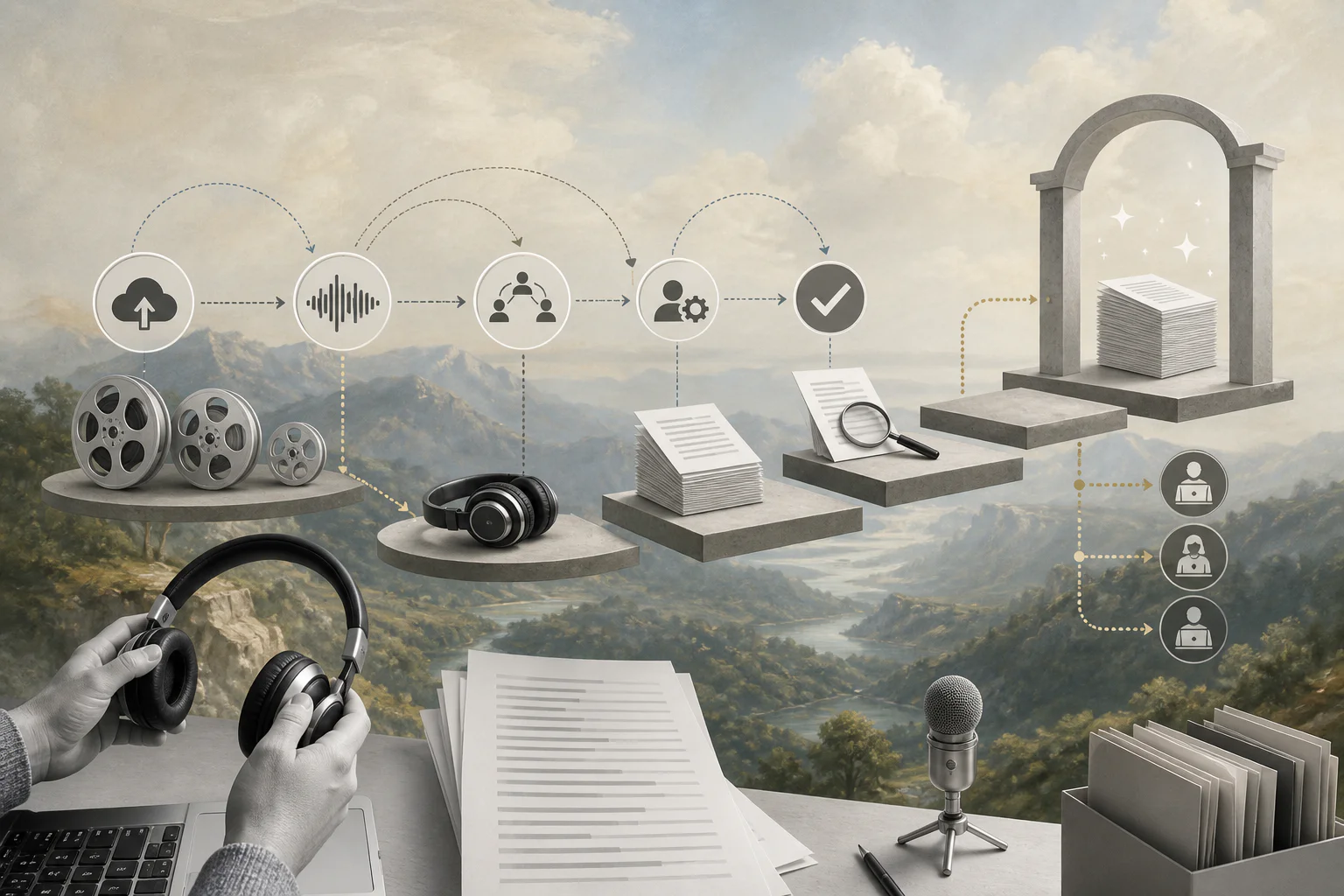
A transcription business can start lean if you sell accuracy, speed, privacy, and reliable delivery before hiring a team.
If you are researching how to start a transcription business, the opportunity is not just typing audio into text. The stronger model is a branded transcription service that receives client files, routes work to trained independent transcriptionists, checks quality, manages deadlines, and delivers clean documents through one simple platform.
That matters because transcription demand has changed. AI tools can create rough transcripts quickly, but many clients still need human review, formatting, confidentiality, speaker cleanup, terminology checks, summaries, captions, or legally usable records. The opening is not to compete with free AI. It is to package a dependable, reviewed transcription workflow for customers who care about accuracy and turnaround.
What’s in this article?
- Why a transcription business still works
- What you need to launch without staff
- How to price transcription services
- How to get your first customers
- How Workhint helps you launch the business
- A 7-day launch plan and final checklist
Why this business works
A transcription business works because many teams create more audio and video than they can organize. Consultants record interviews. Researchers run calls. Coaches record sessions. Podcasters need show notes and captions. Lawyers, clinics, agencies, and training companies need searchable records.
The simplest starting offer is human-reviewed transcription for a narrow customer type. You might begin with podcast transcripts, research interviews, business meetings, webinars, legal intake calls, or academic interviews. A niche helps you write better outreach, set clearer turnaround times, and recruit providers who understand the vocabulary.
You do not need employees to validate demand. You can start with a branded intake page, a clear service menu, a small bench of vetted freelance transcriptionists and editors, and a repeatable review process. Your first job is to prove that customers will upload files, pay for turnaround, and return for more work.
What you need to launch
The lean version of this business needs less equipment than most service businesses. You need a customer-facing platform, secure file intake, basic business setup, quality standards, provider onboarding, and a way to collect payments and pay contractors. Specialized legal or medical work may require stronger privacy controls, contracts, training, and compliance review, so start with the niche you can handle responsibly.
| Launch item | Lean starting approach | Estimated range |
|---|---|---|
| Business setup | LLC or local registration, basic contract templates | $200-$1,000 |
| Branded platform | Client intake, file upload, job status, approvals, payments | $100-$500 |
| Software | Transcription editor, AI draft tool, storage, password manager | $50-$300/month |
| Provider onboarding | Test file, style guide, NDA, turnaround rules | $0-$300 |
| Marketing | Landing page, directory listings, targeted outreach | $100-$750 |
| Insurance and legal review | General liability, professional liability, privacy terms when needed | $300-$1,500 |
Avoid buying complex enterprise transcription systems before you have recurring demand. Start with a controlled workflow. Add more tooling only after customers prove which file types, turnaround times, and review standards they actually buy.
How to price it
Most transcription services price by audio minute, project, turnaround speed, or monthly volume. Your pricing should reflect audio quality, number of speakers, formatting requirements, privacy requirements, and review depth.
| Offer | Best for | Example pricing model |
|---|---|---|
| Clean transcript | Podcasts, interviews, webinars | $1.25-$2.50 per audio minute |
| Rush transcript | Time-sensitive business files | Base rate plus 25%-75% rush fee |
| Edited transcript plus summary | Consultants, researchers, agencies | $2.00-$4.00 per audio minute |
| Monthly retainer | Recurring podcasts, research teams, training companies | $500-$3,000/month based on volume |
Do not compete only on the cheapest transcript. Compete on reliability: secure upload, clear deadline, consistent formatting, named review process, and fewer corrections for the client.
How to get first customers
Your first customers will usually come from focused outreach, not broad advertising. Pick one niche and contact people who already create recordings. Good starting markets include podcast producers, qualitative researchers, coaches, consultants, training companies, video agencies, attorneys, and local business groups.
Send a short message with a concrete offer: upload one file, receive a clean transcript and summary by a specific deadline, and pay through a simple invoice. Ask for a small first job instead of a long commitment. The goal is to validate willingness to pay and learn the operational pattern.
Partnerships can work well. Video editors, podcast agencies, research recruiters, virtual assistant agencies, and marketing consultants often need transcription support but do not want to manage the workflow themselves.
How Workhint helps launch it
Workhint can become the branded operating platform for the transcription business before you hire staff or build custom software. A customer visits your branded portal, uploads audio or video files, chooses a turnaround time, accepts terms, and pays a deposit or invoice.
Behind the scenes, Workhint routes the job to your internal dashboard. You can invite independent transcriptionists, collect NDAs and work samples, assign files based on niche and availability, track deadlines, request edits, approve final transcripts, and release contractor payouts after the client accepts delivery.
For a podcast transcription offer, Workhint can manage the full job: episode upload, speaker notes, transcript assignment, editor review, client approval, invoice payment, contractor payout, and recurring monthly volume. For research interviews, the same platform can track consent requirements, file confidentiality, formatting rules, deadline status, and delivery history.
This lets you launch the business as a real service platform, not a loose inbox full of files. You can validate demand first, build a small provider network, and expand only when the workflow is proven.
First 7-day launch plan
Day 1: Choose one transcription niche, one customer type, and one simple offer. Avoid serving every market at once.
Day 2: Set up the branded Workhint platform basics: intake form, file upload, customer dashboard, internal job board, and payment flow.
Day 3: Create pricing, formatting rules, turnaround options, quote approval, revision policy, and contractor payout rules.
Day 4: Recruit three to five independent transcriptionists or editors. Use a short test file and a style guide before assigning paid work.
Day 5: Contact 30 targeted prospects in one niche. Offer one paid pilot transcript with a clear deadline.
Day 6: Follow up, book first requests, and route any files through the platform instead of handling them manually.
Day 7: Review demand, turnaround time, quality issues, provider readiness, pricing, and margins before spending more.
Final launch checklist
- Choose one transcription niche and customer profile.
- Create the business name, basic registration, service terms, and privacy policy.
- Configure a branded Workhint portal for intake, upload, status, approvals, payments, and delivery.
- Build a small network of independent transcriptionists and editors.
- Create a style guide, test file, quality checklist, and revision policy.
- Publish a simple landing page with packages and turnaround times.
- Contact first prospects and sell one paid pilot.
- Validate demand before buying expensive tools or hiring employees.
FAQ
How much does it cost to start a transcription business?
A lean transcription business can often start with a few hundred to a few thousand dollars, depending on business registration, insurance, platform setup, software, and marketing. Specialized legal or medical work may require more compliance preparation.
Do I need employees to start?
No. You can start with independent transcriptionists or editors as long as you use proper agreements, quality standards, confidentiality rules, and clear assignment workflows.
Is transcription still profitable with AI tools?
Yes, if you sell a reviewed service instead of raw automated output. Many clients need accuracy, formatting, confidentiality, summaries, speaker cleanup, and dependable turnaround.
What type of transcription should I start with?
Start with one niche where you understand the customer and can deliver quality. Podcasts, interviews, webinars, research calls, and business meetings are often simpler than highly regulated medical or legal work.
How should I charge clients?
Use per-audio-minute pricing for simple jobs, project pricing for edited deliverables, rush fees for short deadlines, and retainers for recurring monthly volume.
What equipment do I need?
At minimum, you need a reliable computer, internet, secure storage, transcription software, headphones, quality review tools, and a platform for client intake and delivery.
How do I get first clients?
Start with targeted outreach to people who already publish or record audio: podcasters, researchers, coaches, consultants, agencies, and training teams. Offer a small paid pilot first.
Conclusion
A transcription business is still practical when it is built around a clear niche, a reliable provider network, and a professional delivery workflow. Start small, prove demand, and avoid hiring or buying complex tools until customers show repeat behavior.
Workhint helps turn the idea into a branded service platform from day one, so customer requests, provider assignments, reviews, payments, and payouts move through one operating system while you focus on getting the next client.
Leave a Reply