

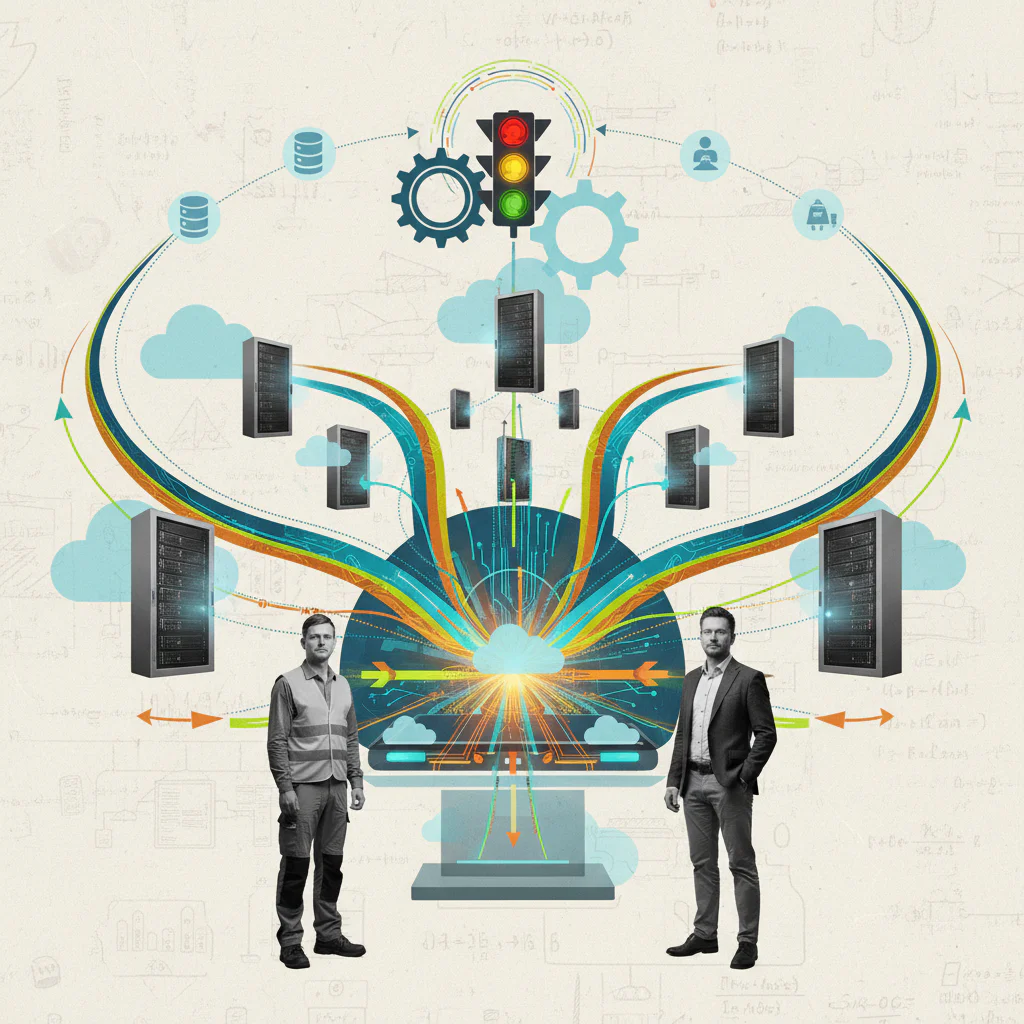
Stuck watching some servers idle while others choke? Understand the hidden dance that keeps a distributed system alive.
Imagine you are watching a dashboard where half the machines sit quiet while the rest gasp for CPU. The pattern feels like a secret choreography that no one invited you to learn. In many organizations the same rhythm plays out in meetings, handoffs and email threads. Someone owns a piece of the puzzle, passes it on, and the next person waits for a signal that never arrives. The result is a line of work that moves slower than the speed of thought, and a feeling that the system itself is holding its breath. I have spent years watching teams scramble to keep the lights on while the underlying flow of responsibility dissolves into invisible gaps. What you are feeling is the friction of a work system that pretends to be seamless but is actually stitched together by assumptions. In the next section we will look at how visibility, or the lack of it, shapes every handoff and why that matters for any group that must deliver across distance.
Why visibility decides the rhythm
When a server sits idle while another strains, the cause is often invisible. Without a clear view of how work moves, teams rely on guesswork, much like a conductor who cannot see the musicians. Real time dashboards, request tracing and simple health checks turn that hidden choreography into a visible map. The map lets you spot a bottleneck before it becomes a choke point and reassign work before a queue backs up. In practice, a team that added per request latency logs discovered that a single microservice was handling three times the load of its peers. By exposing that truth, they redistributed traffic and lifted overall throughput without adding hardware. Visibility is the first lever because it turns assumptions into data, and data into confidence.
What most get wrong about dynamic distribution
A common myth is that load balancing is a set and forget switch. Many assume that equal shares of traffic will keep every node happy, ignoring the fact that nodes differ in capacity, cache warm‑up and current load. Research published on ResearchGate explains that dynamic load balancing must continuously measure demand and adjust routes. Another misunderstanding is treating load balancing as a network concern only; the software layer also decides how tasks are split. When a team followed a static round robin rule, they saw a spike in latency as some nodes ran out of memory while others sat idle. The lesson is that true dynamism requires feedback loops that respect real world variation, not a static recipe.
How to move from guesswork to weighted pools
Weighted pools give each origin a share that reflects its real strength. Instead of sending every request to the next server in line, the balancer assigns a probability based on the weight you set. Cloudflare describes this as a way to honor differences in CPU, bandwidth or geographic proximity. To start, measure each node’s average response time and resource usage. Then assign higher weight to the faster, more capable nodes and lower weight to the slower ones. As traffic patterns shift, adjust the weights in small increments and watch the impact on latency. This approach replaces blind rotation with a calibrated dance, allowing the system to self tune as demand changes.
Why the visibility gap keeps reappearing
When work moves through informal handoffs, each participant records only what is immediately relevant. The lack of a shared ledger means ownership can slip, signals are missed, and bottlenecks remain hidden until they cause delay. Because the flow relies on assumptions rather than a common record, coordination breakdowns recur even when teams are diligent. A centralized work system supplies a single source of truth that captures assignments, status updates, and capacity signals in real time. By aggregating that data, the system makes gaps visible and aligns responsibility without requiring constant manual checks. In this context, Workhint serves as one example of such a system, providing the infrastructure that turns scattered signals into an observable workflow. The structural effect is that the pattern of invisible handoffs is replaced by a transparent, accountable network that naturally limits the recurrence of the problem.
At the beginning we asked what it feels like to watch a chorus of machines where some sit silent while others strain. The journey through visibility, myth and weighted pools shows that the answer is not a secret switch but a habit of turning what is hidden into what is known. When a team watches latency logs, watches the health of each node, and lets the balancer follow measured weight, the dance becomes a conversation rather than a guess. The lasting lesson is simple: a system that can see its own rhythm can choose its own steps. Carry that clarity into any handoff, any meeting, and you will find the breath returning to the work you lead. What will you make visible today?
Leave a Reply