


Partner onboarding works when every new partner knows the role, the route, the tools, and the first real milestone.
A partner onboarding checklist helps companies turn a signed partnership into productive work. That matters because partners are not employees, vendors, or customers. They sit between teams, systems, markets, and incentives. If onboarding is vague, partners get a folder of assets and no operating path. If onboarding is too heavy, momentum dies before the first referral, implementation, campaign, or customer handoff.
Partner ecosystems can be a serious growth lever, but they need structure. McKinsey notes that ecosystem strategies can create near-term benefits and long-term resilience, while Gartner’s market guide for partner and ecosystem relationship management points to the need for systems that help partners expand reach and orchestrate collaborative revenue models. The operating lesson is simple: partner success is not created by recruitment alone. It is created by the handoff into work.
What’s in this article?
- Why partner onboarding fails when it is treated as a content dump
- A practical partner onboarding checklist for external partners
- A workflow table showing owners, gates, and completion criteria
- Common mistakes that slow partner activation
- Where Workhint fits when partner onboarding needs to become a live operating system
Why partner onboarding matters
Strong partnerships depend on mutual value, clear ownership, and active coordination. Harvard Business Review’s classic article on collaborative advantage frames being a good partner as a corporate capability, not a nice-to-have. That is still true for channel partners, referral partners, implementation partners, service partners, affiliates, marketplace partners, and strategic collaborators.
The problem is that many onboarding programs focus on education but miss operations. The partner receives decks, training links, brand rules, and a portal login. But no one clarifies what the partner should do first, who approves activity, how support works, what data can be shared, where opportunities are tracked, when payments or commissions become eligible, or what “activated” means.
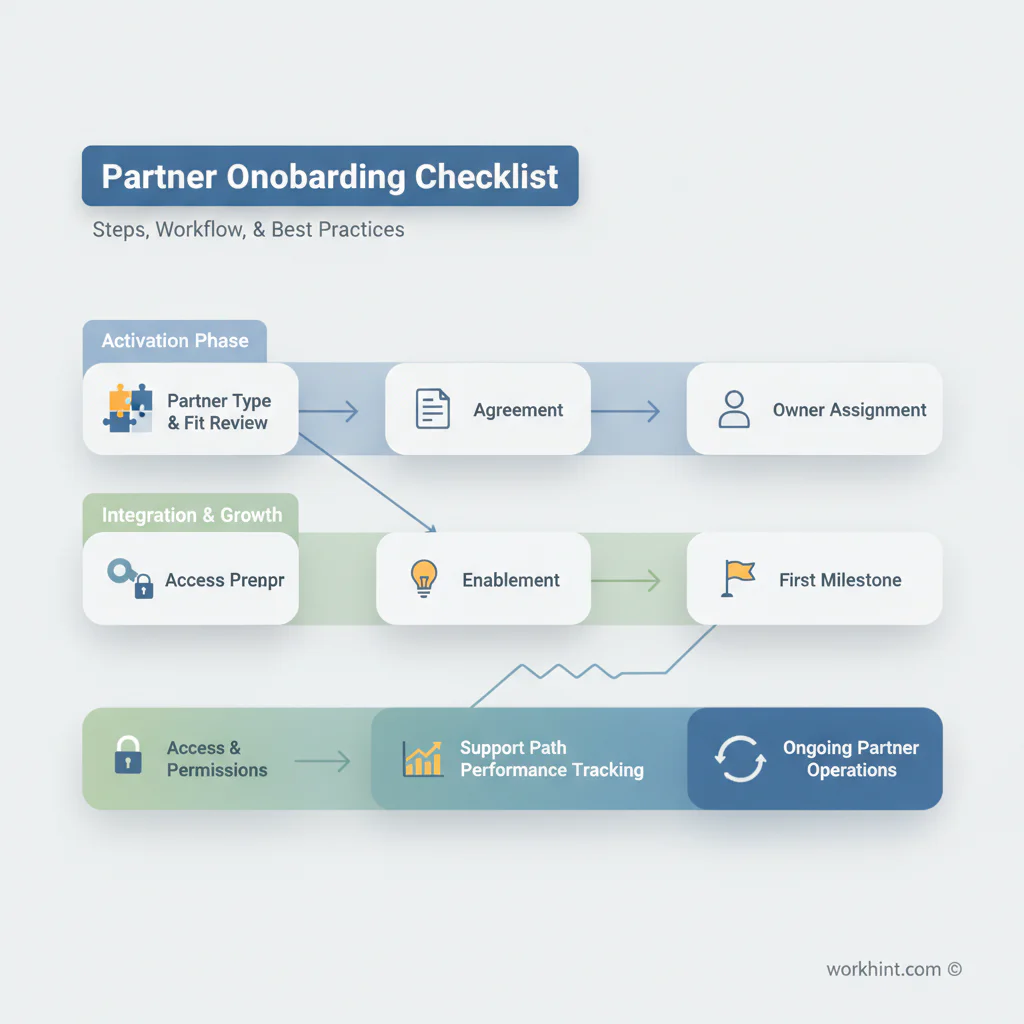
Partner onboarding checklist
The best partner onboarding checklist is not just a list of documents. It is a sequence of decisions and handoffs that prepares the partner to do useful work without constant internal chasing.
- Define the partner type. Confirm whether the partner is a referral partner, reseller, implementation partner, agency, service provider, affiliate, technology partner, or strategic ecosystem partner.
- Confirm fit and scope. Document the target customer, geography, service area, responsibilities, limits, and success criteria.
- Assign internal ownership. Name the partner owner, sales contact, operations contact, support route, and escalation owner.
- Complete agreement and compliance steps. Finalize the agreement, data-sharing terms, brand rules, payment or commission terms, and any required due diligence.
- Set role-based access. Give the partner only the systems, assets, forms, training, customer materials, and reporting views needed for their role.
- Deliver enablement by role. Match training to what the partner actually does: selling, referring, implementing, supporting, delivering, marketing, or integrating.
- Define the first milestone. Choose a concrete activation event such as first registered lead, first completed training, first co-sold opportunity, first customer project, or first approved campaign.
- Create the operating cadence. Set check-ins, reporting rhythm, issue handling, renewal points, and performance review dates.
- Track completion and blockers. Make onboarding status visible to both sides so missing agreements, access, training, or approvals do not hide in email.
- Transition into ongoing partner operations. Move the partner from onboarding into live work, reporting, payments, support, and improvement cycles.
Partner onboarding workflow table
| Stage | Owner | Required output | Completion signal |
|---|---|---|---|
| Partner fit review | Partnerships or growth | Partner type, market, use case, and success criteria | Approved onboarding path |
| Agreement and terms | Legal and finance | Signed agreement, payment terms, data rules, brand permissions | Partner cleared for activation |
| Access and enablement | Operations and partner owner | Portal access, assets, training, support channel, contact map | Partner can perform the first task |
| First milestone | Partner owner and partner lead | First referral, deal, campaign, implementation, or delivery milestone | Activation recorded |
| Ongoing operations | Partner operations | Reporting, issue handling, payments, reviews, improvement backlog | Partner managed as a live workstream |
Partner onboarding best practices
Current partner onboarding guides from companies such as Docebo and Magentrix consistently emphasize structure, training, partner portals, milestones, and ongoing enablement. Those are useful, but they work best when connected to a single operating path.
Start by segmenting partners. A reseller needs deal registration, pricing rules, objections, and sales motions. An implementation partner needs delivery standards, customer handoff rules, escalation paths, and project access. A referral partner needs simple qualification criteria and a fast submission process. A technology partner needs integration ownership, security review, documentation, and joint support rules.
Then make activation measurable. “Completed onboarding” should not mean the partner watched a video. It should mean the partner is ready to complete the first valuable action under the correct terms. For some partners, that action is a lead. For others, it is a customer kickoff, a service delivery task, a co-marketing launch, a certified specialist, or a shared workflow inside a customer account.
Common partner onboarding mistakes
- Using one checklist for every partner. Standardize the core controls, but adapt the path by partner type.
- Skipping internal ownership. Partners stall when they do not know who owns approvals, issues, or next steps.
- Granting broad access too early. Access should follow role, scope, and approved work.
- Confusing enablement with activation. Training is useful only if it leads to the first real partner action.
- Leaving payments and incentives vague. Commission, payout, referral fee, or project-payment rules should be clear before work begins.
- Failing to track blockers. Missing agreement terms, delayed access, unclear support paths, and incomplete training should be visible.
Where Workhint fits
Workhint fits when partner onboarding needs to become a live operating system instead of a static checklist. A company can use Workhint to structure partner intake, assign internal owners, route agreement approvals, collect required documents, control role-based access, manage partner tasks, track enablement, record the first milestone, and connect payment or commission status to approved partner activity.
That matters because partner onboarding usually crosses teams: partnerships, sales, legal, finance, operations, support, customer success, and the partner’s own team. Workhint helps turn those handoffs into visible workflows with statuses, permissions, assignments, reminders, reporting, and escalation paths. The checklist still matters, but the real value comes when the checklist runs the work.
FAQ
What should a partner onboarding checklist include?
A partner onboarding checklist should include partner type, scope, agreement status, owner assignments, access, enablement, support routes, first milestone, reporting cadence, payment or incentive terms, and transition into ongoing operations.
How long should partner onboarding take?
Simple referral partners may be ready in a few days. Resellers, implementation partners, service partners, and technology partners often need several weeks because agreements, training, access, customer handoffs, and support rules are more complex.
Who should own partner onboarding?
One partner owner should be accountable, but onboarding usually needs input from legal, finance, operations, sales, support, and customer success. The owner coordinates the workflow; they should not personally perform every step.
How do you measure partner activation?
Measure activation by the first meaningful partner outcome: first registered lead, first accepted referral, first certified user, first customer project, first integration milestone, first approved campaign, or first completed service delivery.
Is partner onboarding the same as vendor onboarding?
No. Vendor onboarding usually prepares a supplier to provide goods or services. Partner onboarding prepares an outside organization to collaborate on growth, delivery, customer success, technology, referrals, implementation, or shared operations.
Conclusion
A useful partner onboarding checklist does more than collect agreements and send training links. It defines the partner type, clarifies ownership, grants the right access, connects enablement to the first milestone, and turns the partner relationship into an operating workflow. When the process is visible and role-based, partners can move faster, internal teams can stay aligned, and the business can scale external collaboration without losing control.
Leave a Reply