


Continuous improvement only compounds when every useful idea has a path from signal to measurable operating change.
Continuous process improvement is the operating habit of finding friction, testing better ways of working, measuring results, and folding what works back into the system. The idea is not new, but many teams still treat improvement as a workshop, a quarterly initiative, or a manager’s side project. That is why good ideas disappear after meetings and the same operational problems return next month.
A useful improvement system is more concrete. It defines where problems are captured, how ideas are prioritized, who owns each experiment, what data proves progress, and how successful changes become the new default.
What’s in this article?
- What continuous process improvement means in daily operations
- The operating loop that turns ideas into measurable change
- A practical workflow for prioritizing and testing improvements
- A simple scorecard teams can use to choose the next improvement
- Where Workhint fits when improvement needs to become a live system
Why continuous process improvement matters
The American Society for Quality describes continuous improvement as ongoing improvement of products, services, or processes through incremental and breakthrough efforts. In operations, that means problems do not wait for an annual transformation plan. They become visible inputs to a regular system.
This matters because most operational drag is not dramatic. It looks like repeated handoff confusion, approvals sitting too long, rework caused by unclear requirements, inconsistent onboarding, or teams measuring output without measuring flow. Individually, each issue can feel small. Together, they slow delivery, hide ownership, and make scaling harder.
Continuous process improvement gives teams a way to turn those signals into repeatable learning. Atlassian frames continuous improvement around performance analysis, opportunity identification, and incremental change. Asana’s process improvement guidance similarly emphasizes defining the problem, mapping the current process, analyzing causes, testing solutions, and monitoring results. The shared lesson is clear: improvement has to be designed as a cycle, not a suggestion box.
The continuous process improvement loop
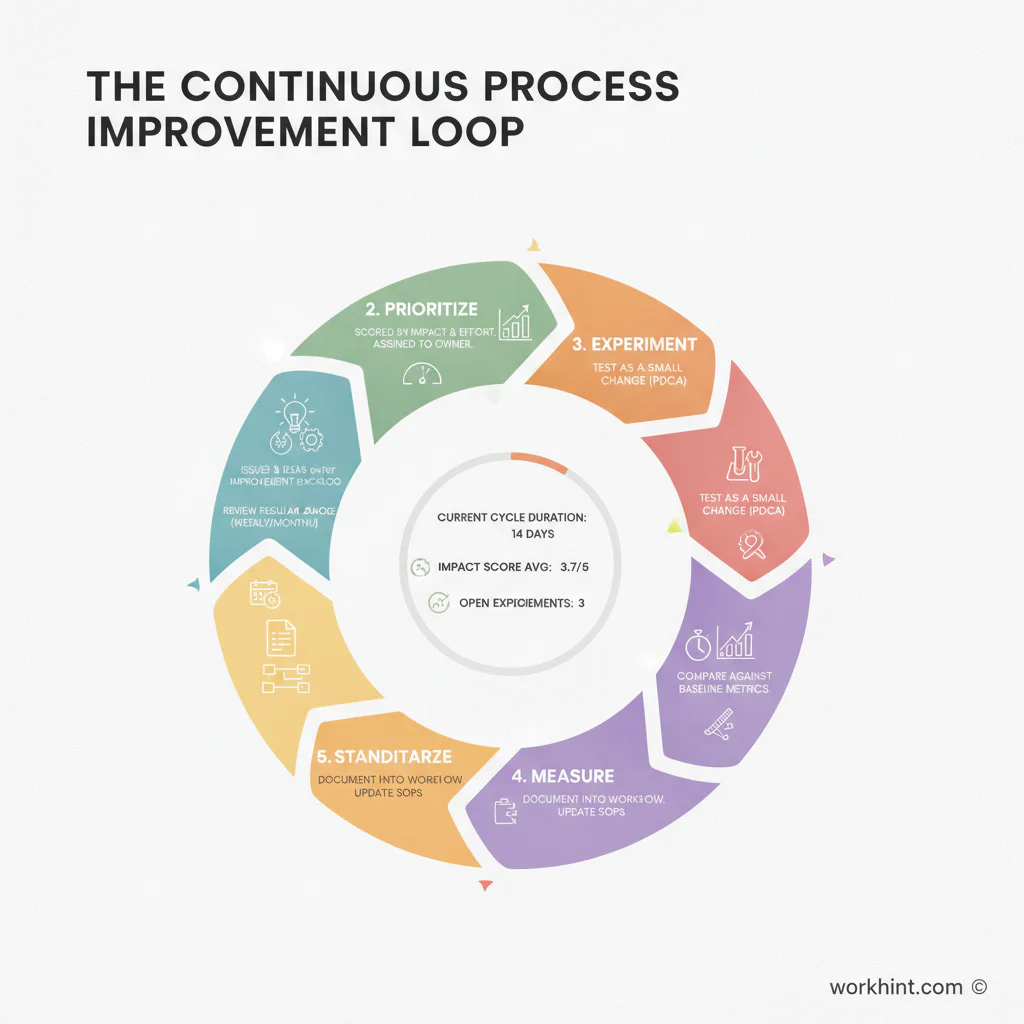
A strong continuous process improvement system has six linked parts. If one part is missing, the loop breaks.
| System part | Purpose | Operational question |
|---|---|---|
| Signal intake | Capture problems, ideas, delays, customer issues, and team observations | Where does improvement work enter the system? |
| Baseline | Measure the current state before changing the process | What are we trying to improve? |
| Prioritization | Choose the highest-value improvement work | Which change matters most now? |
| Owner and experiment | Assign responsibility and test a narrow change | Who will run the test, by when, and with what guardrails? |
| Measurement | Compare results against the baseline | Did the change improve speed, quality, cost, or experience? |
| Standardization | Update the workflow, SOP, automation, role, or dashboard | How does the improvement become the new normal? |
This loop separates improvement from opinion. Teams can still use judgment, but decisions are anchored in a baseline, a limited test, and evidence.
How to build the system
1. Create one intake path for improvement signals
Start by defining the signals the system should accept: customer complaints, missed handoffs, manual workarounds, repeated questions, approval delays, quality defects, compliance concerns, and team suggestions. Use one intake path so the team can see patterns.
2. Require a baseline before debating solutions
Before choosing a fix, ask for the current number. That might be cycle time, error rate, backlog size, wait time, rework count, response time, cost per transaction, or percentage of work missing required information. A baseline only needs to be good enough to compare before and after.
3. Score improvements by impact, effort, and risk
Not every improvement deserves immediate attention. Use a simple scoring model: expected business impact, implementation effort, customer or team pain, risk of doing nothing, and confidence in the proposed change. This keeps loud issues from automatically beating important issues.
4. Assign one accountable owner
Improvement work often fails because everyone agrees and nobody owns. Each test needs one accountable owner, a target date, a scope, and a success measure.
5. Run small tests before rewriting the whole process
The classic PDCA cycle, Plan, Do, Check, Act, is useful because it favors controlled learning over big-bang change. Plan the test, run it on a limited scope, check the result, and act on the evidence. A small test might change one handoff rule, approval threshold, intake form, or dashboard metric.
6. Standardize what works
The improvement is not complete when the experiment succeeds. It is complete when the process changes. Update the SOP, workflow stage, role assignment, automation rule, escalation path, training material, or dashboard.
A practical improvement scorecard
Use this scorecard in a weekly or biweekly operations review. Score each item from 1 to 5, then prioritize the highest total with a realistic owner.
| Criteria | Score 1 | Score 5 |
|---|---|---|
| Business impact | Minor inconvenience | Revenue, customer, compliance, or capacity impact |
| Frequency | Rare edge case | Happens every week or every cycle |
| Effort | Requires major rebuild | Can be tested with a small workflow change |
| Confidence | Unclear cause | Cause and proposed test are clear |
| Adoption likelihood | High behavior change required | Fits naturally into existing work |
Common mistakes to avoid
- Starting with tools instead of process. Automation helps only after the team understands the flow, owner, rule, and metric.
- Collecting ideas without closing the loop. People stop contributing when they never see decisions, tests, or outcomes.
- Improving everything at once. Too many parallel changes make it hard to know what worked.
- Skipping frontline input. PMI’s continuous improvement practices emphasize sharing and capturing improvements through the people doing the work. Operators often see friction before leaders see it in reports.
- Measuring activity instead of outcomes. Counting completed initiatives is less useful than measuring cycle time, error reduction, throughput, quality, cost, or customer experience.
Where Workhint fits
Workhint fits when continuous process improvement needs to move from a document into a live operating system. A team can use Workhint to structure improvement intake, define roles and permissions, assign experiment owners, route approvals, connect supporting documents, track due dates, surface dashboards, and automate follow-up when an improvement stalls.
The value is not that Workhint replaces judgment. It helps teams operationalize judgment. Instead of leaving ideas in scattered notes, the workflow can capture the signal, route it to the right owner, collect baseline data, record the test, and make the approved change part of the actual work system.
FAQ
What is continuous process improvement in business operations?
Continuous process improvement is the ongoing practice of finding, testing, measuring, and standardizing better ways to run business processes. It focuses on making work more reliable, scalable, and measurable over time.
How often should teams review process improvements?
Most operational teams should review improvement work weekly or biweekly. The cadence should be frequent enough to keep work moving but not so frequent that teams discuss the same items without new evidence.
Who should own continuous process improvement?
Ownership depends on the process. A COO, operations leader, service manager, product operations lead, or business systems owner may own the overall system, but each improvement test should have one accountable owner close to the work.
What metrics should a continuous improvement system track?
Useful metrics include cycle time, wait time, rework, error rate, throughput, backlog size, cost per unit, customer response time, SLA performance, and adoption of the new process.
When should process improvement be automated?
Automate after the team understands the rule, handoff, exception, and success measure. Automating a broken or unclear process usually makes the confusion faster, not better.
Conclusion
Continuous process improvement works when it becomes part of how the business operates. Capture signals in one place, measure the current state, prioritize the right changes, assign clear owners, run small tests, and standardize what works.
The strongest improvement systems are practical, visible, and repeatable. They do not depend on heroic managers remembering every issue. They give the business a reliable way to turn operational friction into better execution.
Leave a Reply