


An operating rhythm turns scattered meetings into a repeatable system for decisions, ownership, and follow-through.
An operating rhythm is the cadence a company uses to review work, make decisions, remove blockers, and keep execution connected to business goals. It is not just a meeting calendar. A useful rhythm defines what gets reviewed daily, weekly, monthly, and quarterly; who owns each conversation; what data matters; and how decisions turn into action.
Companies usually notice the need when work starts drifting. Priorities change without context. Dashboards exist but nobody acts on them. Meetings multiply, yet decisions still happen in side conversations. The answer is not more meetings. The answer is a clearer work system.
What’s in this article?
- What an operating rhythm is and why it matters
- A practical operating cadence template
- How to choose metrics, owners, and decision rights
- Common mistakes that make rhythms feel like meeting theater
- Where Workhint fits when the rhythm becomes a live operating system
Why operating rhythm matters
Work becomes scalable when teams know where information enters, where decisions happen, who owns follow-up, and how unresolved issues move forward. The ISO quality management guidance explains that predictable results improve when activities are managed as interrelated processes that function as a coherent system. The same principle applies to operating cadence: each review should connect to the next.
A good rhythm gives the business a regular way to answer four questions: what changed, what is blocked, what decision is needed, and who is accountable before the next review. Without that structure, leaders see lagging indicators too late while operators handle exceptions through chat, spreadsheets, and personal follow-up.
Operating cadence template
Meeting cadence is the schedule. Operating rhythm is the management system around the schedule. Start with the few rhythms that control execution, then define the inputs, owners, outputs, and follow-through for each one.
| Cadence | Primary question | Inputs | Output |
|---|---|---|---|
| Daily or twice weekly | What needs attention now? | Open work, blockers, urgent exceptions | Owner assigned, blocker removed, escalation created |
| Weekly operating review | Are we on track this week? | Scorecard, workload, SLA misses, capacity | Decisions, reprioritized work, action owners |
| Monthly business review | What trend needs correction? | KPIs, customer outcomes, cost, quality, cycle time | Improvement priorities and process changes |
| Quarterly planning | What should change next quarter? | Strategy, capacity, constraints, lessons learned | Goals, operating changes, owners, measurement plan |
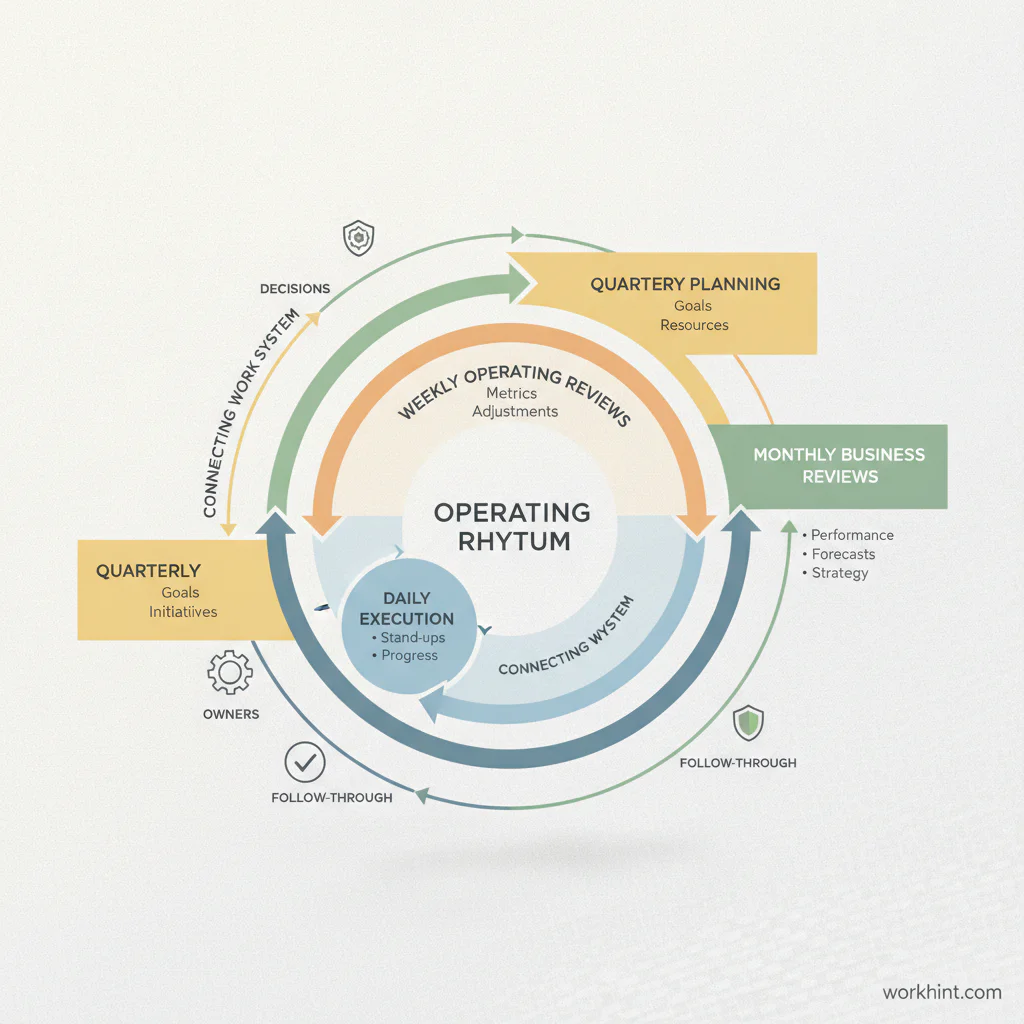
The Weekly Business Review concept is popular because it forces teams to look at customer experience, business performance, and goal progress on a consistent cycle. The Working Backwards summary of Amazon’s operating cadence describes the WBR as a weekly exercise built around those questions. You do not need to copy Amazon’s format, but the discipline is useful: use a recurring review to turn data into decisions.
How to build an operating rhythm
1. Define the work system. Decide what work the rhythm governs. A revenue team, field operation, hiring operation, customer implementation process, vendor network, or internal service desk may each need a different rhythm.
2. Choose the operating questions. Do not start with meetings. Start with questions. Are requests aging? Is capacity overloaded? Which commitments are at risk? Which approvals are stuck? Which decisions are blocking progress?
3. Assign owners before assigning meetings. Each rhythm needs a process owner. Each metric needs a metric owner. Each action needs a person accountable for completion. PMI’s governance standard points to the need for consistent governance across portfolios, programs, and projects; rhythm makes that governance visible at the operating level.
4. Build a scorecard. Use a small set of metrics that reveal whether work is moving. Good options include cycle time, aging work, SLA misses, approval time, handoff delays, rework, customer impact, capacity load, and decision aging.
5. Create a decision log. Capture the decision, owner, date, rationale, affected workflow, and next review point. This creates continuity when people miss meetings or teams change.
6. Connect follow-through to the next cadence. Every unresolved daily action should be visible in the weekly review. Every weekly pattern should roll into the monthly review if it signals a systemic issue. Every monthly trend should influence quarterly planning if it changes capacity, roles, or priorities.
What to measure
The best operating rhythm measures flow, quality, accountability, and capacity. Flow metrics show whether work is moving. Quality metrics show whether work is being done correctly. Accountability metrics show whether decisions and actions are closing.
- Flow: cycle time, queue time, request age, handoff time, throughput
- Quality: defects, rework, customer complaints, exception rate, audit findings
- Accountability: open decisions, overdue actions, ownerless work, unresolved escalations
- Capacity: workload by role, utilization, backlog, forecasted demand
Atlassian’s guidance on meeting cadence points to recurring reminders and captured action items as practical ways to manage meeting work. In an operating rhythm, those basics sit inside a broader system of metrics, ownership, and decision follow-up.
Common mistakes
- Reviewing everything at the same frequency. Urgent blockers need a short cycle. Strategic tradeoffs need more context.
- Using dashboards without owners. A metric without an accountable owner becomes decoration.
- Letting status updates dominate. Use rhythm meetings for exceptions, decisions, tradeoffs, and accountability.
- Failing to close the loop. If actions do not come back in the next review, follow-through becomes optional.
- Copying another company’s cadence exactly. Borrow the idea, then fit it to your risk, pace, team size, and operating model.
Where Workhint fits
Workhint fits when an operating rhythm needs to become more than a calendar and dashboard. A team can use Workhint to turn the rhythm into a live work system: intake for issues and requests, role-based ownership, recurring review workflows, decision logs, approvals, escalations, task assignments, dashboards, and reporting.
That matters when the cadence crosses functions. A weekly operating review may involve operations, finance, customer success, product, HR, vendors, or field teams. Workhint helps connect the rhythm to the underlying work: what changed, who owns the next action, which approvals are waiting, what remains blocked, and which metrics need review before the next cycle.
FAQ
What is an operating rhythm?
An operating rhythm is the recurring cadence of reviews, decisions, metrics, and follow-up that a team uses to manage work. It helps people know when work is reviewed, where decisions happen, and who owns the next action.
What is the difference between operating rhythm and operating cadence?
Operating cadence usually refers to the timing of recurring reviews. Operating rhythm includes the cadence plus the inputs, owners, metrics, decision rules, escalations, and follow-through system around those reviews.
How often should operating reviews happen?
Use the pace of the work to choose the cadence. Fast-moving operational issues may need daily checks. Most teams benefit from a weekly operating review, monthly business review, and quarterly planning reset.
Who owns the operating rhythm?
A senior operator, founder, COO, program leader, department head, or process owner should own the rhythm. Individual metrics and actions should have named owners.
What should be included in a weekly operating review?
Include a small scorecard, open blockers, missed commitments, aging work, key decisions, capacity concerns, escalations, and unresolved actions from the previous review.
Conclusion
An operating rhythm is how a business turns recurring attention into reliable execution. Build it around the questions that matter, give every metric and action an owner, connect each cadence to the next, and review the system when it stops helping work move. The goal is not to meet more often. The goal is to make work easier to see, decide, and complete.
Leave a Reply