


A contractor agreement works best when it protects the relationship and gives operations a clear path to run the work.
An independent contractor agreement template helps a business define the terms of work before a freelancer, consultant, agency, or specialist starts. The document should clarify scope, payment, ownership, confidentiality, contractor status, and what happens when the engagement changes or ends.
This guide is not legal advice. Use it as an operator-ready checklist, then have counsel adapt it for your state, industry, risk level, and contractor model. Worker classification is fact-specific. The IRS says businesses should consider evidence of control and independence across behavioral control, financial control, and the relationship of the parties.
What’s included
- A practical independent contractor agreement template checklist
- The clauses most business teams should review before work starts
- A simple workflow for turning the agreement into an operational process
- Common mistakes that create scope, payment, IP, and classification problems
- FAQ for business teams using contractor agreements
How to use this resource
Start by deciding what kind of contractor relationship you are creating. A one-time design project, a monthly advisory retainer, a field service engagement, and a long-running technical implementation need different levels of detail. Use the checklist below to gather the business terms before drafting the final document.
Do not use the agreement to disguise an employment relationship. The U.S. Department of Labor’s independent contractor rule FAQs describe a totality-of-the-circumstances economic reality test under the FLSA. State rules may add more requirements.
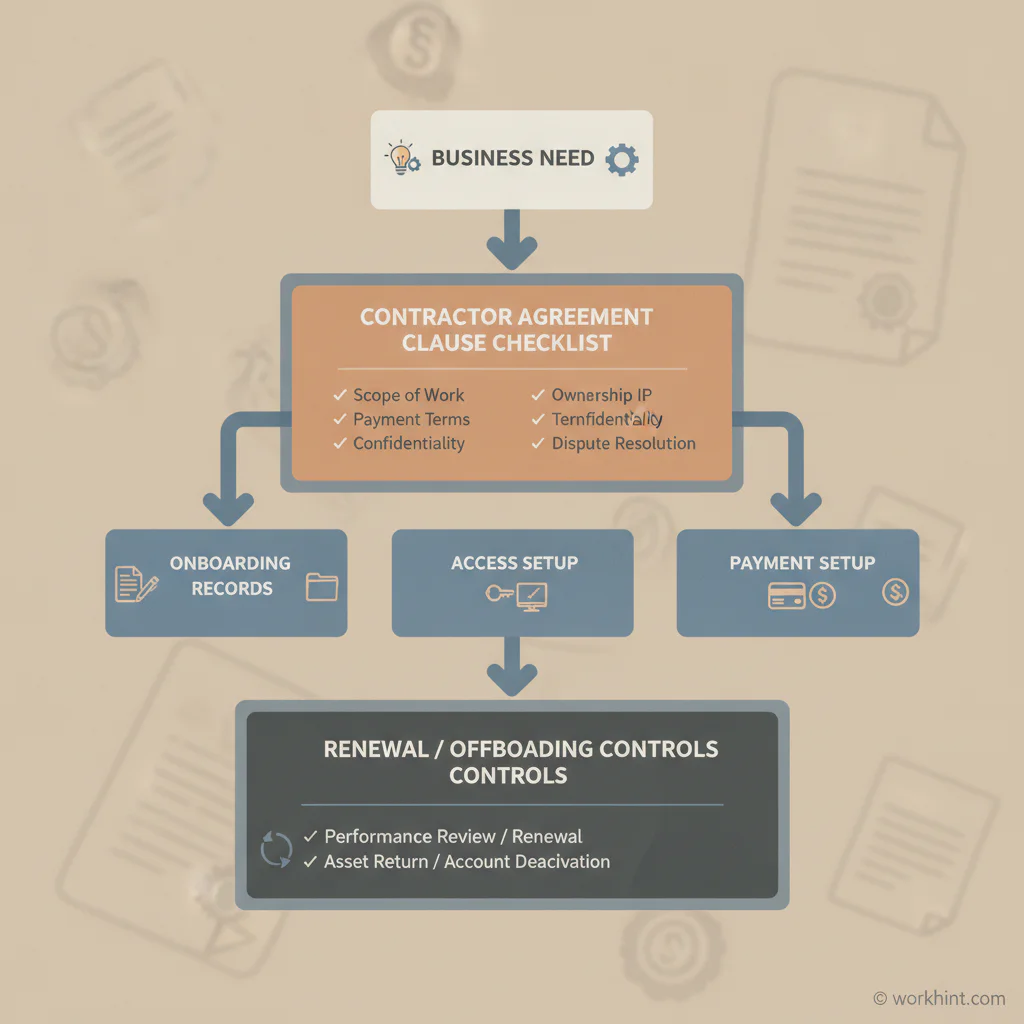
Independent contractor agreement template checklist
A strong template should answer the questions a finance, legal, operations, manager, and contractor team will ask later.
| Section | What to include | Why it matters |
|---|---|---|
| Parties | Legal names, entity types, start date, and contact owners | Prevents confusion about who is bound by the agreement |
| Services | Work description, deliverables, milestones, tools, and exclusions | Reduces scope creep and unclear handoffs |
| Contractor status | Independent business language, tax responsibility, no benefits, and control boundaries | Supports the intended relationship but does not replace proper classification analysis |
| Payment | Rate, fee, retainer, milestones, invoicing cadence, expenses, currency, and payment method | Gives finance a clear payment record |
| Confidentiality | Confidential information, permitted use, survival period, and return or destruction rules | Protects business, customer, product, and operational information |
| Intellectual property | Work product, background IP, licenses, portfolio use, and assignment language | Clarifies who owns what after delivery |
| Security and access | System access, data handling, device rules, credentials, and incident reporting | Connects the contract to real operating risk |
| Changes | Change request process, approval owner, pricing impact, timeline impact, and written approval | Stops informal scope changes from becoming disputes |
| Termination | Notice period, cause, final invoice rules, unfinished work, and return of materials | Makes exit predictable for both sides |
| Records | Signed agreement, tax form, insurance certificates, licenses, approvals, and payment records | Helps operations, finance, and compliance find evidence later |
Sample agreement structure
Use this structure as a drafting map. Replace bracketed areas with your actual terms and review the final version with counsel.
- Introduction: Identify the client, contractor, effective date, and purpose of the engagement.
- Services: State what the contractor will provide, what is excluded, and which SOW or project brief controls detailed scope.
- Deliverables and acceptance: Define outputs, due dates, review windows, revision limits, and acceptance criteria.
- Compensation: List fees, invoicing rules, expenses, taxes, payment timing, and payment triggers.
- Independent contractor relationship: Clarify control boundaries and state that the contractor is not eligible for employee benefits.
- Confidentiality and data protection: Limit information use to the engagement and define return or deletion obligations.
- Intellectual property: Address work product ownership, pre-existing materials, third-party materials, and licenses.
- Compliance and insurance: Add role-specific requirements such as licenses, insurance, safety rules, or customer policies.
- Term and termination: Define duration, notice, termination rights, transition support, and final payment process.
- Governing law and signatures: Specify governing law, dispute path, signature method, and signers.
Documents to collect before work starts
The agreement is only one part of contractor readiness. For U.S. contractors, the IRS says Form W-9 is used to provide a correct taxpayer identification number to the person required to file an information return. Depending on the role, you may also need insurance, certifications, banking details, security acknowledgments, signed policies, data terms, or an onboarding form.
If the contractor will create copyrightable work, do not assume ownership transfers automatically. Under 17 USC 204, a transfer of copyright ownership generally needs a written, signed instrument or memorandum from the owner of the rights conveyed. IP language should be explicit.
Example workflow for business teams
- Confirm classification fit. Review whether the role should be contractor work before drafting.
- Collect business terms. Gather scope, milestones, payment terms, owner, access needs, risk, and duration.
- Draft from the approved template. Use the approved base agreement and attach a statement of work when scope is detailed.
- Route for approval. Send higher-risk, higher-value, regulated, or unusual engagements to review.
- Collect signatures and records. Store the agreement, tax form, insurance, approvals, and onboarding records in one place.
- Connect execution. Create assignments, access, reporting, payment status, milestones, and renewal reminders.
Common mistakes
- Using one template for every engagement. A field contractor, software developer, consultant, and creative freelancer carry different risks.
- Leaving scope vague. Define deliverables, review windows, and what is out of scope.
- Ignoring classification reality. Contract language helps document intent, but the real working relationship still matters.
- Forgetting access and data rules. The agreement should connect to system, customer data, credential, and device controls.
- Not tracking renewals and end dates. Open-ended contractor relationships can create budget, access, and compliance drift.
- Missing IP details. Clarify ownership of new work, existing materials, reusable components, and portfolio permissions.
Where Workhint fits
Workhint fits after the template is approved and the business needs to run the contractor process consistently. A team can use Workhint to turn the agreement checklist into intake fields, approval routing, document collection, role-based access, onboarding tasks, milestone tracking, payment status, renewal reminders, and offboarding steps. For compliance-sensitive contractor resources, contractor compliance software can organize classification checks, required documents, approvals, renewals, and audit trails.
That is useful when contractor work spans multiple teams, locations, projects, customers, or payment paths. The agreement defines the relationship. Workhint helps digitize the operating system around it so records, approvals, assignments, and follow-ups do not live in scattered emails and spreadsheets.
FAQ
What is an independent contractor agreement?
It is a written contract between a business and a self-employed person or entity. It defines services, payment, contractor status, confidentiality, ownership, term, termination, and other working terms.
Is an independent contractor agreement enough to prove someone is not an employee?
No. A written agreement is useful evidence, but classification depends on the real working relationship. Review federal, state, and local rules when status is uncertain.
What should be included in a contractor agreement template?
Most templates should include parties, scope, deliverables, payment, contractor status, confidentiality, IP ownership, security rules, change control, termination, governing law, signatures, and required records.
Do I need a statement of work too?
Use one when the project has detailed deliverables, milestones, acceptance criteria, or changing scope. The main agreement can hold stable terms while the SOW handles project-specific terms.
Should contractor agreements include payment milestones?
For project work, milestones are often clearer than open-ended hourly billing. Tie payment to a deliverable, acceptance event, retainer period, or approved invoice.
Conclusion
An independent contractor agreement template should do more than fill a legal form. It should define the business relationship clearly enough that legal, finance, operations, managers, and contractors can run the work without guesswork. Start with the clause checklist, adapt it to the real engagement, verify classification risk, and connect the signed agreement to the onboarding, access, payment, and offboarding workflow that follows.
Leave a Reply