


You can test a laundry pickup and delivery business before buying machines, hiring staff, or leasing a storefront.
A laundry pickup and delivery business is attractive because people do not want to lose time washing, folding, and transporting laundry.
The old way to enter the laundry industry was to buy equipment, lease a laundromat, hire attendants, and hope volume arrived. A leaner way is to launch the customer-facing platform first, recruit independent wash-and-fold providers or laundromat partners, and validate repeat demand before investing in owned equipment.
This guide explains how to start a laundry pickup and delivery business with minimal upfront investment, price it, find first customers, and use Workhint as the branded operating system.
What’s in this article?
- Why a laundry pickup and delivery business works
- What you need to launch without overinvesting
- How to price pickup, wash-and-fold, delivery, and add-ons
- How to get first customers and validate demand
- How Workhint helps launch the operating platform
- A first 7-day launch plan, checklist, and FAQ
Why this business works
A laundry pickup and delivery business sells time back to customers. Busy professionals, families, apartment residents, students, short-term rental hosts, salons, gyms, and small businesses all create recurring laundry needs.
The strongest version is a platform where customers request pickup, set preferences, approve pricing, track orders, pay online, and receive clean folded laundry on schedule.
The platform-first model reduces risk. Instead of buying commercial machines on day one, you coordinate demand, routes, communication, and fulfillment. Independent providers, laundromat partners, or contractors handle washing and folding while you own the customer relationship.
Customers buy convenience and predictability. Providers join because the platform brings paid orders, clear instructions, scheduled pickups, and payouts without requiring them to run marketing alone.
What you need to launch
You do not need a laundromat to validate the business. You need a tight first market, a clear service promise, a branded customer platform, a provider network, and a simple fulfillment process.
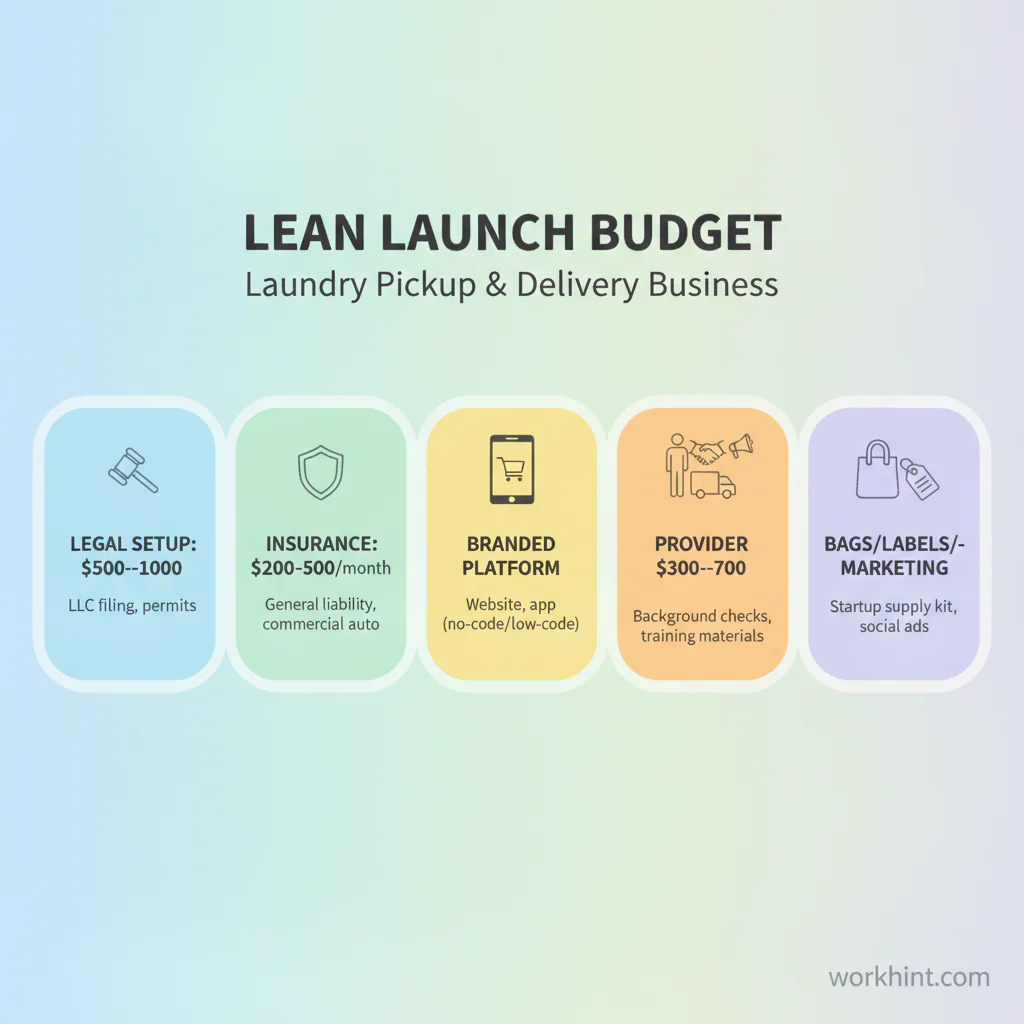
Start with one city zone. Pick a first offer such as weekly wash-and-fold pickup for households, recurring linen service for small businesses, or pickup laundry for apartment communities. Keep it narrow so routing and quality control stay manageable.
Check local rules before launch. You may need registration, sales tax setup, commercial auto coverage, liability insurance, laundry care policies, and terms for damaged or lost items. Document standards for detergents, separation, turnaround time, packaging, and photo confirmation.
| Launch item | Lean startup range | Why it matters |
|---|---|---|
| Registration and legal setup | $100-$800 | Creates the entity and tax setup. |
| Insurance | $300-$1,500 initial | Protects against liability and delivery risk. |
| Brand and local landing page | $100-$750 | Lets customers request pickup. |
| Branded Workhint platform setup | Variable | Runs intake, scheduling, payments, and reporting. |
| Provider onboarding | $100-$500 | Builds the first fulfillment network. |
| Bags, tags, labels, and packaging | $150-$600 | Keeps orders organized and trackable. |
| Local marketing tests | $200-$1,000 | Validates demand before larger investments. |
Owned vans, commercial machines, lockers, storefronts, and employees can come later. They are not the first proof that the business works.
How to price it
Most laundry pickup and delivery businesses price around pounds, bags, subscriptions, delivery fees, and add-ons. The best model pays providers, covers route time, replaces supplies, and leaves margin.
Start with simple packages. Per-pound pricing works for flexible order sizes. Per-bag pricing is easier for households. Subscriptions create recurring revenue. Business accounts may need custom pricing.
| Pricing model | Example | Best for |
|---|---|---|
| Per pound | $1.75-$2.75 per pound, with a minimum order | Households with variable laundry volume. |
| Per bag | $35-$55 per standard bag | Customers who want predictable pricing. |
| Weekly subscription | $129-$249 per month based on pickup frequency | Recurring household or professional customers. |
| Business account | Custom weekly rate by pound, bag, or item type | Salons, gyms, spas, clinics, and short-term rental operators. |
| Add-ons | Rush turnaround, hypoallergenic detergent, hang-dry, ironing | Margin expansion and customer preference handling. |
Protect the minimum order. Set a minimum charge, cluster service areas by day, and avoid same-day promises before route density exists.
How to get first customers
The fastest first customers usually come from dense local demand sources: apartment buildings, parent groups, neighborhood associations, coworking spaces, gyms, salons, Airbnb hosts, college housing, and busy professionals in a tight delivery radius.
Sell the outcome, not the logistics: weekly laundry pickup, wash, fold, and delivery in 48 hours with online scheduling and payment.
Use direct outreach before ads. Contact property managers, local businesses, and community groups. Offer a limited launch route for the first 20 customers and route every booking through the platform.
How Workhint helps launch it
Workhint can act as the branded platform and operating foundation before you invest in custom software, multiple tools, or owned laundry infrastructure.
A customer visits your branded portal, chooses pickup laundry, enters address, bag count, preferences, turnaround needs, and special instructions. Workhint routes the request to your dashboard, calculates the quote, collects approval, and schedules pickup.
On the provider side, you can invite wash-and-fold providers, laundromat partners, drivers, or contractors with role-based access. Each order can include preferences, pickup windows, checklists, status updates, photos, delivery confirmation, payment, and payout tracking.
The owner sees one operating system: requests, providers, routes, overdue orders, customer messages, payments, reviews, and reporting. That makes the first version feel organized while the team is still small.
The advantage is speed. You can launch as a real branded business, validate demand, and build a provider network before committing to vans, equipment, storefronts, or full-time staff.
First 7-day launch plan
- Day 1: choose the first market, customer type, and service promise.
- Day 2: set up the branded Workhint platform basics.
- Day 3: create pricing, quote approval, scheduling, payment, and payout flows.
- Day 4: recruit the first independent providers or laundromat partners.
- Day 5: contact apartments, local groups, small businesses, and busy professionals.
- Day 6: route early requests through the platform.
- Day 7: review demand, route density, provider quality, and pricing.
The goal of the first week is proof. If customers book, providers fulfill, and margins survive delivery time, you have a business worth improving.
Final launch checklist
- Choose a narrow first customer segment and service area.
- Register the business and check local laundry, delivery, and tax requirements.
- Define wash-and-fold standards, turnaround time, minimum order, and damage policy.
- Configure the branded Workhint platform for intake, scheduling, provider assignment, payments, and payouts.
- Recruit independent providers or partner laundromats before accepting volume.
- Create bags, labels, customer instructions, and order tracking rules.
- Launch direct outreach to apartments, local groups, professionals, and small businesses.
- Validate demand before buying vehicles, machines, lockers, or a storefront.
FAQ
How much does it cost to start a laundry pickup and delivery business?
A lean launch starts with setup, insurance, brand, platform, provider onboarding, bags, labels, and local marketing tests. Costs rise sharply if you buy machines, vehicles, lockers, or a storefront before proving demand.
Do I need to own a laundromat?
No. You can start by coordinating customers, pickup, delivery, and fulfillment through independent providers or laundromat partners. Owning equipment can come later if order volume justifies it.
What licenses do I need?
Requirements vary by location. Check business registration, sales tax, local service rules, insurance, commercial auto coverage, and rules for operating from home or handling customer property.
How should I price pickup and delivery laundry?
Use a model customers understand: per pound, per bag, recurring subscription, business account pricing, or add-ons. Include a minimum order so short routes and small loads do not destroy margin.
Can independent contractors do the laundry?
They can be part of the model if local law, insurance, quality standards, and contractor classification rules are handled properly. Use clear onboarding, written standards, checklists, and payout rules.
Who are the best first customers?
Good first targets include apartment residents, busy professionals, families, students, Airbnb hosts, salons, gyms, clinics, and businesses with recurring laundry needs.
When should I buy equipment or a vehicle?
After demand is proven. Buy assets when customer volume, route density, and provider capacity show that ownership will improve margin or reliability.
Conclusion
A laundry pickup and delivery business can launch as a modern service platform instead of a capital-heavy laundry operation. Start with demand, not equipment. Build the branded customer experience, recruit reliable providers, test pricing, and route real orders through an operating system.
Workhint makes that approach practical by giving the business a branded platform for customer requests, scheduling, provider coordination, payments, payouts, and reporting from the beginning. That lets you validate the opportunity before investing like a traditional laundry company.
Leave a Reply