


Contractor invoices move faster when approval starts with accepted work, clear owners, and payment-ready records.
A contractor invoice approval workflow is the process a business uses to review, validate, approve, dispute, and release contractor invoices for payment. For external teams, the invoice has to connect to the contractor record, statement of work, accepted deliverables, tax documentation, budget ownership, and payment terms.
When that structure is missing, finance chases managers, contractors chase finance, approvals sit in inboxes, and the company loses a clean audit trail. It is a shared workflow that makes every invoice answer the same questions before money moves: who did the work, what was accepted, what is billable, who owns approval, and what happens if something does not match?
What’s in this article?
- A practical contractor invoice approval workflow.
- The roles that should own each approval step.
- A checklist for validating invoices before payment.
- Common mistakes that slow payment or create risk.
- Where Workhint fits when contractor invoice approval needs to become a repeatable system.
Why contractor invoice approval matters
Contractor invoices sit at the intersection of workforce operations and finance. They are evidence that external work was delivered under agreed terms, usually governed by a contract, statement of work, milestone schedule, hourly limit, expense policy, or purchase approval.
Tax and compliance records matter too. The IRS guidance on forms for independent contractors explains that businesses should collect Form W-9 after determining a payee is an independent contractor, and the IRS also explains when businesses may need to report payments to independent contractors. This is not legal or tax advice, but it is a reminder that invoice approval should not be disconnected from the contractor record.
The same principle appears in formal procurement environments. Acquisition.gov’s payment documentation guidance says invoice review should determine whether claimed items and amounts are consistent with contract terms and prudent business transactions. The operating idea is useful: approve invoices against the agreement and the work, not against memory.
Contractor invoice approval workflow
A strong contractor invoice approval workflow has six stages. Owners may vary by company size, but the logic should stay consistent.
| Stage | Primary owner | What to verify |
|---|---|---|
| 1. Contractor record check | Operations or HR | Approved contractor, signed agreement, tax/payment details, active engagement, correct entity. |
| 2. Invoice intake | Finance or AP | Invoice number, dates, billing period, currency, payment terms, required fields, duplicate status. |
| 3. Scope match | Project owner | Invoice matches statement of work, purchase approval, milestone, hourly cap, or agreed rate. |
| 4. Work acceptance | Manager or requester | Deliverables, hours, expenses, or milestones were reviewed and accepted. |
| 5. Exception handling | Operations and finance | Missing records, disputed hours, over-budget items, unapproved expenses, wrong billing period. |
| 6. Payment readiness | Finance | Final approval, coding, due date, payment method, withholding or reporting flags, audit trail. |
This structure also gives contractors a better experience. They can see whether an invoice is received, under review, waiting on approval, disputed, approved, or scheduled for payment. Oracle’s project contract invoice workflow documentation describes a similar model where assignees approve, reject, or request more information, then the invoice status changes. Status visibility reduces follow-up noise.
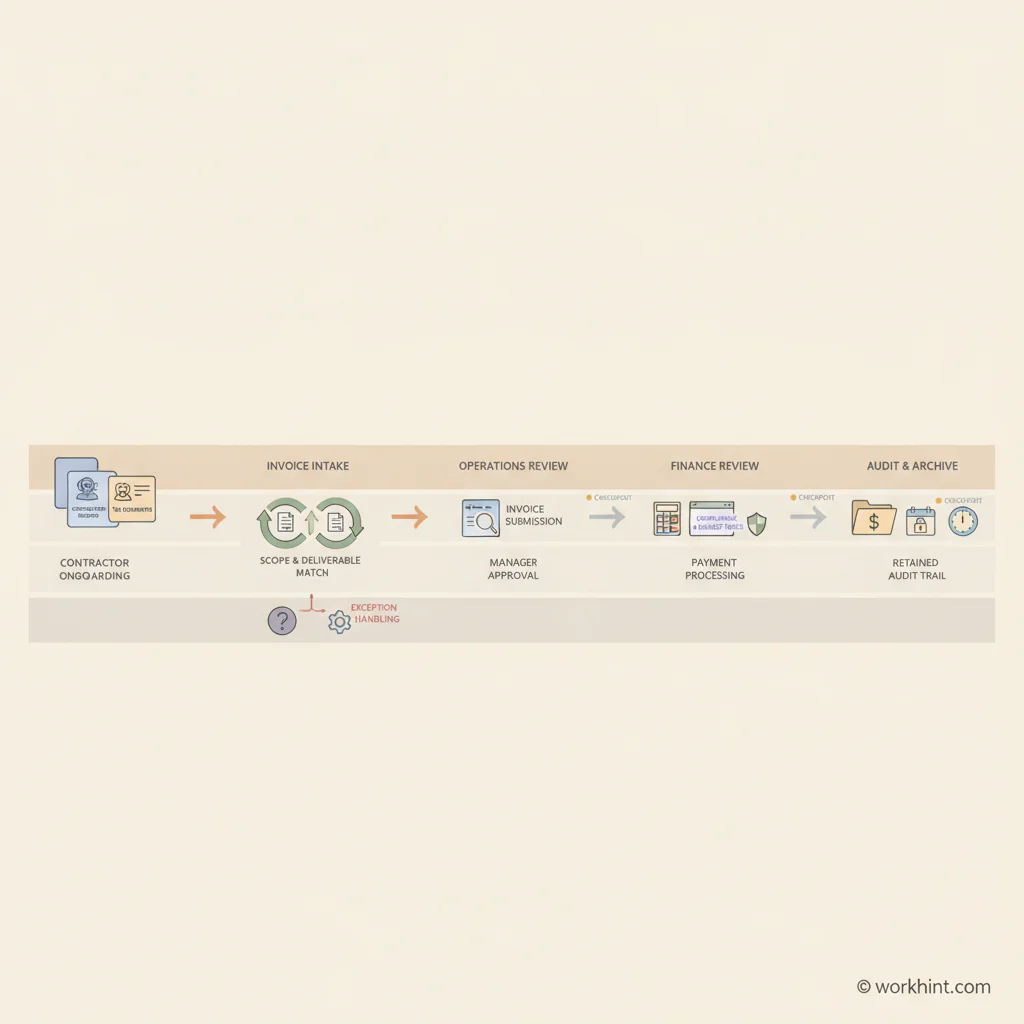
Step-by-step contractor invoice approval checklist
Use this checklist before approving contractor invoices for payment:
- Confirm the contractor is approved. The contractor should have an active record, approved scope, signed agreement, and required tax/payment documentation before the invoice moves forward.
- Check invoice completeness. Require the legal name, invoice number, invoice date, billing period, description of work, amount, currency, payment details, and any project or cost codes your finance team needs.
- Match the invoice to the agreement. Compare rates, milestones, hourly limits, expenses, retainers, or deliverable fees against the contract or statement of work.
- Confirm accepted work. The person closest to the work should verify that the deliverable was received, the milestone was completed, or the hours are reasonable under the agreed scope.
- Route exceptions visibly. If an invoice is incomplete, disputed, over budget, or outside scope, assign a clear owner and reason instead of letting the invoice stall.
- Separate approval from payment execution. Manager approval says the work is acceptable. Finance approval says the invoice is ready to pay under company policy.
- Keep an audit trail. Store the invoice, approval comments, supporting evidence, payment status, and exception history with the contractor engagement.
Approval roles for contractor invoices
The biggest workflow failure is unclear ownership. A manager may think finance owns the invoice while finance waits for manager approval.
Assign these roles:
- Requester or project owner: confirms the work was requested and delivered.
- Operations owner: confirms contractor status, onboarding, scope, and required records.
- Finance owner: confirms invoice completeness, coding, payment timing, and duplicate prevention.
- Approver: accepts or rejects the invoice based on agreed authority limits.
- Exception owner: resolves disputes, missing documentation, or scope mismatches.
For higher-risk invoices, add approval tiers. A small recurring invoice may need manager approval and finance review. A large milestone invoice, international payment, reimbursable expense claim, or new vendor relationship may need operations, legal, procurement, or executive review.
Common mistakes in contractor invoice approval
The first mistake is approving from email alone. Email often loses the connection between the invoice, agreement, accepted work, and payment record.
The second mistake is paying before the contractor record is complete. Missing tax details, incorrect entity names, outdated payment information, or unclear classification can create cleanup work later.
The third mistake is treating all invoices the same. The workflow should route by amount, project, risk, location, contractor type, and exception status.
The fourth mistake is not telling contractors what happened. If an invoice is rejected or held, give a clear reason and next action.
Where Workhint fits
Workhint fits when contractor invoice approval needs to become a live workforce workflow instead of a scattered finance task. A business can use Workhint to structure contractor intake, define roles and permissions, collect documents, connect statements of work to assignments, route invoice approvals, track exceptions, maintain payment readiness, and report on external workforce spend. When contractors are paid by job, milestone, or approved hours, a contractor payment platform can connect approvals, invoices, payment status, and payouts.
The value is not replacing finance judgment. It is giving operations, managers, contractors, and finance the same system of record. Each invoice can move through the right steps with clear owners, visible status, supporting evidence, and a retained history tied back to the contractor engagement.
FAQ
Who should approve contractor invoices?
The project owner or manager should confirm the work was accepted, while finance should confirm invoice completeness, coding, payment terms, and payment readiness. Higher-risk invoices may also need operations, legal, procurement, or executive approval.
What should be checked before paying a contractor invoice?
Check the contractor record, signed agreement, tax/payment documentation, invoice details, billing period, rates, milestone or hours, accepted work, expense approvals, duplicate status, and any exception notes.
How long should contractor invoice approval take?
The approval timeline should match the contract terms and internal payment calendar. Many delays happen because companies do not define whether payment timing starts from invoice date, receipt date, manager approval, deliverable acceptance, or the next payment run.
What is the difference between invoice approval and payment approval?
Invoice approval confirms that the invoice is valid and the work was accepted. Payment approval confirms that finance can release payment under company policy, budget, timing, tax, and recordkeeping requirements.
Should contractor invoices be approved automatically?
Some low-risk recurring invoices can use automated routing or prefilled checks, but the workflow should still validate the contractor record, payment terms, scope, and exception status. Automation should remove repetitive routing, not remove accountability.
Conclusion
A contractor invoice approval workflow works best when it connects workforce operations with finance control. Start with an approved contractor record, route the invoice through the right owners, match it to scope and accepted work, handle exceptions visibly, and release payment only when the record is complete. Contractors get clearer status, managers approve with better context, and finance gains a cleaner path from invoice intake to payment readiness.
Leave a Reply