


A remote work policy works best when it is clear enough to run, not just careful enough to file away.
A remote work policy template gives a company a practical starting point for deciding who can work remotely, how work is coordinated, what security rules apply, which expenses are handled, and how performance is managed. It should not be a generic permission slip. It should be an operating document that helps managers, employees, HR, IT, finance, and legal run remote work consistently.
This template is written for business teams that need a clear policy they can adapt before legal review. It is not legal advice, and employment, tax, privacy, reimbursement, and accommodation rules vary by location. Use it as a structured draft, then tailor it to your workforce and jurisdictions.
What’s included
- A section-by-section remote work policy template
- A checklist for customizing the policy before rollout
- A table showing which teams should own each policy area
- Common mistakes that make remote work policies hard to enforce
- Guidance on where Workhint fits when the policy needs to become a live workflow
How to use this remote work policy template
Start by deciding whether the policy covers fully remote employees, hybrid employees, temporary remote arrangements, or all three. Then review each section with the owner who will actually manage it.
The U.S. Department of Labor’s telework guidance is a useful reminder that remote employees remain covered by wage and leave rules. For example, nonexempt employees still need accurate timekeeping and compensation for hours worked. The National Institute of Standards and Technology also emphasizes that telework and remote access create security risks that organizations should address through policy and technical controls.
Remote work policy template
1. Purpose
This policy explains how employees may work remotely while protecting productivity, collaboration, security, confidentiality, compliance, and employee experience. Remote work is a work arrangement, not a change in performance expectations.
2. Scope and eligibility
This policy applies to employees approved for remote or hybrid work. Eligibility may depend on role requirements, performance, location, team coverage, client obligations, equipment needs, legal constraints, and manager approval. Some roles may require on-site presence because of customer interaction, equipment, supervision, safety, confidentiality, or operational coverage.
3. Approval process
Employees requesting remote work should submit the requested arrangement, work location, schedule, business reason, equipment needs, and any expected impact on team coverage. Approved arrangements should be documented with an effective date, review date, and owner.
4. Work location and availability
Employees must work from approved locations unless the company allows temporary exceptions. Define core working hours, meeting availability, response expectations, and rules for working from another state or country. Employees should notify the company before changing their regular work location.
5. Timekeeping and breaks
Nonexempt employees must record all hours worked, including approved overtime and unscheduled work. Managers should not discourage accurate time reporting. Meal breaks, rest breaks, and protected breaks should follow company policy and applicable law, whether the employee is remote or on site.
6. Equipment, expenses, and workspace
List which equipment the company provides, which expenses may be reimbursed, how employees request reimbursement, and whether employees may use personal devices. The IRS fringe benefit guide explains that accountable plan reimbursements generally require a business connection, substantiation, and return of excess advances.
7. Security and confidentiality
Employees must protect company, customer, employee, and partner information. Include rules for password managers, multifactor authentication, approved devices, VPN or remote access, software updates, screen locking, document storage, incident reporting, and use of shared spaces.
8. Communication and collaboration
Define the team’s communication channels, meeting norms, documentation expectations, handoff rules, and escalation path. The policy should make clear where work is assigned, where status is updated, where decisions are recorded, and how urgent issues are escalated.
9. Performance and conduct
Remote employees are expected to meet the same standards for quality, responsiveness, confidentiality, professionalism, attendance, and results as employees working on site. Managers should evaluate outcomes, role expectations, and collaboration behaviors rather than monitoring activity for its own sake.
10. Accessibility and accommodations
Remote work may intersect with disability accommodation requests. The EEOC’s guidance on telework as a reasonable accommodation explains that work from home can be considered when it enables an employee to perform essential job functions.
11. Review, changes, and termination of arrangement
The company may review remote arrangements periodically and may modify or end them based on role changes, performance concerns, business needs, compliance requirements, security issues, or policy violations.
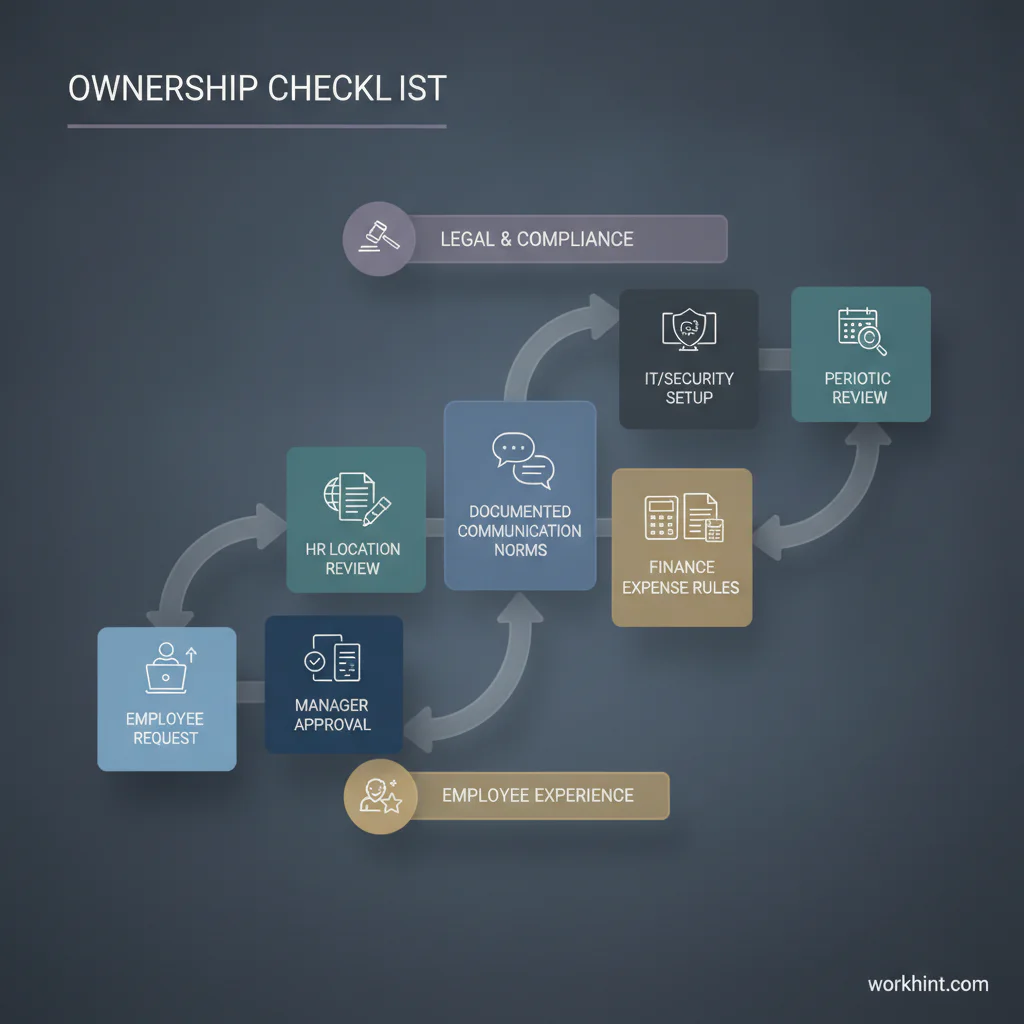
Ownership checklist
| Policy area | Primary owner | Before launch, confirm |
|---|---|---|
| Eligibility and approvals | HR and manager | Criteria are consistent and documented |
| Work location | HR, payroll, legal | State, country, tax, benefits, and labor implications are reviewed |
| Timekeeping | HR and finance | Nonexempt employees have a clear reporting process |
| Security | IT and security | Device, access, authentication, data, and incident rules are specific |
| Expenses | Finance | Reimbursement rules and documentation requirements are clear |
| Communication | Manager | Status, handoffs, meetings, and escalation paths are defined |
| Accommodations | HR and legal | Requests follow the formal accommodation process |
Common mistakes to avoid
- Writing one policy for every work model. Fully remote, hybrid, temporary remote, and occasional work-from-home arrangements may need different rules.
- Ignoring employee location changes. A move across state or country lines can affect payroll, tax, benefits, labor law, privacy, and company registration obligations.
- Leaving security vague. “Use secure systems” is not enough. Name the tools, devices, authentication rules, storage locations, and incident process.
- Confusing availability with surveillance. Clarify working norms without encouraging activity tracking that damages trust.
- Letting approvals live in email. Remote arrangements should be recorded where HR, managers, IT, finance, and payroll can see the current status.
Where Workhint fits
Workhint fits when a remote work policy needs to become more than a document. A company can use Workhint to turn the policy into an approval workflow with intake questions, manager review, HR checks, IT setup, equipment tasks, expense rules, security acknowledgments, review dates, and reporting.
That matters because remote work touches multiple teams. A manager may approve the arrangement, but IT may need to provision access, finance may need reimbursement documentation, HR may need location records, and legal may need accommodation or jurisdiction review.
FAQ
What should a remote work policy include?
A remote work policy should include eligibility, approval process, work location rules, availability expectations, timekeeping, equipment, expenses, security, confidentiality, communication norms, performance expectations, accommodations, and review rules.
Is a remote work policy legally required?
Not every employer is required to have a standalone remote work policy, but companies with remote or hybrid employees should document the rules. The policy helps support wage and hour compliance, security, expense handling, accommodations, and consistent management.
Should remote employees be allowed to work from anywhere?
Usually not without approval. Working from another city, state, or country can affect payroll, tax, benefits, labor law, insurance, privacy, and security requirements. The policy should require advance approval for regular location changes.
How often should a remote work policy be reviewed?
Review the policy at least annually and whenever the company changes work models, expands into new locations, adopts new security tools, changes reimbursement rules, or sees repeated exceptions.
Conclusion
A remote work policy template is useful only when it becomes specific to how the business runs. Clarify who is eligible, how approval works, where employees may work, how hours are recorded, what security rules apply, which expenses are covered, and how performance will be managed.
The strongest remote work policies are operational. They tell employees what is expected, give managers a consistent decision process, and give HR, IT, finance, and legal enough structure to keep the arrangement compliant, secure, and workable.
Leave a Reply