


Slow decisions are usually a system problem: unclear owners, vague input rules, and no visible path from choice to execution.
A decision-making framework gives a team a repeatable way to make business decisions without turning every question into a meeting or escalation. It defines the decision type, recommendation owner, input providers, approver, execution owner, and record.
This matters most in cross-functional work. Product, operations, finance, legal, customer success, and leadership may all have a valid stake in the same decision. Without a system, the loudest voice wins, the safest option drifts forward, or nobody knows whether a decision has actually been made.
What’s in this article?
- What a decision-making framework is and when to use one.
- How DACI, RAPID, and RACI differ in business operations.
- A practical workflow for building a decision system.
- A decision framework comparison table.
- Common mistakes that slow decisions down.
Why decision-making frameworks matter
Most teams do not need more opinions. They need a cleaner way to turn expertise into a decision and a decision into action. Atlassian describes DACI as a way to assign decision roles so teams know who drives, approves, contributes, and stays informed. Bridgespan explains that RAPID is meant to clarify decision roles at the appropriate speed, not simply make every decision faster.
The operational issue is not the acronym. It is whether the team can answer five questions before work stalls: What decision are we making? Who recommends? Whose input is required? Who has final authority? Who executes?
Decision-making framework options
There is no single best framework. Use the lightest model that clarifies ownership without adding unnecessary process.
DACI
DACI works well for cross-functional project decisions. The Driver coordinates the decision, the Approver makes the call, Contributors provide input, and Informed stakeholders receive the outcome. It is useful when one person needs to move the decision forward but another person has final authority.
RAPID
RAPID works well for higher-stakes decisions where recommendation, agreement, input, final decision, and execution need to be separated. Asana summarizes RAPID as a role model for Recommend, Agree, Perform, Input, and Decide. It is especially useful when legal, finance, risk, or executive stakeholders have formal veto or approval responsibilities.
RACI
RACI is better for work ownership than decision ownership. Cornell defines a RACI chart as a responsibility matrix that maps roles against tasks, deliverables, or decisions. Use it when the main confusion is who does the work, who is accountable, who must be consulted, and who only needs updates.
How to build a decision-making framework
Start with the real decision, not the template. A useful framework should fit the risk, speed, and reversibility of the decision.
- Define the decision clearly. Write the decision as a question. For example: should we launch this vendor onboarding workflow in all regions or pilot it with one market?
- Classify the decision type. Separate strategic, operational, financial, compliance, customer-impacting, and reversible decisions. High-risk decisions need stronger controls than routine operating choices.
- Name one decision owner. A group can provide input, but a decision needs one accountable owner. If two leaders can override each other, the framework will fail.
- Separate input from approval. Stakeholders often confuse being consulted with having veto power. Make the difference explicit before the discussion starts.
- Set the decision deadline. A framework without timing becomes another place for work to wait. Define when input closes and when the decision will be made.
- Record the rationale. Capture the decision, owner, date, options considered, key tradeoffs, and follow-up actions. This prevents the same debate from reopening later.
- Connect the decision to execution. Assign the implementation owner, first milestone, required approvals, and success metric.
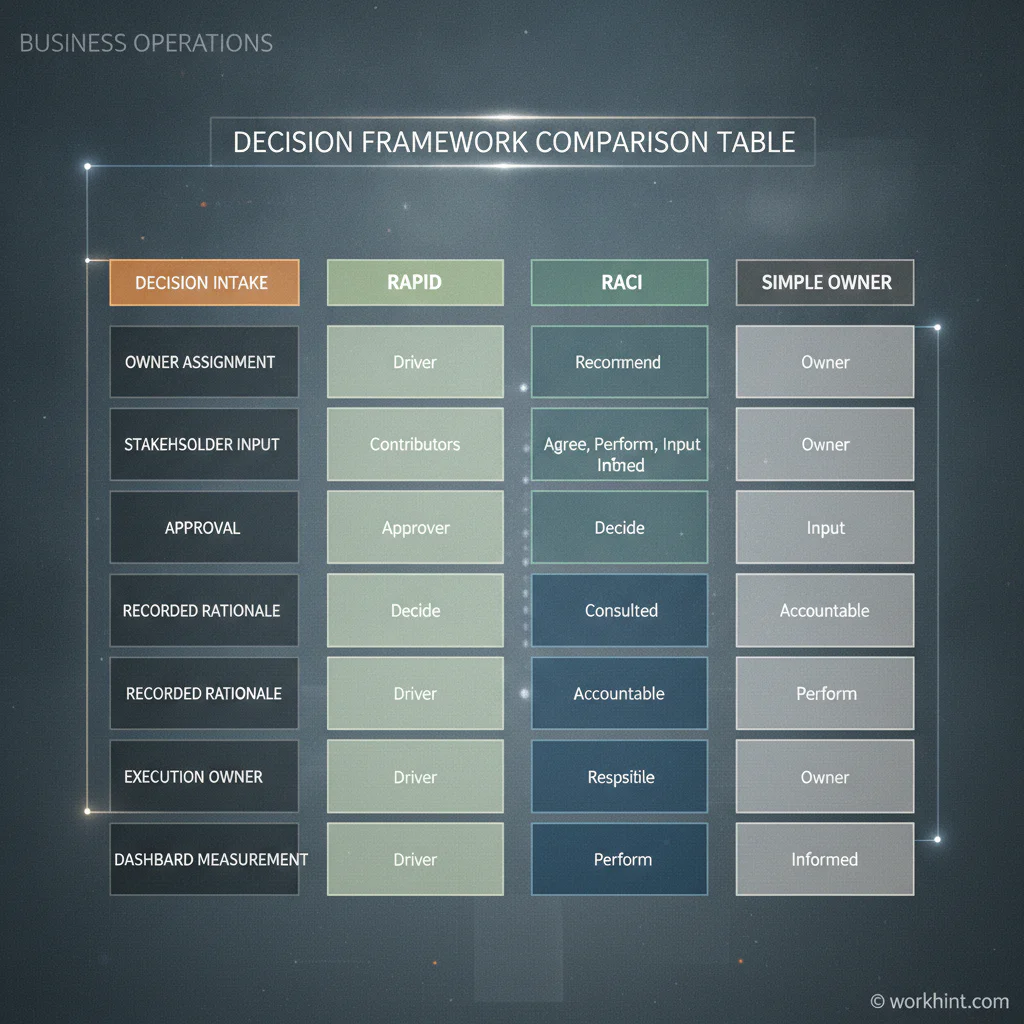
Decision framework comparison table
| Framework | Best for | Core roles | Watch out for |
|---|---|---|---|
| DACI | Project and cross-functional decisions | Driver, Approver, Contributors, Informed | Drivers without enough authority to keep momentum |
| RAPID | High-stakes decisions with formal input or veto rights | Recommend, Agree, Perform, Input, Decide | Too many Agree roles turning into hidden vetoes |
| RACI | Task ownership and recurring operational workflows | Responsible, Accountable, Consulted, Informed | Using a task matrix when the real issue is decision authority |
| Simple owner model | Fast, reversible operating choices | Owner, input providers, execution owner | Skipping documentation for decisions that later create precedent |
A practical decision workflow
For most operations teams, the framework should become a workflow, not a document saved in a folder. A practical decision workflow looks like this:
- Intake captures the decision question, context, deadline, risk level, and impacted teams.
- The system routes the decision to the right owner based on type, cost, customer impact, or compliance risk.
- Input requests go to named stakeholders with a clear deadline and required response format.
- The decision owner reviews options, tradeoffs, and input in one place.
- The final decision is recorded with rationale, execution owner, milestone, and success metric.
- Follow-up tasks, approvals, notifications, and dashboard updates are triggered automatically.
This is where decision frameworks become useful beyond the meeting. They reduce ambiguity at the exact points where work usually slows: ownership, review, approval, execution, and reporting.
Common decision framework mistakes
The first mistake is using a heavy framework for every decision. Not every choice needs DACI or RAPID. If a decision is low-risk and reversible, assign an owner and move.
The second mistake is giving too many people approval power. Consultation improves decisions; unlimited vetoes delay them. Keep final authority narrow and explicit.
The third mistake is stopping at the decision. A decision that does not create assignments, deadlines, system changes, or communication is only a note. The operating system must carry the decision into execution.
The fourth mistake is failing to review decision quality. Track cycle time, reopened decisions, escalations, missed dates, and stakeholder disputes. These metrics show whether the framework is improving execution.
Where Workhint fits
Workhint fits when a decision-making framework needs to become a live work system. A team can describe the decision process it wants, then structure the roles, intake fields, approval rules, stakeholder input steps, permissions, escalation paths, implementation tasks, and reporting around that work.
For example, a company designing a vendor selection decision can use Workhint to capture the request, route it by spend and risk, collect finance, legal, security, and operations input, assign the decision owner, record the rationale, trigger onboarding, and show cycle time or blocked decisions in a dashboard. The framework stays practical because it is embedded in the work.
FAQ
What is the best decision-making framework for business teams?
DACI is often best for cross-functional project decisions, RAPID is useful for high-stakes decisions with formal approval or veto roles, and RACI is better for clarifying task ownership. The best choice depends on decision risk, number of stakeholders, and whether the problem is authority or execution.
What is the difference between DACI and RACI?
DACI is designed for decisions. It defines who drives the decision, approves it, contributes input, and stays informed. RACI is usually designed for work ownership across tasks or deliverables.
How do you avoid too many approvers?
Separate consulted stakeholders from true approvers. Only give approval authority to people with formal accountability for risk, budget, policy, customer impact, or strategy. Everyone else can provide input without blocking the decision.
What should be documented after a decision?
Document the decision, date, owner, options considered, key tradeoffs, required approvals, implementation owner, next milestone, and success metric. This gives the team a record without turning the process into bureaucracy.
Conclusion
A decision-making framework works when it makes ownership visible, input useful, approval authority clear, and execution measurable. Start with the decisions that create the most delay: cross-functional launches, vendor choices, workflow changes, budget approvals, customer-impacting exceptions, and strategic tradeoffs.
The goal is not to force every decision through a template. The goal is to build a system where important decisions have a clear path from question to choice to action.
Leave a Reply