


Use this template to turn stakeholder noise into clear owners, priorities, risks, and next actions.
A stakeholder analysis template helps teams identify who matters to a project, how much influence they have, what they care about, and how the team should engage them. It is useful before a project kickoff, system rollout, client implementation, vendor change, policy update, hiring process redesign, or any operational change that depends on people outside the core team.
The point is not to create another spreadsheet. The point is to prevent late objections, missed approvals, duplicated communication, unclear decision rights, and surprised executives. A good stakeholder analysis gives the project team a shared map of relationships, expectations, risks, and communication needs before the work starts moving.
What is included
This resource includes a practical stakeholder analysis matrix, a scoring guide, an example, common mistakes, and a simple workflow for keeping the analysis current. It is written for operators, founders, project managers, program leads, implementation teams, HR leaders, client services teams, and anyone responsible for cross-functional execution.
PMI describes stakeholder analysis as a practice for identifying stakeholders and understanding their requirements. The NOAA Digital Coast stakeholder analysis worksheet similarly uses a structured worksheet to identify stakeholders, interests, positions, and other factors that may affect decisions. Those ideas are simple, but they become powerful when the template connects analysis to ownership and action.
How to use this stakeholder analysis template
- List stakeholder groups first. Start with teams, roles, customers, vendors, regulators, executives, managers, operators, and people affected by the outcome.
- Score influence and interest. Influence means ability to shape decisions or block progress. Interest means how much the outcome affects them or how closely they will follow the work.
- Name the decision or concern. Do not write vague notes like “needs updates.” Write the specific concern, approval, dependency, or outcome they care about.
- Assign an owner. Every important stakeholder relationship should have one accountable internal owner.
- Define the engagement plan. Decide whether the stakeholder needs consultation, approval, regular updates, early risk review, training, or change support.
- Review it during the project. Stakeholder maps age quickly. Revisit the template when scope, timeline, leadership, budget, or adoption risk changes.
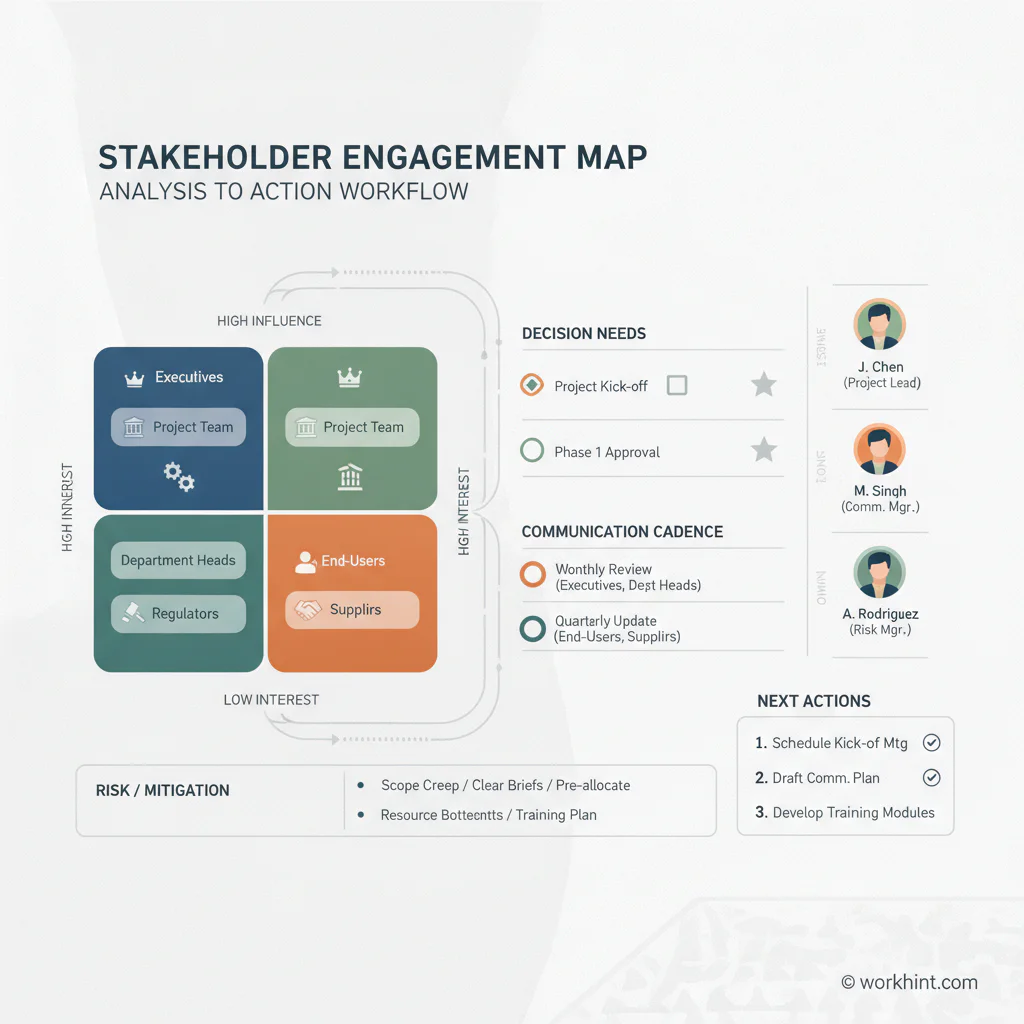
Stakeholder analysis template
Copy this structure into a spreadsheet, project workspace, implementation plan, or operating system. Keep the columns specific enough that another person can understand what to do next.
| Field | What to capture | Example |
|---|---|---|
| Stakeholder | Person, role, team, customer group, vendor, or approver | Regional operations managers |
| Interest | Low, medium, or high interest in the outcome | High |
| Influence | Low, medium, or high ability to affect decisions or adoption | High |
| Main concern | What they need, fear, approve, or depend on | Whether the new workflow creates extra admin work for field teams |
| Engagement strategy | Manage closely, consult, keep informed, monitor, or train | Consult during design; manage closely before launch |
| Owner | Internal person responsible for the relationship | Director of Operations |
| Cadence and channel | How often and where communication happens | Weekly rollout review plus launch-readiness checklist |
| Next action | The concrete step needed now | Review pilot workflow and collect location-specific risks by Friday |
Simple scoring guide
Use a three-level scale unless the project needs more precision. A lightweight score is easier to maintain and usually good enough for business operations.
- High influence, high interest: Manage closely. These stakeholders can shape the outcome and care about the details.
- High influence, low interest: Keep satisfied. They may not need every update, but they need timely escalation and clear decision points.
- Low influence, high interest: Keep informed. They may be highly affected by the change even if they do not approve it.
- Low influence, low interest: Monitor. Keep them on the communication list, but avoid overloading the project rhythm.
The ProjectManagement.com stakeholder analysis worksheet uses interests, importance, and influence to guide engagement. That structure is useful because it separates power from concern. Someone may have low formal authority but high adoption risk if the work changes their day-to-day process.
Example stakeholder analysis
Imagine a company rolling out a new client onboarding workflow. The executive sponsor has high influence and medium interest; they need milestone visibility and budget risk escalation. Client success managers have high interest and medium influence; they need training, scripts, and a feedback channel. Finance has medium interest and high influence if billing changes are involved. Clients have high interest, but their influence varies depending on contract size and implementation complexity.
A weak stakeholder analysis would list those groups and stop. A stronger one assigns owners, decision needs, communication cadence, and next actions. The client success lead owns manager training. Finance owns billing approval. Operations owns workflow adoption. The executive sponsor receives a short weekly risk summary. That turns stakeholder analysis from a planning artifact into a working coordination system.
Common mistakes
Only listing executives. Senior leaders matter, but adoption often depends on managers, frontline teams, administrators, customers, vendors, or support teams.
Confusing interest with influence. A stakeholder can care deeply without having approval power. Another can have approval power but only care when risk appears.
Leaving engagement vague. “Keep updated” is not a plan. Name the channel, cadence, owner, and expected outcome.
Ignoring opponents or skeptics. Resistance is information. Capture the concern early and decide whether it requires design changes, training, communication, or escalation.
Failing to update the map. Stakeholders change as the project moves from planning to implementation. Review the template at major milestones.
Where Workhint fits
A stakeholder analysis template is most useful when it becomes part of the workflow. Workhint can help teams turn this resource into a live operating system: stakeholder intake, role-based permissions, engagement owners, approval paths, communication tasks, escalation reminders, launch readiness checks, and reporting.
For example, a project team can use Workhint to assign each stakeholder relationship to an owner, route approvals to the right people, track unresolved concerns, collect readiness feedback, and keep leadership visibility tied to actual progress. The template remains the thinking tool. Workhint helps digitize and manage the work that follows from it.
FAQ
What should a stakeholder analysis template include?
It should include stakeholder name or group, interest, influence, main concern, decision need, engagement strategy, owner, communication cadence, risk, and next action.
When should stakeholder analysis happen?
Do it before kickoff or before a major change is announced. Then revisit it at scope changes, launch checkpoints, leadership changes, and adoption reviews.
What is the difference between stakeholder analysis and a communication plan?
Stakeholder analysis identifies who matters, what they care about, and how much influence they have. A communication plan defines messages, channels, timing, and owners. The Association for Project Management’s communication planning guide reinforces the need to match communication to the project and audience.
How many stakeholders should be included?
Include enough to cover decisions, adoption, risks, dependencies, and people affected by the work. For a small project, that may be ten stakeholders. For a major rollout, it may be dozens grouped by role or team.
Conclusion
A strong stakeholder analysis template gives teams more than a list of names. It clarifies influence, interest, concerns, owners, communication cadence, and next actions. Use it before work starts, keep it current as conditions change, and connect it to the operating workflow that drives decisions, approvals, adoption, and follow-through.
Leave a Reply