


The right system depends on whether you manage suppliers, freelancers, or both inside one external workforce operation.
VMS vs FMS is a practical question for any company that relies on outside talent. A vendor management system and a freelance management system both help coordinate non-employee work, but they are built around different operating models. Choose the wrong one and the business may still have scattered requests, unclear ownership, slow onboarding, weak approval trails, and payment disputes.
The distinction matters because external work is not one thing. A staffing supplier providing temporary workers is different from a designer hired directly for a campaign, a consultant delivering a project, or a local service partner handling field work. The system should match the relationship, risk, and workflow.
What’s in this article?
- The operational difference between a VMS and an FMS.
- A side-by-side comparison for external workforce teams.
- A decision workflow for choosing the right model.
- Common mistakes that create compliance, payment, and visibility problems.
- Where Workhint fits when the business needs one connected work system.
Why VMS vs FMS matters
A VMS is usually designed for vendor-led or supplier-led workforce programs. It helps a company manage staffing agencies, labor suppliers, service vendors, rates, requisitions, approvals, and invoices. The supplier often owns part of the worker relationship, especially sourcing and employment administration.
An FMS is usually designed for direct freelancer or contractor engagement. It helps a company source, onboard, classify, contract, assign, coordinate, approve, and pay individual external workers. ADP describes a freelance management system as a workforce solution for managing independent contractors from one platform.
The decision is not just software terminology. It affects who owns worker classification, who collects documents, who grants access, who approves work, who handles invoices, and what evidence the business can show if something goes wrong.
VMS vs FMS: side-by-side comparison
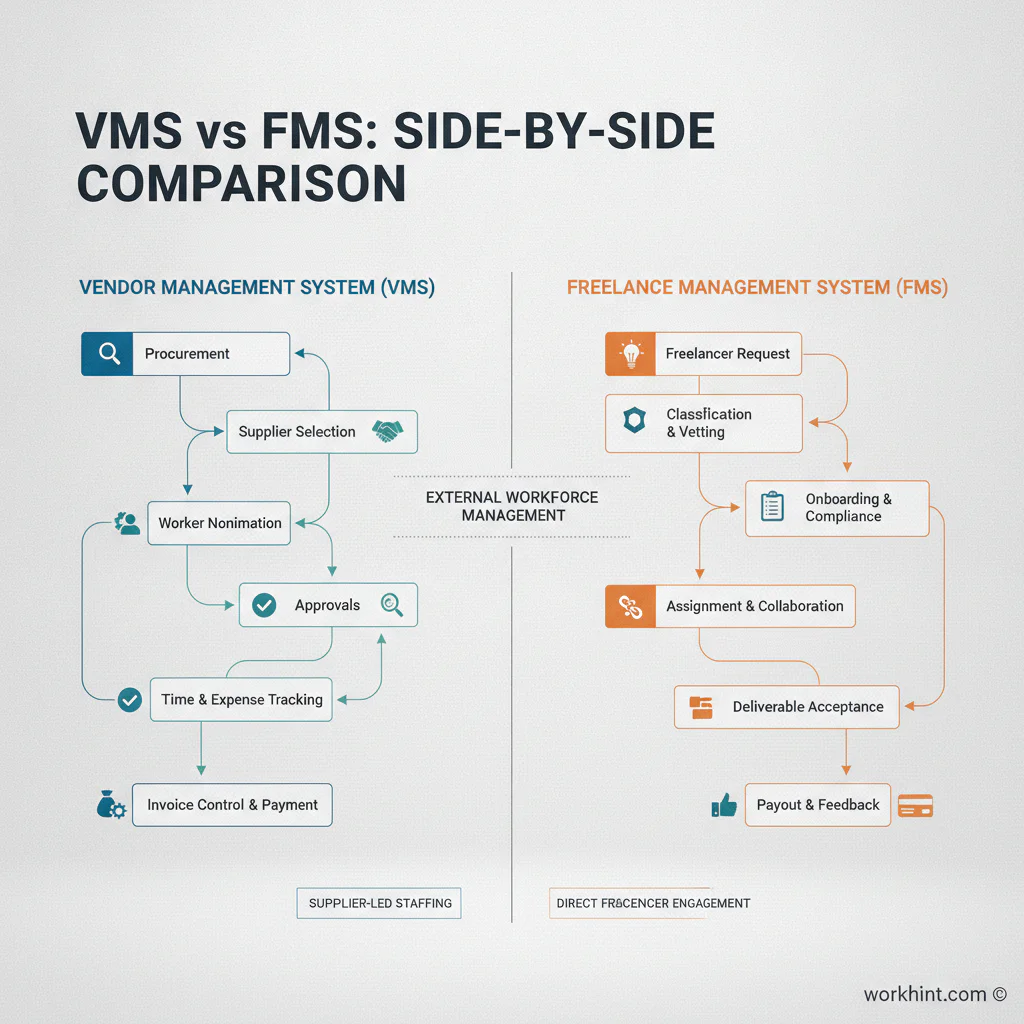
| Question | VMS | FMS |
|---|---|---|
| Primary relationship | Company to supplier, staffing agency, or service vendor | Company to freelancer, contractor, consultant, or specialist |
| Best fit | Supplier-led staffing, managed labor categories, vendor panels | Direct external talent pools, project-based freelancers, recurring contractors |
| Core workflow | Requisition, supplier response, worker assignment, time or milestone approval, invoice | Request, classification, contract, onboarding, assignment, acceptance, payout |
| Risk focus | Supplier compliance, rate control, tenure, spend visibility | Worker classification, documentation, scope control, direct payment readiness |
| Business owner | Often procurement, workforce program, HR, or vendor management | Often operations, talent, finance, legal, or business teams hiring directly |
| Where it struggles | Direct freelancer experience and fast project-based onboarding | Complex staffing supplier ecosystems and large vendor panels |
How to decide which system you need
Start with the work relationship, not the software category. A simple decision workflow usually gives a clearer answer than a feature checklist.
1. Map who supplies the worker
If a staffing agency, labor supplier, or service vendor supplies the worker, a VMS may fit better. If your team finds and hires the individual directly, an FMS is usually closer to the actual workflow.
2. Identify who owns classification and compliance
Classification cannot be solved by a label alone. The IRS says businesses should look at the entire relationship and the degree of control when deciding whether someone is an employee or independent contractor. The Department of Labor also warns that misclassification can affect worker protections and business obligations. For compliance-sensitive decisions, use official guidance and qualified legal advice.
3. Look at how work is requested
VMS workflows often begin with a requisition sent to suppliers. FMS workflows often begin with a business request for a specific deliverable, skill, project, or repeatable task. If request intake is unstructured, neither system will fix the problem by itself.
4. Define what approval means
For supplier-led work, approval may mean rate approval, supplier selection, time approval, or invoice matching. For direct freelancers, approval may mean classification approval, contract approval, access approval, milestone acceptance, and payout release.
5. Decide whether you need one model or a hybrid
Many companies need both. A media company may use agencies for large production teams while hiring individual editors, translators, photographers, or analysts directly. A field services company may use regional vendors and direct specialists. The question becomes whether the business can maintain one operating view across both models.
Common mistakes when comparing VMS and FMS
- Choosing by acronym: A system name matters less than whether it supports the workflow you actually run.
- Ignoring intake: If anyone can request external work in any format, approvals and reporting will stay messy.
- Treating direct contractors like employees: Daily supervision, open-ended duties, and employee-style control can create classification risk.
- Separating work approval from payment: Finance needs accepted work, tax records, invoice rules, and payment approvals connected.
- Missing hybrid visibility: Procurement may see vendors, HR may see workers, and finance may see invoices, but leadership still lacks a complete external workforce view.
A practical operating model
Before buying or rebuilding a system, define the external workforce workflow in one page:
- Who can request outside work?
- What information is required before approval?
- Is the work supplier-led, freelancer-led, or hybrid?
- Who reviews classification, contract terms, insurance, tax forms, and access?
- What milestones or evidence prove the work is complete?
- Who approves changes, exceptions, renewals, and final payment?
- What records must be retained for audit, finance, and performance review?
SAP’s external workforce documentation emphasizes maintaining standardized records for global external workers. That principle is useful even if a company is not using an enterprise VMS. External workforce operations become safer and faster when requests, people, suppliers, documents, approvals, work evidence, and payments live in a consistent structure.
Where Workhint fits
Workhint fits when the business needs the VMS vs FMS decision to become a working operating system, not just a software comparison. A team can use Workhint to define intake paths for supplier-led work and direct freelancer work, assign role-based approvals, collect onboarding documents, route classification and access checks, track milestones, connect accepted work to invoice status, and report on external workforce activity.
That is especially useful for hybrid teams. Instead of forcing every outside relationship into one rigid category, Workhint helps the business design the workflow around the relationship: vendor, staffing supplier, freelancer, contractor, consultant, agency, or partner.
FAQ
Is a VMS the same as an FMS?
No. A VMS usually manages staffing suppliers, vendors, requisitions, rates, and supplier-led labor workflows. An FMS usually manages direct freelancers, contractors, onboarding, classification, assignments, and payments.
Can one company need both a VMS and an FMS?
Yes. Companies with staffing agencies, service vendors, and direct freelancers often need a hybrid model. The key is keeping requests, approvals, records, and payments visible across the full external workforce.
Which system is better for independent contractors?
An FMS is usually better for direct independent contractor relationships because it is built around individual onboarding, contracts, classification workflows, work assignments, and payouts. A VMS may still help if those contractors come through suppliers.
Who should own the VMS vs FMS decision?
Ownership should be cross-functional. Procurement, HR, legal, finance, operations, IT, and business sponsors all touch different parts of the external workforce lifecycle.
Conclusion
The best answer to VMS vs FMS starts with how external work actually enters, moves through, and exits the business. Use a VMS when supplier-led workforce management is the core problem. Use an FMS when direct freelancer and contractor operations need structure. Use a hybrid work system when both models already exist and leadership needs one reliable view of requests, approvals, documents, work, and payments.
Leave a Reply