


A strong job description does more than attract candidates; it turns a role into clear responsibilities, requirements, and operating expectations.
A job description template gives hiring managers, HR teams, and operators a repeatable way to define a role before recruiting begins. It also creates a reference point for interviews, compensation review, onboarding, access setup, performance expectations, and later role changes.
This resource is not legal advice, and employment requirements vary by jurisdiction. Use it as an operating template, then have HR, legal, or compliance review role requirements, equal employment opportunity language, accommodations, wage-and-hour classification, and local posting rules before publishing.
What’s included in this job description template
- A complete business-ready job description structure
- A field-by-field table showing what each section should include
- A copy-ready template hiring managers can adapt
- A simple approval workflow for HR, finance, legal, IT, and the hiring manager
- Common mistakes to avoid before posting a role
How to use the job description template
Start with the work, not the person you hope to hire. Northwestern University’s job description guidance puts this simply: consider the job, not the person, when completing the description. That keeps the document focused on business need, role outcomes, and essential work rather than a wish list built around a specific candidate.
Use the template in four passes. First, define the role purpose and expected outcomes. Second, list duties in order of importance. Third, separate required qualifications from preferred qualifications. Fourth, route the draft for approval before it becomes a job posting, onboarding plan, or compensation input.
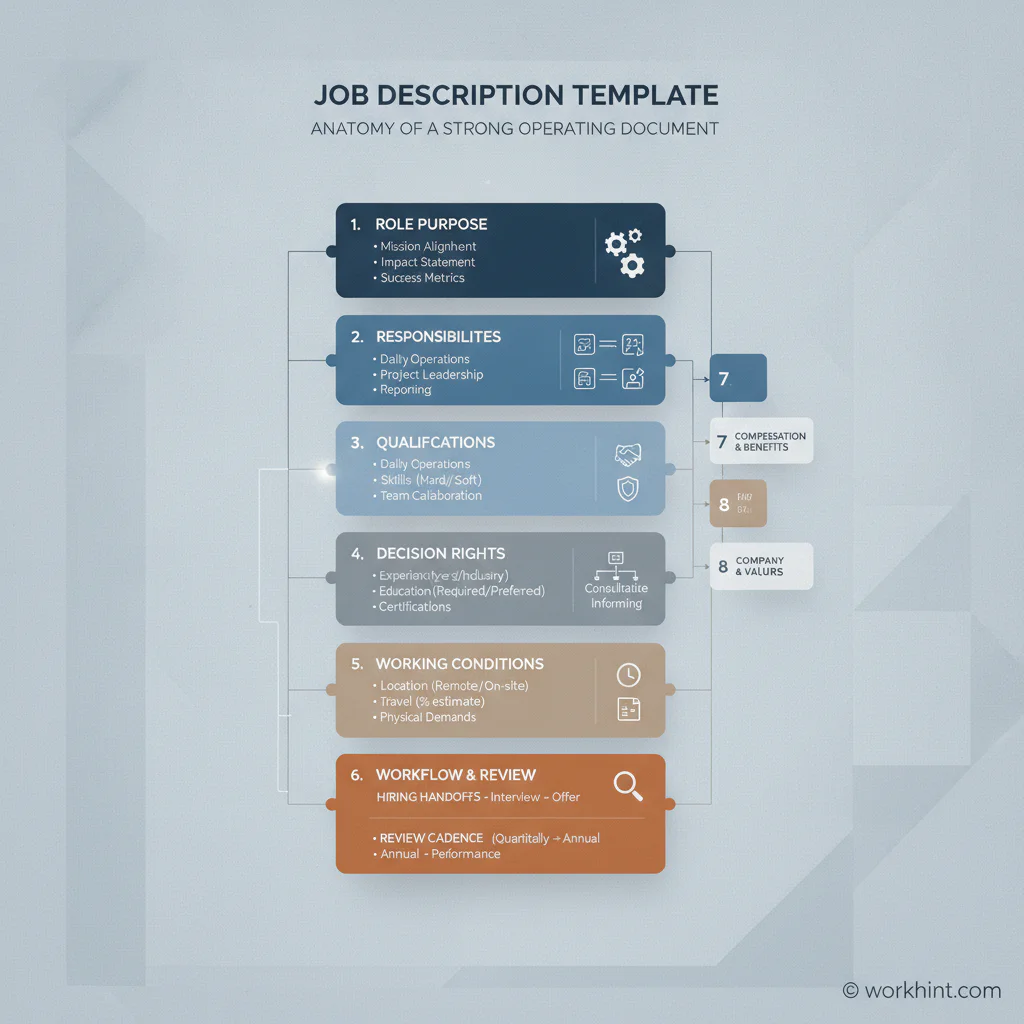
Job description template
| Section | What to include | Owner |
|---|---|---|
| Job title | Clear role name, level, department, and employment type | Hiring manager and HR |
| Role summary | Two to four sentences explaining why the role exists and what business outcome it supports | Hiring manager |
| Key responsibilities | Six to ten duties, ordered by importance and written as action statements | Hiring manager |
| Success measures | How performance will be judged in the first 90 days and ongoing | Hiring manager |
| Required qualifications | Minimum skills, experience, education, certifications, or licenses truly needed for the role | HR and hiring manager |
| Preferred qualifications | Helpful experience that should not screen out capable candidates unnecessarily | HR and hiring manager |
| Working conditions | Location, schedule, travel, tools, physical demands, environment, and remote or hybrid expectations | HR and operations |
| Reporting and collaboration | Manager, direct reports, internal partners, customer or vendor interaction, and decision rights | Hiring manager |
| Compensation and classification | Pay range if required or used, exempt/nonexempt review, bonus eligibility, and benefits summary | HR and finance |
| Approval and update history | Approvers, effective date, last reviewed date, and review cadence | HR operations |
Copy-ready job description format
Job title: [Role title, level, department]
Employment type: [Full-time, part-time, contract, temporary, internship]
Location: [Office, hybrid, remote, required time zone, travel expectations]
Reports to: [Manager title]
Role summary: [Explain why the role exists, who it serves, and the outcome it owns.]
Key responsibilities:
- [Responsibility 1 written as an action and outcome]
- [Responsibility 2 written as an action and outcome]
- [Responsibility 3 written as an action and outcome]
- [Responsibility 4 written as an action and outcome]
- [Responsibility 5 written as an action and outcome]
Success measures: [List the metrics, service levels, deliverables, quality expectations, or milestones that define good performance.]
Required qualifications:
- [Required skill, experience, credential, or capability]
- [Required tool, domain, or operational experience]
- [Required communication, compliance, or work authorization requirement where applicable]
Preferred qualifications:
- [Helpful but nonessential experience]
- [Industry or tool familiarity that can be learned after hire]
Working conditions and physical demands: [Include schedule, travel, work environment, equipment, lifting, standing, driving, field work, screen time, or other role-relevant conditions.]
Collaboration and decision rights: [Name the teams, customers, vendors, or stakeholders the role works with, plus the decisions the role can make independently.]
Compensation and benefits: [Add pay range where required or used, bonus or commission eligibility, and benefits summary.]
Equal opportunity and accommodations statement: [Use company-approved language.]
Approval history: [Prepared by, reviewed by, approved by, effective date, next review date.]
What to review before publishing
The SHRM job description resources show the value of standard fields such as title, department, summary, duties, and qualifications. For accommodation-sensitive details, the Job Accommodation Network notes that job descriptions often include essential functions, knowledge and skills, physical demands, environmental factors, and explanatory information. The point is not to make the job description longer. The point is to make it accurate enough that hiring, onboarding, and performance conversations all refer to the same role.
Before posting, review whether each requirement is genuinely job-related. The EEOC has discussed Title VII and ADA considerations around hiring requirements and job descriptions, so employers should avoid unnecessary requirements that could create discrimination or accommodation risk. If the role is salaried or exempt, review classification separately; the U.S. Department of Labor’s FLSA exemption guidance is a useful starting point, but your final classification should be reviewed by qualified HR or legal support.
Example approval workflow
- Hiring manager drafts the role: Define outcomes, duties, team context, and success measures.
- HR reviews structure: Check title consistency, required versus preferred qualifications, EEO language, and internal leveling.
- Finance reviews budget: Confirm compensation range, headcount approval, and cost center.
- Legal or compliance reviews risk: Check sensitive requirements, contractor versus employee language, regulated duties, and accommodation-sensitive wording.
- IT and operations review access: Identify systems, equipment, credentials, physical location, and onboarding dependencies.
- Final approver releases the posting: Store the approved version and send the role into recruiting, onboarding, and performance workflows.
Common mistakes
- Writing for an ideal candidate instead of the actual job. This creates bloated requirements and screens out capable people.
- Mixing required and preferred qualifications. Keep must-haves narrow and defensible.
- Leaving out success measures. A job description should help the new hire understand what good performance looks like.
- Forgetting working conditions. Remote expectations, travel, equipment, and physical demands should be clear where relevant.
- Skipping approval history. Without a review date and owner, job descriptions drift away from real work.
Where Workhint fits
Workhint helps organizations turn a job description template into a live work system. Once the role is defined, the same structure can drive hiring intake, approval routing, onboarding tasks, system access, document collection, training steps, manager check-ins, and performance milestones. That matters because a job description is only useful if it connects to the work that happens after approval.
For example, a company can use the role summary and responsibilities to generate onboarding tasks, use required qualifications to shape interview scorecards, use reporting lines to set permissions, and use success measures to create 30-, 60-, and 90-day check-ins. The template remains the source, while the workflow keeps the role operational.
FAQ
What should a job description include?
A practical job description should include title, role summary, responsibilities, required qualifications, preferred qualifications, working conditions, reporting structure, compensation or classification notes, EEO language, and approval history.
How long should a job description be?
Most business job descriptions should be long enough to explain the work clearly but short enough to scan. Aim for a focused role summary, six to ten key responsibilities, and a concise qualification list.
Who should approve a job description?
At minimum, the hiring manager and HR should approve it. Finance, legal, compliance, IT, and operations may also need review depending on compensation, regulated duties, system access, location, and employment classification.
How often should job descriptions be updated?
Review job descriptions at least annually, and update them when responsibilities, reporting lines, tools, location, compliance requirements, or compensation bands materially change.
Conclusion
A job description template is not just a recruiting document. Used well, it defines the work, sets expectations, reduces approval confusion, supports compliant hiring, and gives onboarding and performance management a clearer starting point. Keep the template practical, review it with the right owners, and connect it to the workflows that make the role real.
Leave a Reply