


Lessons learned only matter when they change the next workflow.
An after action review process helps a business turn completed work into better future execution. It is useful after launches, client implementations, incidents, campaigns, internal projects, service failures, field operations, and major workflow changes. The goal is not to host a blame session or produce a ceremonial report. The goal is to understand what happened, why it happened, what should be repeated, and what must change before the next cycle of work.
Used well, an after action review gives teams a structured way to compare plan against reality. Wharton Executive Education frames the method around four practical questions: what the team intended, what it did, why execution differed from intent, and what should be adapted or repeated. BetterEvaluation describes AAR as a simple method for assessing organizational performance after a task. For business teams, the important move is turning that discussion into owned changes in the operating system.
What’s in this article?
- What an after action review process is and when to use it.
- The core questions to ask during the review.
- A practical AAR workflow for business operations.
- A table your team can use to convert lessons into action.
- Where Workhint fits when reviews need follow-through.
Why the after action review process matters
Most teams already know more than their systems remember. A launch team spots handoff gaps. A support team sees the same escalation pattern. A field team learns which checklist step was unclear. A project team discovers that approval came too late. Then the next project starts, the same people are busy, and the lesson disappears into meeting notes.
An AAR prevents that loss. It creates a regular operating habit for capturing evidence, discussing causes, and assigning follow-up. The USAID After-Action Review guide emphasizes planning, conducting, and following up on the review, which is the part many business teams skip. The review is only useful if the team changes a process, template, owner, metric, training step, automation, or escalation rule afterward.
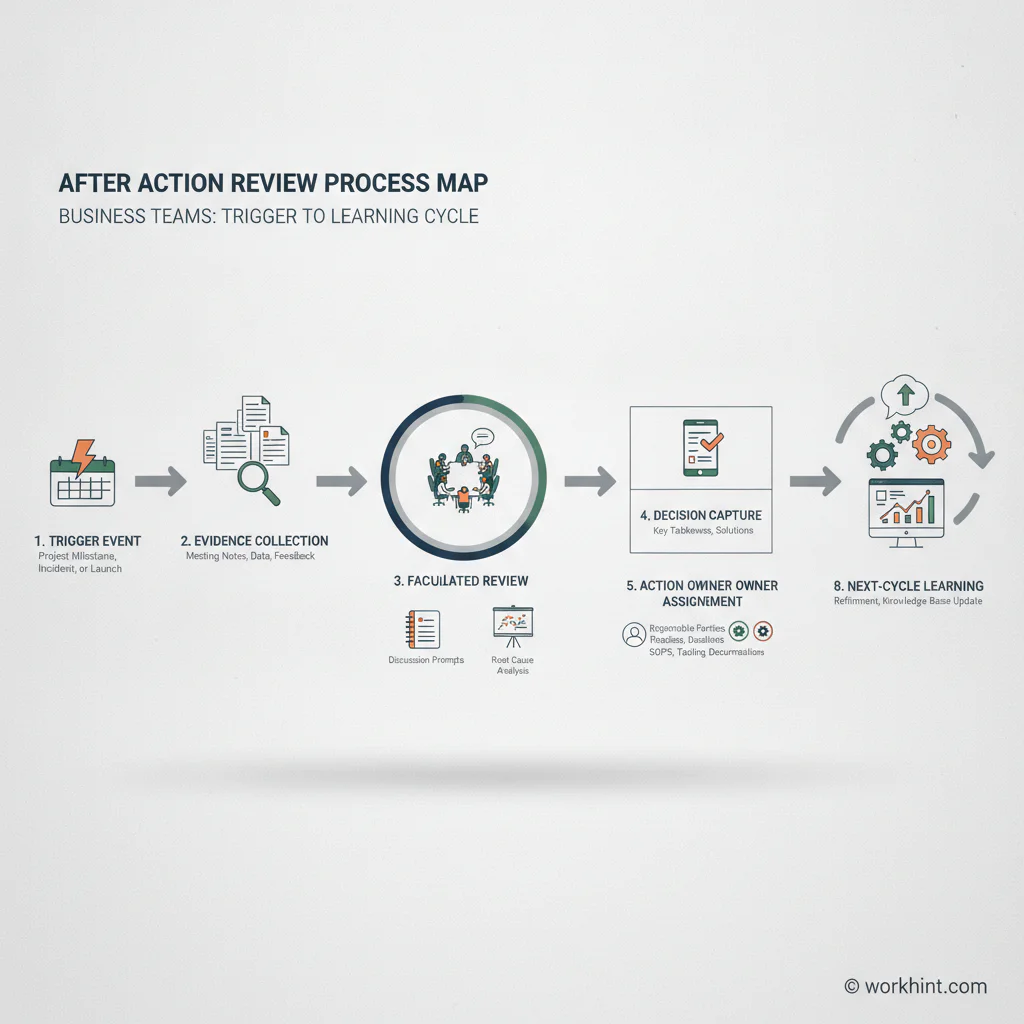
After action review process map
A business AAR should be short enough to run regularly and structured enough to produce action. Use the process below as a default.
- Choose the trigger. Define when an AAR is required. Examples include a missed SLA, a completed customer onboarding, a failed launch, a major escalation, a high-performing campaign, or a project over a defined budget threshold.
- Name the facilitator. The facilitator should guide the discussion, protect candor, and keep the team focused on evidence. The U.S. Army AAR guidance describes AARs as guided analysis with a facilitator, participants, and observers.
- Collect evidence before the meeting. Pull the plan, timeline, owners, handoffs, metrics, customer feedback, incident notes, decision log, and relevant workflow records. Do not rely only on memory.
- Run the four-question discussion. Ask what was supposed to happen, what actually happened, why there was a difference, and what the team will sustain or change.
- Separate causes from symptoms. Late delivery may be the symptom. The cause may be unclear intake, missing approval authority, undercounted capacity, poor handoff criteria, or a system that never showed the blocker.
- Turn lessons into assigned changes. Every accepted lesson needs an owner, due date, success measure, and place where the process will be updated.
- Review follow-through. Add the actions to the operating rhythm. Check whether the change was implemented and whether the same problem reappeared.
After action review questions to ask
The classic questions are simple, but business teams should make them specific enough to expose workflow problems.
| Question | What to look for | Operational output |
|---|---|---|
| What was supposed to happen? | Goal, scope, owner, timeline, customer promise, approval path | Baseline plan and success criteria |
| What actually happened? | Dates, delays, exceptions, handoff gaps, rework, customer impact | Evidence-based timeline |
| Why was there a difference? | Root causes, assumptions, missing capacity, unclear authority | Cause statement, not blame |
| What should change next time? | Process update, new owner, training, automation, escalation rule | Action register with owners |
How to run the meeting
Keep the meeting focused. Start with the intended outcome and the evidence. Then invite the people closest to the work to describe what they saw. The facilitator should ask for specifics: which request arrived late, which handoff had no owner, which approval rule was unclear, which dashboard failed to show risk, which decision came too slowly.
Do not let the discussion turn into a general complaint list. Capture facts first, causes second, and actions third. If a topic is too large for the meeting, park it as a separate improvement item with an owner. The best AARs create fewer, stronger actions rather than a long list no one will revisit.
Common mistakes
The first mistake is waiting too long. Run the review while the work is still fresh. The second is inviting only leaders. Leaders may know the outcome, but operators know how the work actually moved. The third is treating the AAR as a document instead of a system. A beautiful report does not improve operations unless it changes the next workflow.
Another common failure is confusing accountability with fault. A good AAR can name owners without creating fear. The question is not, “Who failed?” The better question is, “What did the system require people to guess, chase, repeat, or escalate manually?” That framing makes improvement easier to accept.
Where Workhint fits
Workhint fits when an after action review process needs to move from meeting notes into daily execution. A team can use Workhint to capture the review trigger, collect evidence from the workflow, assign facilitator and participant roles, document decisions, route improvement actions, update SOPs or checklists, set escalation rules, and track whether the fix changes future performance.
That matters because AAR output usually touches multiple parts of the operating system: intake forms, role assignments, approval steps, service levels, training tasks, dashboards, customer updates, and reporting. Workhint helps teams turn the lesson into a live workflow change rather than another note buried in a project folder.
FAQ
What is an after action review process?
An after action review process is a structured way to review completed work, compare intended results with actual results, identify causes, and assign improvements for the next cycle.
When should a business run an after action review?
Run one after meaningful events such as launches, incidents, missed deadlines, customer escalations, completed projects, major campaigns, operational changes, or unusually strong performance that should be repeated.
Who should attend an after action review?
Include the people who planned the work, performed the work, approved key decisions, supported the customer or stakeholder, and own follow-up changes. Keep the group small enough for honest discussion.
Is an after action review the same as a retrospective?
They are similar. Retrospectives are common in agile teams, while AARs are often used more broadly after operations, events, projects, and incidents. Both should turn learning into action.
What should happen after the AAR meeting?
Convert accepted lessons into assigned actions, update the workflow or documentation, communicate the change, and review whether the change worked during the next operating cadence.
Conclusion
An after action review process is valuable because it makes learning operational. Start with one meaningful event, gather the evidence, ask the four core questions, and turn the answers into owners, due dates, workflow updates, and measures. The review should not end when the meeting ends. It should end when the next version of the work runs better.
Leave a Reply