


The pay rate is only one number; the bill rate is the operating model around it.
Bill rate vs pay rate is one of the first pricing questions a staffing agency, client, or operations team has to understand. The pay rate is what the worker earns. The bill rate is what the client pays for that worker’s time. The difference between them must cover payroll costs, statutory burden, insurance, recruiting work, administration, technology, risk, and agency margin.
If a staffing request, assignment, timesheet, invoice, or rate change moves without clear rules, small pricing mistakes can become margin leakage or client disputes.
What’s in this article?
- The difference between bill rate and pay rate.
- How markup, spread, burden, and margin fit together.
- A calculation table and approval workflow teams can adapt.
- Common mistakes that make staffing pricing messy after work starts.
- Where Workhint fits when pricing becomes a live workflow.
Why bill rate vs pay rate matters
Staffing is a large operating category. The American Staffing Association reports that staffing companies provided job and career opportunities for about 11 million employees in 2024. That scale makes pricing discipline important for agencies and the companies that use them.
For a client, the bill rate affects budget, purchase approvals, invoice review, and workforce planning. For a staffing agency, it affects worker pay competitiveness, gross margin, payroll funding, and service quality.
The mistake is treating pricing as simple markup. The better question is: what cost, risk, service level, and margin must the bill rate support?
Bill rate vs pay rate explained
The pay rate is the hourly, daily, weekly, or assignment-based amount paid to the worker. In temporary staffing, this is usually the worker’s hourly wage.
The bill rate is the amount the client pays the staffing agency for that worker’s time. It includes the pay rate plus the costs and margin needed to operate the assignment.
The difference between the two is often called the spread, markup, or pay-bill spread. Spread is the dollar difference. Markup is usually a percentage above pay rate. Margin is the profit relationship after costs are considered.
What the bill rate has to cover
A staffing bill rate usually has to cover more than direct pay. Depending on worker model, jurisdiction, and assignment type, the rate may account for payroll taxes, unemployment insurance, workers’ compensation, benefits, recruiting, onboarding, payroll administration, software, credit risk, and agency profit.
For U.S. employee staffing models, teams should use official payroll guidance and professional advice. IRS Publication 15 explains employer tax responsibilities for wages, withholding, Social Security, Medicare, and federal unemployment tax. The Bureau of Labor Statistics Employer Costs for Employee Compensation also shows why labor cost is broader than wages alone.
This is not legal, tax, or payroll advice. Rate models should be reviewed against the actual worker classification, location, contract terms, and applicable requirements.
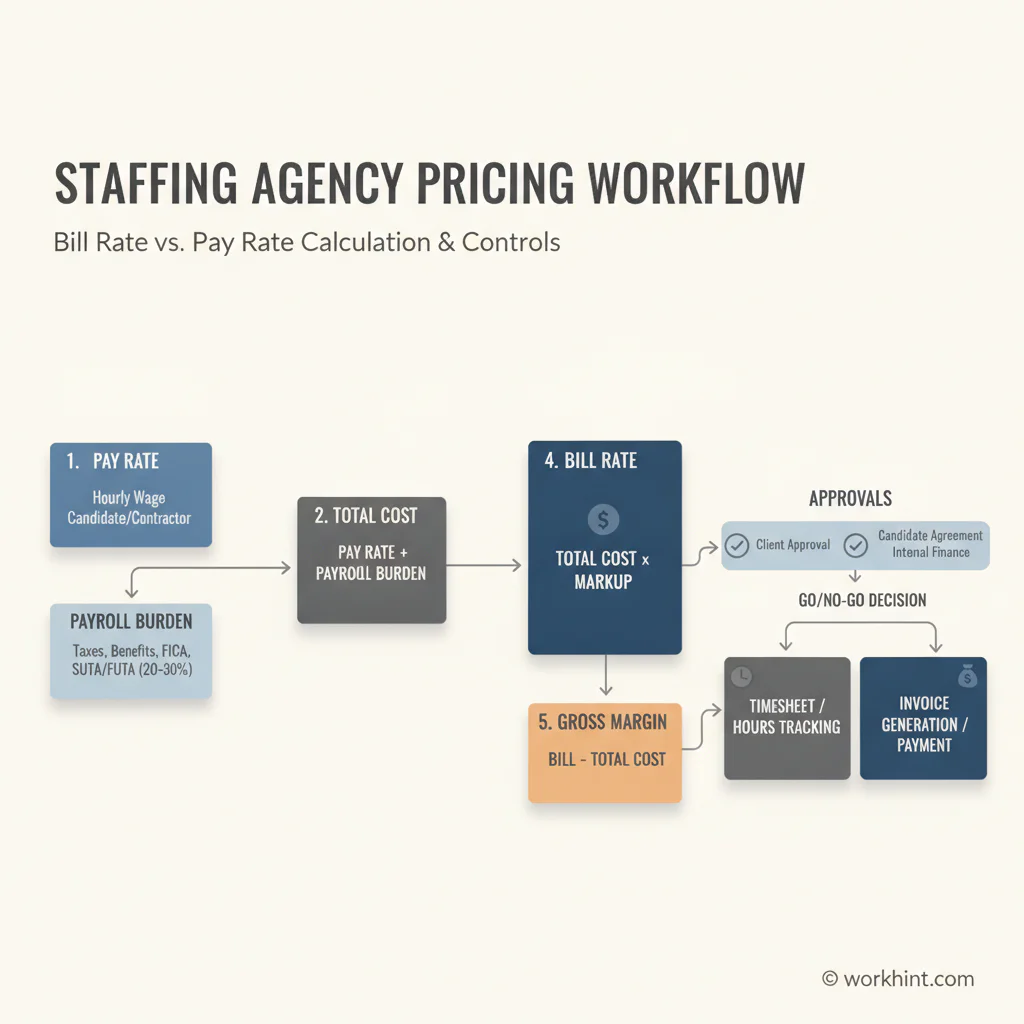
Bill rate vs pay rate calculation table
Use this table as a practical model, not a universal benchmark. The numbers depend on role, location, staffing model, insurance, taxes, benefits, risk, and competition.
| Pricing component | What it means | Example | Control to add |
|---|---|---|---|
| Pay rate | Amount paid to the worker | $25.00 per hour | Confirm role, location, skills, and market range |
| Estimated burden | Employer costs tied to payroll and assignment risk | $4.50 per hour | Use approved assumptions by worker type and state |
| Operating cost allowance | Recruiting, onboarding, payroll, tools | $5.00 per hour | Review by client tier and service level |
| Target margin | Profit needed after direct and operating costs | $6.50 per hour | Set minimum margin rules |
| Bill rate | Total hourly amount charged to the client | $41.00 per hour | Require approval before quoting or changing |
In this example, the client pays $41.00 per hour and the worker earns $25.00 per hour. The $16.00 difference is not pure profit. It supports costs, operational work, risk, and margin.
How to manage staffing rate approvals
- Start with the staffing request. Capture role, location, shift, start date, assignment length, required skills, safety requirements, budget owner, and worker model.
- Set a pay range before sourcing. The pay rate should be high enough to attract qualified workers, but it should also match the client budget and assignment expectations.
- Apply approved burden assumptions. Finance or payroll should define cost assumptions by state, worker type, insurance category, and employment model.
- Calculate the proposed bill rate. Show the pay rate, burden, operating allowance, target margin, and resulting client rate.
- Route exceptions before quoting. Low-margin deals, rush orders, unusual risk, overtime, travel, or special equipment should trigger review.
- Lock the approved rate to the assignment. Connect the approval to the worker, client, job order, timesheet, and invoice.
- Review after real work starts. Compare planned hours, actual hours, overtime, attendance, invoice disputes, and gross margin.
Common mistakes
- Calling the spread profit. The pay-bill difference must cover real costs before profit exists.
- Approving the pay rate but not the bill rate. A competitive pay rate can still create a bad deal if the client rate is too low.
- Using one markup for every role. Safety-sensitive, hard-to-fill, overnight, technical, or high-turnover roles may need different assumptions.
- Letting rate changes happen in email. If a rate changes, the assignment, approval, worker agreement, timesheet, and invoice rules should all match.
- Ignoring overtime and shift premiums. A clean straight-time margin can disappear when overtime, weekends, holidays, or premiums are not priced.
- Comparing vendors only on bill rate. The lowest bill rate may come from a weak pay rate, thin support model, poor worker retention, or hidden exceptions.
Where Workhint fits
Workhint fits when staffing pricing needs to become part of the operating workflow instead of a spreadsheet, email chain, or one-time quote. A team can structure the staffing request, role details, pay range, bill rate assumptions, approvals, worker onboarding, timesheets, invoice review, payment status, and reporting in one connected work system.
That matters when operations, finance, HR, procurement, account managers, recruiters, clients, and workers all touch different pieces of the same assignment. Workhint keeps the rate decision connected to the work that follows, so pricing, documents, approvals, and invoices do not drift apart.
FAQ
What is the difference between bill rate and pay rate?
The pay rate is what the worker earns. The bill rate is what the client pays the staffing agency or workforce provider. The difference helps cover payroll burden, operating costs, risk, and agency margin.
Is staffing agency markup the same as profit?
No. Markup or spread is the difference between pay rate and bill rate. Profit is what remains after payroll burden, insurance, recruiting, administration, technology, and other costs are covered.
Who should approve staffing bill rates?
Approval depends on the organization. Common approvers include the hiring manager, budget owner, finance, procurement, HR, and staffing agency account owner. Low-margin, high-risk, or unusual assignments should have exception approval.
Should clients know the worker pay rate?
Some contracts disclose pay rate, markup, and bill rate. Others only state the client bill rate. The right approach depends on the agreement, market, procurement policy, and relationship. Operationally, the approved pricing model should be documented and consistently applied.
How often should staffing rates be reviewed?
Review rates when assignments renew, worker pay changes, overtime becomes common, margins fall below target, market rates shift, scope changes, or invoice disputes appear. High-volume programs should review rate performance on a regular cadence.
Conclusion
Bill rate vs pay rate is simple at the definition level and complicated at the operating level. The pay rate affects worker acceptance and retention. The bill rate affects client cost, agency margin, and service quality.
The practical answer is to make rate decisions visible. Capture the request, calculate assumptions, route approvals, lock the numbers to the assignment, and review the results after work starts. When pricing is connected to operations, staffing teams can protect margin without losing sight of worker experience or client trust.
Leave a Reply