


The BPM lifecycle only works when each stage creates an operating decision, not another process document.
Business process management lifecycle steps help operations teams improve repeatable work without treating every process problem like a one-time project. The lifecycle gives a team a way to choose a process, redesign it, run it, measure it, and keep improving it as volume, risk, tools, and expectations change.
IBM describes business process management as a way to analyze and improve business processes, with lifecycle stages that help teams identify improvement areas and track metrics. Microsoft frames the steps of business process management around planning, designing, modeling, implementing, monitoring, and optimizing. The exact labels vary, but the operating question is the same: how does work become more predictable, measurable, and easier to improve?
What’s in this article?
- What the BPM lifecycle is meant to accomplish
- The business process management lifecycle steps operators should use
- A table for turning each step into owners, artifacts, and metrics
- Common mistakes that make BPM efforts stall
- Where Workhint fits when the lifecycle becomes a live work system
Why business process management lifecycle steps matter
Teams usually start caring about BPM when work depends too much on memory. Requests arrive through different channels. Approvals happen in side conversations. Managers do not know where work is stuck. Metrics show outcomes, but not the handoffs that caused them.
The BPM lifecycle matters because it creates a repeatable loop for improvement. Instead of jumping straight to automation, the team first defines what the process is for, who owns it, what inputs it needs, what decisions it contains, where exceptions happen, and which metrics prove that it works.
This is close to the process approach described in ISO 9001 guidance, where processes operate as an integrated system rather than isolated activities. For modern operations teams, that system view is essential. A workflow that looks efficient inside one department can still fail if intake, approvals, permissions, reporting, or downstream handoffs are disconnected.
The business process management lifecycle steps
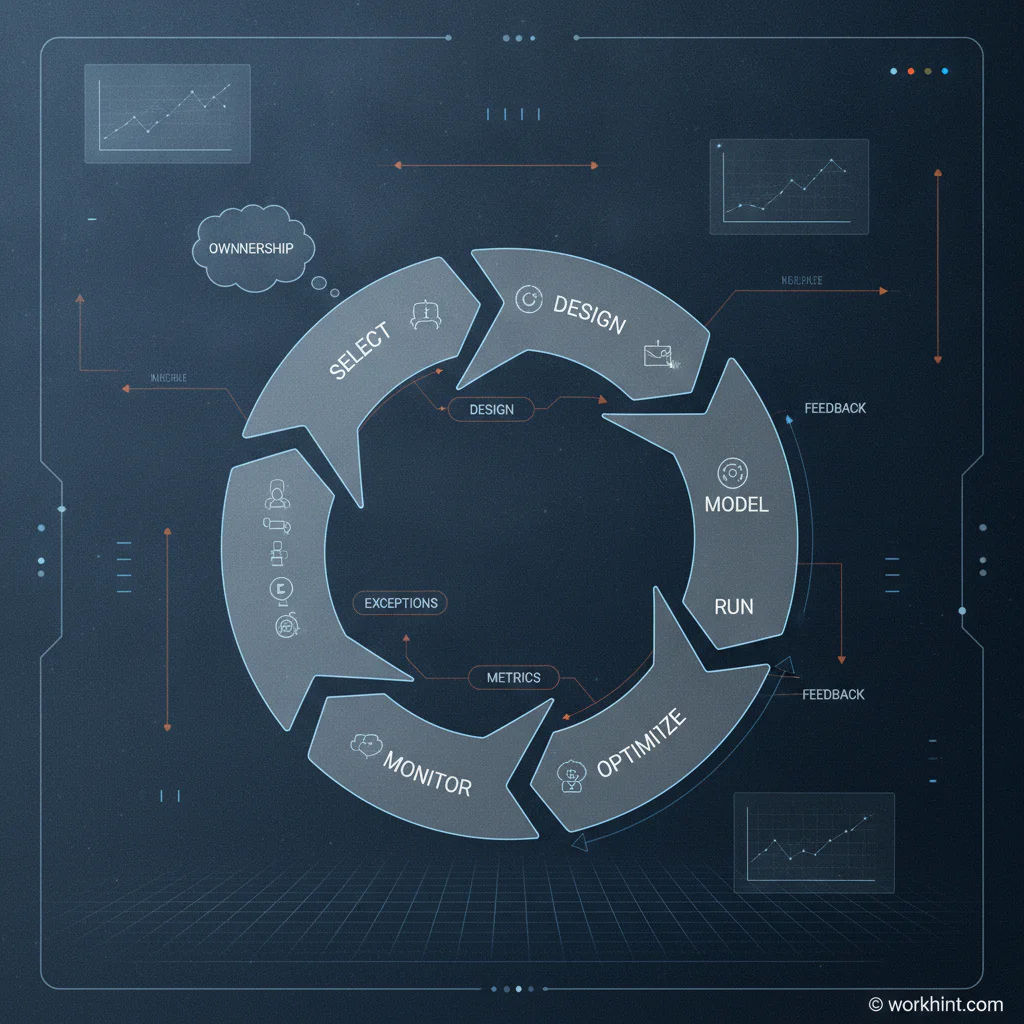
Use the lifecycle as a practical operating loop. The steps below are written for business teams that need to improve real work, not just document an ideal state.
| Step | Operator question | Useful output | Metric to watch |
|---|---|---|---|
| 1. Select and scope | Which process is important enough to improve now? | Process charter, owner, scope, success criteria | Business impact or volume |
| 2. Discover current work | How does work actually move today? | Current-state map, systems, handoffs, pain points | Cycle time and rework |
| 3. Design the future process | What should happen, who decides, and what rules apply? | Future-state workflow, roles, rules, exception paths | Decision speed |
| 4. Model and test | Where could the new process break before launch? | Scenario test, edge cases, capacity assumptions | Exception rate |
| 5. Run the process | How will people and systems execute it consistently? | Live workflow, forms, assignments, approvals, notifications | On-time completion |
| 6. Monitor and optimize | What does performance show, and what should change? | Dashboard, review cadence, improvement backlog | Throughput, quality, cost, SLA performance |
The first step is selection. Do not start with every process. Pick one with enough volume, risk, cost, or customer impact to justify attention. Good candidates include internal requests, vendor onboarding, customer escalations, procurement approvals, and service delivery workflows.
The second step is discovery. Interview the people doing the work, review system records, and trace recent examples from request to completion. The point is to expose the real sequence: where work starts, where it waits, who touches it, what information is missing, and where decisions happen outside the official path.
The third step is design. This is where the team defines the future workflow, owners, decision rights, required fields, permissions, approvals, escalation rules, and records. If formal modeling is needed, the Object Management Group’s BPMN standard provides a notation for specifying business processes.
The fourth step is modeling and testing. Walk through normal, urgent, incomplete, high-risk, and exception cases before launch. Ask what happens when an approver is unavailable, a document is missing, scope changes, priority shifts, or an integration fails. A process that cannot handle exceptions will route them back to private messages and spreadsheets.
The fifth step is execution. This is where the process stops being a diagram and becomes the way work runs. Forms collect inputs. Roles and permissions control access. Tasks and approvals route automatically. Notifications make the next action visible. Records stay attached to the work.
The final step is monitoring and optimization. Review cycle time, backlog, aging work, first-pass completion, error rate, SLA performance, and exception volume. Then improve the process in small, traceable changes. A BPM lifecycle is complete only when the team knows how it will learn from real use.
A practical BPM lifecycle checklist
- Name one accountable process owner before redesign starts.
- Define the process boundary: trigger, endpoint, included teams, and excluded work.
- Map the current process from actual examples, not memory alone.
- Separate required steps from habits, preferences, and legacy workarounds.
- Write approval rules in plain language before automating them.
- Design exception paths for missing information, overdue approvals, and risk flags.
- Choose metrics that show speed, quality, ownership, and customer or employee impact.
- Set a review cadence so the process improves after launch.
Common mistakes in BPM lifecycle work
The first mistake is starting with software selection. Tools matter, but choosing a tool before defining ownership, rules, and metrics preserves the same broken model in a cleaner interface.
The second mistake is documenting the happy path only. Most operational drag comes from exceptions: unclear requests, missing approvals, conflicting priorities, compliance checks, handoffs, and work that changes after it starts. Model those cases early.
The third mistake is treating monitoring as a dashboard project. Monitoring should answer questions: where is work stuck, which rules create delay, which owners are overloaded, which exceptions repeat, and which changes would help fastest?
Where Workhint fits
Workhint fits when the BPM lifecycle needs to become a working system rather than a static process map. A team can describe the process it wants to run, then use Workhint to shape the intake forms, roles, permissions, assignments, approvals, documents, notifications, dashboards, and automations around that workflow.
That is especially useful after the design and modeling stages. Instead of handing a diagram to a separate implementation team, operations leaders can turn the process into a live work system, test the handoffs, adjust rules, and keep the performance view connected to the actual work. Workhint is not a substitute for thinking through the process. It is the place where that thinking becomes executable.
FAQ
What are the main business process management lifecycle steps?
The common BPM lifecycle steps are selecting or planning the process, discovering the current state, designing the future process, modeling and testing it, implementing or running it, monitoring performance, and optimizing the process over time.
How is BPM different from workflow automation?
BPM is the broader discipline of improving repeatable business processes. Workflow automation is one way to execute parts of a process. A team should understand the process before automating it.
Who should own a BPM lifecycle project?
One business owner should be accountable for outcomes, but the work should include the people who execute the process, the teams affected by handoffs, and any system or compliance owners involved.
When should a process enter the BPM lifecycle?
A process is a strong candidate when it is repeated often, creates measurable delay or errors, crosses teams, affects customers or employees, or depends too much on manual follow-up.
Conclusion
Business process management lifecycle steps give teams a disciplined way to improve work. Start with a process that matters, study the current workflow, design the future state, test exceptions, run the process in a system, and measure what happens. The value is not the lifecycle diagram. The value is a repeatable operating loop that makes work clearer, faster, and easier to improve.
Leave a Reply