


Co-employment risk is easier to manage when roles, controls, approvals, and records are clear before work begins.
Co-employment risk appears when a business works with contractors, staffing agencies, vendors, or contingent workers in a way that starts to look like shared employment control. The risk is that managers blur who hires, supervises, pays, disciplines, schedules, trains, evaluates, and terminates the worker.
This article is not legal advice. Employment rules vary by jurisdiction, worker type, industry, and facts. Use this as an operating guide, then involve counsel for classification, joint-employer, wage-and-hour, safety, and labor questions.
What’s in this article?
- What co-employment risk means in practical business terms
- A control workflow teams can use before external work starts
- A role-boundary table for managers, vendors, and workers
- Common mistakes that create avoidable exposure
- Where Workhint fits when controls need to become a live process
Why co-employment risk matters
Co-employment and joint employment are fact-specific. A company may believe another organization is the employer of record, but its own actions can still matter if it controls key employment terms or day-to-day working conditions. The U.S. Department of Labor explains in its FLSA employment relationship guidance that employees receive minimum wage and overtime protections, while independent contractors are in business for themselves.
The IRS also frames worker status around control and independence. Its independent contractor or employee guidance looks at behavioral control, financial control, and the relationship of the parties. Those categories force a practical question: who actually controls how the work gets done?
What creates co-employment risk
Risk usually grows through small operating habits. A manager gives a staffing-agency worker the same performance review as employees. A contractor gets an internal title, a company email signature, and open-ended duties. A vendor employee starts taking daily direction from the client instead of the vendor. None of these facts alone answers the legal question, but together they can weaken the boundary between external work and employment.
The goal is not to make collaboration impossible. The goal is to define the relationship honestly, route decisions through the right owner, and keep records that show the business acted consistently.
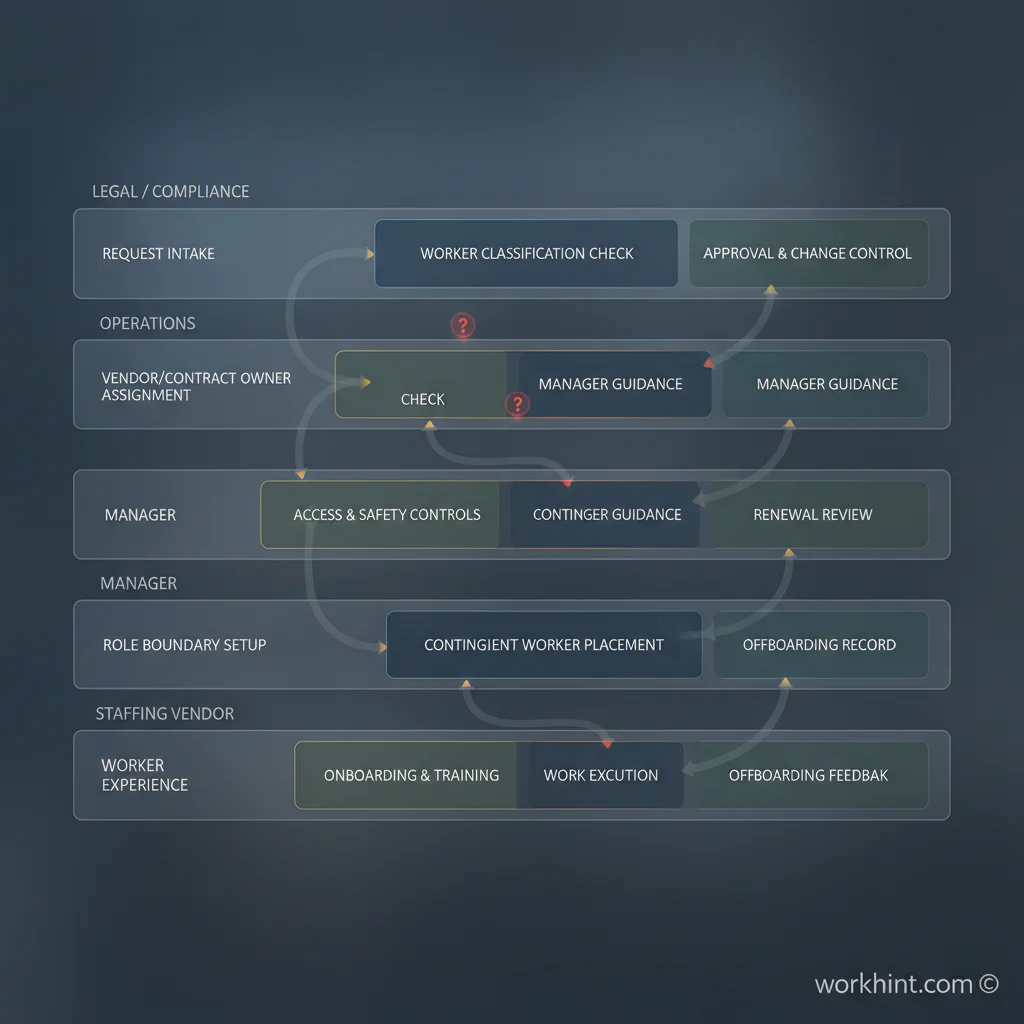
Co-employment risk control workflow
- Define the work before sourcing. Write the business need, deliverables, duration, location, access needs, reporting line, and approval path.
- Classify the engagement type. Decide whether the work should be handled by an employee, independent contractor, staffing agency worker, vendor team, consultant, or professional services firm. Escalate uncertain cases.
- Assign the right owner. A contractor, staffing worker, or vendor team needs a named owner. Do not leave ownership informal.
- Set role boundaries. Document who can assign work, approve schedule changes, evaluate performance, approve pay, manage safety, and end the engagement.
- Limit access to the work need. Give external workers the tools, systems, data, and locations required for the assignment, not default employee access.
- Train managers on the boundary. Managers should know what they can direct, what must go through the vendor or contract owner, and when to escalate a change.
- Review changes before they happen. Scope, schedule, tenure, location, supervisor, or tool changes should trigger review.
- Keep a record. Store the request, classification rationale, agreement, scope, approvals, safety responsibilities, access decisions, reviews, and offboarding confirmation.
Role boundary table
| Area | Lower-risk operating habit | Higher-risk habit to review |
|---|---|---|
| Work direction | Manager defines outcomes, deadlines, and acceptance criteria. | Manager controls daily methods, hours, and step-by-step work like an employee supervisor. |
| Performance | Business owner reviews deliverables or routes concerns through the staffing vendor. | External worker receives employee-style reviews, discipline, or promotion paths. |
| Schedule | Schedule expectations are documented in the agreement or vendor workflow. | Managers change shifts, overtime, or availability without vendor or compliance review. |
| Tools and access | Access is limited to assignment needs and removed at offboarding. | External workers receive broad employee-like access, titles, equipment, and privileges. |
| Renewal | Extensions trigger a fresh business, classification, budget, and risk review. | Long-running assignments renew automatically because the worker is embedded. |
Do not ignore safety and workplace responsibilities
Co-employment conversations often focus on taxes or wage-and-hour rules, but temporary worker safety needs the same discipline. OSHA states that staffing agencies and host employers are jointly responsible for maintaining a safe work environment for temporary workers, with responsibilities depending on the facts. That means a host company cannot treat safety as entirely someone else’s job just because the worker came through an agency.
For workforce operations, define safety ownership during onboarding. Capture who provides site orientation, role-specific training, protective equipment, incident reporting, hazard communication, and injury documentation. If the worker changes location, task, shift, or supervisor, review the responsibilities again.
How to manage joint-employer uncertainty
Joint-employer standards can change across laws and over time. The National Labor Relations Board’s joint-employer standard page explains that entities may be joint employers under the NLRA when each has an employment relationship with the employees and they share or codetermine essential terms and conditions of employment.
Operators do not need to turn every manager into a lawyer. They do need a review path. If a manager wants to control pay, schedule, discipline, supervision, job duties, tenure, or termination, that decision should move through the right owners before it reaches the worker.
Common mistakes
- Using the same onboarding path for everyone. Employees, contractors, staffing workers, and vendor employees need different workflows, documents, permissions, and owners.
- Letting managers improvise. Managers under pressure will solve the work problem in front of them. Give them clear rules before the assignment starts.
- Extending assignments without review. Long tenure can change the operational reality of the relationship, especially when the worker becomes part of the normal org chart.
- Skipping vendor communication. If performance, conduct, safety, schedule, or pay concerns exist, the staffing agency or vendor contact often needs to be involved.
- Weak records. The best policy is hard to defend if no one can show the request, approval, classification, scope, access, and offboarding history.
Where Workhint fits
Workhint fits when co-employment risk needs to be managed as an operating workflow, not a policy PDF. A team can build intake forms for external work requests, route classification reviews, assign legal, HR, procurement, vendor, and business owners, collect documents, set permissions, track approvals, and trigger renewal or offboarding steps.
That matters because risk usually appears in handoffs. Workhint can help connect the request, worker type, scope, access, safety responsibilities, vendor communication, payment status, review dates, and records in one controlled process. The judgment still belongs to the business and its advisors. Workhint helps make the process visible and repeatable.
FAQ
What is co-employment risk?
Co-employment risk is the possibility that a business may share employer responsibilities or liability for workers supplied by another company, or may treat contractors or contingent workers in ways that look like employment control.
How can a company reduce co-employment risk?
Reduce risk by classifying the engagement correctly, documenting scope and ownership, training managers, routing sensitive decisions, limiting access, reviewing extensions, and keeping clear records.
Is co-employment always illegal?
No. Co-employment or joint employment can exist lawfully in some arrangements. The issue is whether the business understands its responsibilities, manages the relationship correctly, and avoids misclassification or uncontrolled employment practices.
Who should own co-employment controls?
Ownership should be shared across legal, HR, procurement, operations, finance, security, and the business owner. One process owner should coordinate the workflow.
Do staffing agencies remove all co-employment risk?
No. Staffing agencies can help manage payroll, benefits, assignment administration, and worker support, but the host company may still have responsibilities depending on control, safety, working conditions, and applicable law.
Conclusion
The practical way to avoid co-employment risk is to manage external work deliberately. Define the work, classify the relationship, assign ownership, set boundaries, train managers, control access, review changes, and preserve the record. External work can move quickly without becoming chaotic, but only when the operating system around that work is clear before the worker starts.
Leave a Reply