


When a workflow is structurally broken, small improvements only make the wrong system run a little faster.
Business process reengineering steps help teams redesign work when the current process cannot be fixed with another checklist, meeting, or automation rule. The goal is to rethink how work should move from request to outcome, then rebuild the roles, handoffs, controls, data, and measurement around that better design.
That distinction matters for operations teams. Continuous improvement is useful when a process mostly works and needs tuning. Business process reengineering is useful when the process is fundamentally misaligned: too many approvals, duplicated data entry, unclear ownership, disconnected systems, poor customer visibility, or cycle times that cannot improve without changing the structure of the work.
What’s in this article?
- What business process reengineering means in practical operations work
- When to use reengineering instead of ordinary process improvement
- A step-by-step method for redesigning a broken workflow
- A table for turning the future state into an operating system
- Common mistakes that make reengineering projects fail
Why business process reengineering matters
IBM defines business process reengineering as the radical redesign of business processes to improve performance, efficiency, and effectiveness. In plain operating terms, BPR asks a harder question than “How can we make this step faster?” It asks, “Should this step exist, and what system would we build if we were designing the outcome from scratch?”
The question is high stakes because reengineering changes how people work. It may remove steps, combine roles, replace approval chains, change system ownership, or shift decisions closer to the customer. The U.S. Government Accountability Office’s BPR assessment guide treats reengineering as a disciplined effort tied to customer needs, performance problems, strategic goals, risk control, organizational change, and implementation. BPR is not a brainstorming exercise. It is a managed redesign of how value gets delivered.
Reengineering should be reserved for processes where incremental fixes have stopped working. If a procurement workflow takes three weeks because one approval field is confusing, improve the field. If it takes three weeks because every request passes through five departments, no one owns exceptions, data is reentered in three systems, and leadership cannot see blocked work, the process may need redesign.
When to use reengineering instead of improvement
A practical test is whether the current process can meet the business goal without changing its structure. If the answer is yes, use process improvement. If the answer is no, consider BPR.
The difference is similar to the contrast ASQ draws between continuous improvement and BPR: continuous improvement aims at long-term incremental gains, while BPR pursues rapid and radical redesign of strategic processes. In modern operations, the best approach is usually sequenced. Use reengineering to replace the broken operating model, then use continuous improvement to keep the new system healthy.
Good candidates include customer onboarding, vendor approval, field service dispatch, claims review, partner onboarding, order-to-cash, and service delivery. These processes usually cross teams, depend on multiple systems, and create measurable pain when they stall.
Business process reengineering steps
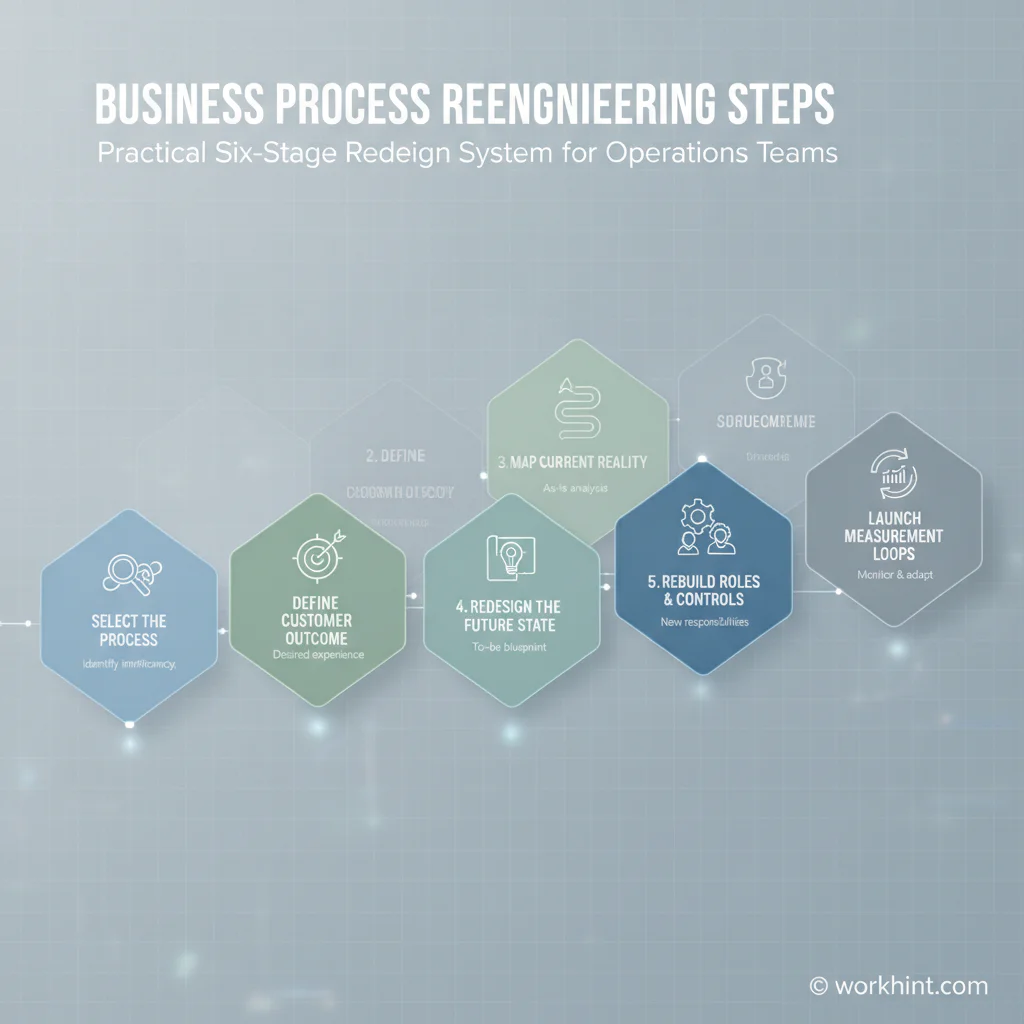
- Select the process that deserves redesign. Pick one workflow with visible business impact. Use cycle time, cost, error rate, customer complaints, missed SLAs, rework, or employee workload as evidence. Do not start with a vague goal like “fix operations.”
- Define the customer outcome. Name the person or group the process serves and the result they actually need. A vendor approval process, for example, is not done when a form is submitted. It is done when the right vendor can safely start work under the right terms.
- Map the current reality. Capture the real workflow, not the official diagram. Include intake, routing, approvals, handoffs, systems, exceptions, waiting time, decision rights, and reporting. IBM’s BPR examples emphasize defining goals, assessing current state, identifying gaps, and process mapping before redesigning the work.
- Identify structural constraints. Look for constraints that cannot be solved by asking people to try harder: duplicated entry, missing ownership, unnecessary approvals, unclear decision authority, fragmented data, hidden queues, and manual status chasing.
- Design the future state. Start from the outcome and work backward. Decide what information is needed at intake, which rules route work, who owns each stage, which approvals are risk-based, what exceptions need escalation, and which dashboards show performance.
- Rebuild the operating controls. A redesigned process needs roles, permissions, handoff rules, approval criteria, documents, notifications, escalation paths, and metrics. Without those controls, the new design becomes another diagram people ignore.
- Launch, measure, and adjust. Start with a controlled rollout. Measure cycle time, blocked work, rework, customer experience, compliance exceptions, and owner response time. Then improve the redesigned system as real data shows what still breaks.
Future-state operating system table
| Design element | Question to answer | System decision |
|---|---|---|
| Intake | What information is needed before work starts? | Create structured request forms with required fields and validation. |
| Ownership | Who is accountable for each stage? | Assign one owner per stage and one process owner for the whole flow. |
| Routing | How does work reach the right person? | Use rules based on request type, risk, location, customer, value, or urgency. |
| Approvals | Which decisions need human review? | Use risk-based approval paths instead of sending every item through the same chain. |
| Exceptions | What happens when work does not follow the standard path? | Define escalation triggers, timeout rules, and named decision owners. |
| Measurement | How will leaders know the process works? | Track cycle time, throughput, aging work, rework, SLA performance, and blockers. |
Where Workhint fits
Workhint fits after the future state is clear enough to operationalize. The method may produce a better process design, but the business still needs a live system where people can submit work, reach the right owner, approve decisions, see status, handle exceptions, and measure performance.
In Workhint, a team can describe the redesigned workflow and turn it into a work system with intake forms, roles, permissions, assignments, approval steps, documents, schedules, escalation rules, dashboards, and reporting. That matters because business process reengineering often fails in the gap between the redesign workshop and daily execution. The new process has to become the way work actually runs.
Common mistakes in business process reengineering
- Automating the old process too early. Automation can lock in bad handoffs if the workflow has not been redesigned first.
- Ignoring frontline reality. The people doing the work know where data is missing, approvals stall, and exceptions pile up.
- Redesigning without decision rights. A future state without named owners and approval authority will drift back to informal workarounds.
- Measuring only launch completion. The real test is whether cycle time, quality, visibility, and customer outcomes improve after launch.
- Trying to reengineer everything at once. Start with one high-impact process, prove the model, then expand.
FAQ
What is business process reengineering?
Business process reengineering is the fundamental redesign of a business process to improve major performance outcomes such as speed, cost, quality, service, visibility, or customer experience.
What are the main business process reengineering steps?
The core steps are selecting the process, defining the customer outcome, mapping current reality, identifying structural constraints, designing the future state, rebuilding controls, and measuring the new system after launch.
How is BPR different from process improvement?
Process improvement makes an existing workflow better. BPR questions whether the existing workflow should exist in its current form and redesigns the process when incremental changes are not enough.
Which processes are best for reengineering?
Good candidates are cross-functional, high-impact workflows with repeated delays, rework, customer pain, unclear ownership, fragmented systems, or costs that cannot improve without changing how the work is structured.
Conclusion
Business process reengineering is useful when a team has outgrown its current work. Start with a measurable process problem, understand the real workflow, redesign around the customer outcome, and rebuild the controls that make the new process repeatable. The strongest result is not a cleaner diagram. It is a work system that makes execution faster, clearer, and easier to measure.
Leave a Reply