


The label you choose changes how the work should be scoped, supervised, onboarded, paid, and documented.
The search for contingent worker vs contractor starts with a simple question: are these two terms the same? In everyday business conversations, they often get mixed together. In operations, HR, procurement, finance, and legal workflows, they should not be interchangeable.
A contingent worker is a broad term for non-permanent labor. A contractor is one type of external worker, usually engaged to deliver defined services under a contract or statement of work. The wrong operating model can create misclassification risk, unclear ownership, weak access controls, and payment delays.
What is in this article?
- The practical difference between a contingent worker and a contractor
- How staffing agency temps, independent contractors, and contract-firm workers differ
- A decision table for choosing the right workforce model
- The workflow businesses should use before work starts
- Common mistakes that create compliance and coordination problems
Why the distinction matters
The U.S. Bureau of Labor Statistics describes contingent jobs as jobs workers do not expect to last or that are temporary. BLS also tracks alternative arrangements such as independent contractors, on-call workers, temporary help agency workers, and contract-firm workers.
That is the first useful distinction: contingent work describes a temporary or non-permanent arrangement, while contractor status describes a specific legal and operational structure. A staffing agency temp, an independent designer, and a consulting-firm specialist may all sit outside the permanent employee base. They still need different controls.
This article is not legal advice. Classification rules vary by jurisdiction and fact pattern. For U.S. businesses, the IRS weighs behavioral control, financial control, and the relationship of the parties when reviewing independent contractor or employee status. The Department of Labor also applies an economic reality analysis under the FLSA, summarized in its Fact Sheet 13.
Contingent worker vs contractor: the core difference
A contingent worker is a broad category. It can include temporary employees, agency workers, freelancers, independent contractors, consultants, on-call workers, seasonal staff, and people supplied by a contract firm. The relationship is not a standard permanent employment arrangement.
A contractor is narrower. Contractors are usually engaged to complete a defined body of work, provide specialized expertise, or deliver an outcome under agreed terms. A true independent contractor generally controls how the work is performed, carries business responsibility, and is not managed like an employee.
In practice, the business must decide who controls the work, who pays the worker, who handles taxes and benefits, how long the work lasts, what systems the worker can access, and what proof is needed before invoices or timesheets are approved.
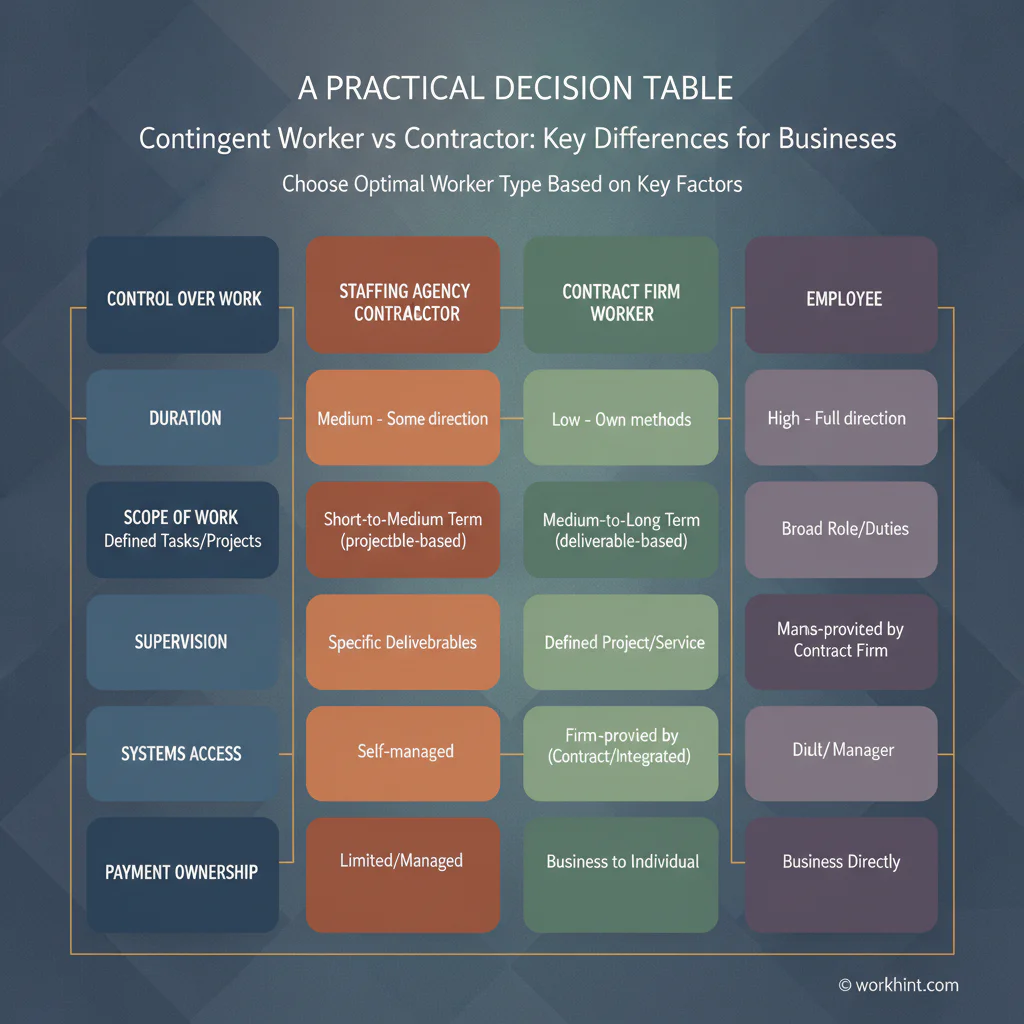
A practical decision table
| Workforce model | Best fit | Operational owner | Watchout |
|---|---|---|---|
| Staffing agency contingent worker | Temporary coverage, seasonal volume, shift-based work, or fast replacement needs | Hiring manager plus staffing partner | Confirm supervision, safety, timesheets, and agency responsibilities before work starts |
| Independent contractor | Project-based work with defined deliverables, specialized skills, and limited direct supervision | Business owner, procurement, and finance | Avoid managing the person like an employee or leaving scope open-ended |
| Contract-firm or consulting worker | Managed services, implementation projects, technical programs, or outsourced functions | Vendor manager and project sponsor | Make sure deliverables, escalation paths, and acceptance criteria are documented |
| Employee | Ongoing work requiring direct management, training, role continuity, and company-controlled methods | People team and department manager | Do not force an employee-like role into contractor paperwork |
How to choose the right model
1. Start with the work, not the label
Write down the business outcome, duration, deliverables, supervision level, required tools, system access, location needs, and payment structure. If the role is ongoing, integrated into the team, and controlled day to day by your managers, it may not belong in a contractor workflow.
2. Decide who controls how the work gets done
Control is one of the biggest practical signals. If you need to dictate hours, training, methods, tools, sequence, and performance management, the model may look more like employment or agency staffing. If the worker is hired to deliver an outcome using their own expertise and business judgment, a contractor model may fit better.
3. Match onboarding to risk
All external workers need onboarding, but not the same onboarding. A contractor may need an agreement, statement of work, tax documentation, insurance, deliverables, payment terms, and project access. A staffing agency worker may need site rules, manager contacts, shift expectations, and timesheet routing. A vendor team may need security review, milestones, escalation contacts, and acceptance criteria.
4. Separate access from employment status
Non-permanent workers often need access to systems, files, facilities, customer information, or operational workflows. Access should be role-based, time-limited, and reviewed when the engagement ends.
5. Define payment ownership early
Payment flows differ. Independent contractors may invoice against milestones or hours. Staffing agencies may bill the company while paying the worker. Contract firms may invoice against deliverables, retainers, or managed service terms. Finance should know the payment trigger, approver, documentation, tax form, purchase order, and dispute path.
Common mistakes
- Using one generic onboarding checklist. This creates unnecessary friction for low-risk work and misses important checks for higher-risk engagements.
- Confusing temporary with independent. Temporary work can still be employee-like, especially when the company controls the worker’s schedule and methods.
- Skipping scope definition. Contractors need clear deliverables, exclusions, milestones, acceptance criteria, and payment terms.
- Letting managers improvise classification. Managers should request the work; HR, legal, procurement, or finance should help determine the right model.
- Forgetting offboarding. External access, payment status, equipment, documents, and performance records should be closed out when the engagement ends.
Where Workhint fits
Workhint helps businesses turn these distinctions into an operating system instead of scattered forms and manual follow-ups. A team can build a workflow that starts with external workforce intake, routes the request to HR, procurement, legal, finance, or the hiring manager, and applies the right onboarding path. For ongoing contractor operations, contractor management software can connect onboarding, assignments, access, records, performance, and offboarding in one operating system.
For a contractor, that might mean collecting agreements, tax details, insurance, scope, milestones, project access, and invoice approvals. For a staffing agency worker, it might mean agency confirmation, shift assignment, manager approval, safety acknowledgement, and timesheet routing. For a vendor team, it might mean risk review, permissions, deliverable tracking, payment status, and performance reporting. The point is to make the right process repeatable.
FAQ
Is every contractor a contingent worker?
Often, yes in ordinary business language, because contractors usually sit outside permanent employment. But “contingent worker” is broader and can also include temps, on-call workers, seasonal workers, freelancers, and workers supplied by contract firms.
Is a contingent worker the same as a temporary employee?
Not always. A temporary employee is one type of contingent worker. A contingent worker may also be an independent contractor, consultant, freelancer, or worker supplied by a vendor or staffing agency.
Who should decide whether someone is a contractor?
The business manager should describe the work need, but classification should involve HR, legal, procurement, or finance when the decision affects tax, labor, contract, insurance, or payment obligations. The Department of Labor notes that misclassification can deny workers wage and hour protections, so this should not be a casual label choice.
What is the biggest operational difference?
Contractors usually need a deliverable-based workflow with scope, acceptance, invoices, and limited supervision. Staffing or temporary workers usually need an assignment-based workflow with schedules, manager contacts, timesheets, safety instructions, and agency coordination.
Conclusion
The difference between a contingent worker and a contractor is more than vocabulary. It shapes how the business scopes the work, controls the relationship, collects documents, grants access, approves work, and pays for results. Use “contingent worker” as the broad category, then choose the specific model that matches the work: staffing agency temp, independent contractor, contract-firm worker, or employee.
The strongest workforce operations teams do not rely on labels alone. They document the model selected and route each worker through the right onboarding, access, approval, payment, and offboarding process.
Leave a Reply