


Accepted work should trigger payment confidence, not another round of inbox archaeology.
Contractor deliverable acceptance is the process a business uses to decide whether external work is complete, usable, documented, and ready for invoice approval. It sits between the statement of work and payment. If that middle step is vague, teams either pay for unfinished work, delay good contractors unnecessarily, or turn every review into a subjective debate.
The goal is not to supervise contractors like employees. The goal is to define outcomes, review submitted work against agreed criteria, document acceptance, and give finance a clean signal that payment can move forward. For classification-sensitive questions, teams should use qualified legal or HR advice; the U.S. Department of Labor explains that misclassification can happen when the real working relationship is employment.
What’s in this article?
- Why contractor deliverable acceptance matters before payment.
- The acceptance criteria to define before work starts.
- A practical workflow for reviewing submitted contractor work.
- An owner table for business, legal, finance, IT, and operations teams.
- Common mistakes that cause rework, disputes, and payment delays.
Why contractor deliverable acceptance matters
Contractor work often moves through several tools: the SOW in one folder, project updates in chat, files in shared drives, approvals in email, and invoices in accounting software. When acceptance is not explicit, finance sees an invoice but cannot tell whether the work was approved. The contractor sees silence and does not know whether to revise, invoice, or escalate. The business owner may remember approving something informally, but the record is hard to find later.
Strong acceptance criteria solve the problem before it starts. Ohio’s acceptance criteria guidance describes acceptance criteria as conditions a deliverable must meet before acceptance, and Atlassian frames them as predefined requirements for deciding when work is complete. For contractor operations, those criteria need to be tied to scope, evidence, review windows, revision rules, and payment triggers.
What to define before a contractor starts
The acceptance process begins before the first file is submitted. A contractor should know what counts as complete work, where to submit it, who reviews it, how long review takes, and what happens if revisions are needed. The internal team should know whether acceptance means the work is final, conditionally approved, rejected, or accepted for a specific milestone only.
At minimum, define the deliverable name, acceptance owner, success criteria, evidence required, format, due date, review window, revision limit, dispute path, and payment trigger. If the deliverable touches regulated work, customer data, safety, brand risk, or client commitments, add the correct review owner before the contractor begins.
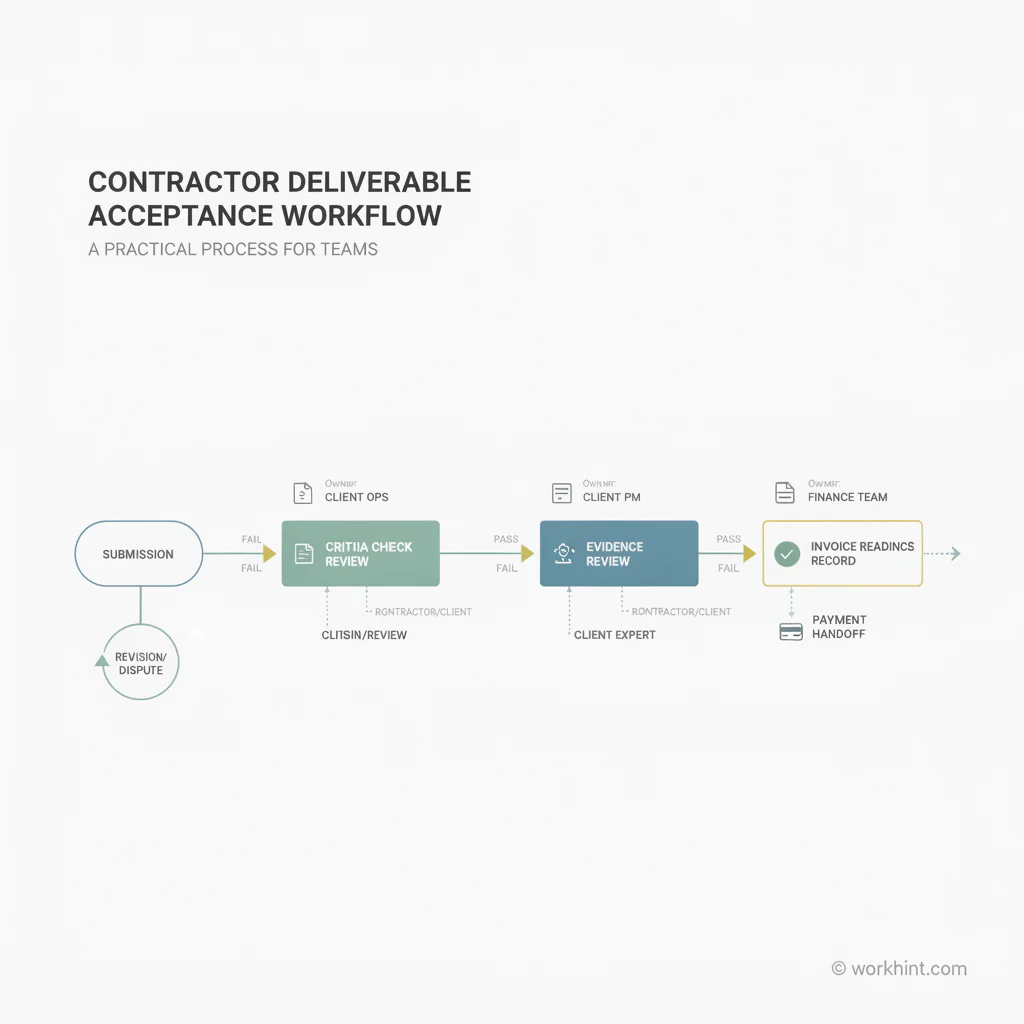
A practical contractor deliverable acceptance workflow
Use a simple workflow that separates intake, review, revision, acceptance, and payment readiness. The sequence matters because each stage produces a record the next team can trust.
- Receive the deliverable: Capture the submission in the agreed channel with date, contractor, project, milestone, files, links, and invoice status if applicable.
- Check completeness: Confirm the right files, formats, evidence, access notes, or supporting documentation are included before asking reviewers to evaluate quality.
- Review against criteria: Compare the work to the SOW, brief, acceptance criteria, and any agreed standards. Keep feedback tied to the criteria, not personal preference.
- Route exceptions: If the work is incomplete, unclear, risky, or disputed, assign a named owner to decide whether it needs revision, partial acceptance, escalation, or rejection.
- Record acceptance: Save who accepted the deliverable, when, against which milestone, and whether acceptance is final or conditional.
- Release payment readiness: Only after acceptance should finance validate the invoice details, tax or vendor record, payment terms, and scheduled payment run. Adobe’s invoice approval workflow guide frames approval as verification before payment.
Acceptance owner table
| Decision | Primary owner | Record to keep | Payment impact |
|---|---|---|---|
| Scope matches the SOW | Business owner | SOW link and acceptance checklist | Allows review to continue |
| Quality meets criteria | Project or functional reviewer | Review notes and evidence | Supports full or partial approval |
| Legal or compliance issue | Legal, HR, or compliance | Exception decision and rationale | May block acceptance |
| Invoice matches accepted work | Finance or AP | Invoice, amount, terms, and approval | Moves payment forward |
| Revision or dispute needed | Business owner with operations support | Revision request or dispute log | Pauses or adjusts payment |
How to handle revisions without creating confusion
Revision rules should be visible before work begins. A good rule says how many revision cycles are included, what counts as a valid revision, who can request one, and how quickly the contractor must receive feedback. A vague request like “make it better” is not an acceptance decision.
For milestone work, partial acceptance can be useful. The business may accept completed pieces, hold back a disputed component, and release payment according to the agreement. That is cleaner than rejecting an entire invoice because one item is unclear. The key is to document exactly what was accepted, what remains open, and whether the contractor can invoice now or must resubmit first.
Common mistakes
- Letting the invoice become the first review: The invoice should confirm accepted work, not start the quality review.
- Using subjective acceptance: If the reviewer cannot point to criteria, the contractor cannot know what to fix.
- Approving in chat only: Chat is easy to lose. Save the acceptance decision with the contractor record, milestone, files, and invoice.
- Skipping exception ownership: Disputes drag when nobody owns the decision to revise, reject, partially accept, or escalate.
- Managing methods instead of outcomes: Contractors should usually be reviewed against deliverables and agreed standards, not controlled through employee-style daily supervision.
Where Workhint fits
Workhint fits when contractor deliverable acceptance needs to become a repeatable workflow instead of a chain of messages. A team can use Workhint to connect the contractor request, SOW, milestone, files, review criteria, approver roles, revision decisions, acceptance record, invoice readiness, and payment status in one operating flow.
That helps business owners review outcomes, finance see what is approved for payment, operations spot stuck reviews, and contractors understand what is still blocking acceptance. Workhint is not the reviewer of quality or the legal decision maker. It is the system that keeps the workflow, records, owners, and handoffs visible enough for the human decisions to happen cleanly.
FAQ
What is contractor deliverable acceptance?
Contractor deliverable acceptance is the documented decision that submitted contractor work meets the agreed scope, criteria, evidence requirements, and review standard. It usually happens before an invoice is approved for payment.
Who should approve contractor deliverables?
The business owner or functional reviewer should approve the quality and completeness of the deliverable. Finance should approve payment only after accepted work is connected to the invoice, payment terms, and contractor record.
Should acceptance criteria be in the contract or the project workflow?
Use both. The agreement or SOW should define the commercial rule, while the workflow should make the criteria operational through owners, due dates, evidence, revision limits, and approval records.
Can a company partially accept contractor work?
Yes, if the agreement allows it and the decision is clearly documented. Partial acceptance should identify which deliverables were accepted, which items need revision, and how payment will be handled.
How does deliverable acceptance reduce payment disputes?
It gives both sides a shared record of what was submitted, what was reviewed, which criteria were met, what was accepted, and what remains open. That makes payment decisions less dependent on memory or scattered messages.
Conclusion
A contractor deliverable acceptance process gives teams a clean way to move from completed work to payment readiness. Define the criteria before work starts, collect the right evidence, review against the agreed standard, document revisions or exceptions, and record acceptance before finance releases payment. The process should be structured enough to protect the business and clear enough to keep good contractors moving.
Leave a Reply