


A document prep business can launch as a focused service platform before you hire a team or build custom software.
If you want to start a document prep business, the lean path is not to open an office, hire paralegals, or promise legal advice. It is to choose one document-heavy customer problem, validate demand, and build a branded way for customers to request help, upload information, approve work, pay, and receive finished documents.
Document preparation is attractive because people and small businesses need help organizing forms, gathering information, formatting documents, and moving paperwork through a clear process. The risk is scope. Stay inside administrative preparation and follow state rules.
This guide shows how to launch with a small budget, a narrow offer, independent providers, and Workhint as the operating foundation.
What’s in this article?
- Why a document prep business works
- What you need before the first client
- How to price services
- How to find first customers without overbuilding
- How Workhint helps launch the business platform
- A 7-day launch plan, checklist, and FAQ
Why this business works
A document prep business works because paperwork creates friction. Customers may know what they need to file or organize, but not how to gather inputs, complete forms cleanly, track revisions, and avoid missed signatures.
The best first version is specific. Instead of offering every document service, start with one practical package: business formation packets, contractor onboarding packets, landlord document organization, or court-form preparation where allowed.
The business also fits a provider-network model. The founder can own the brand, platform, intake process, quality checklist, payments, and relationships while using independent preparers, notaries, translators, or attorney referral partners only when demand justifies it.
What you need to launch
Start with the pieces that let you sell, fulfill, and stay inside clear boundaries. Rules vary by state and service type, so check requirements for document assistants, paralegal services, notary work, tax documents, immigration support, and unauthorized practice of law before accepting clients.
The first offer should fit in one sentence. For example: “We help independent contractors prepare a complete onboarding packet for new client work.” That is easier to sell, price, and fulfill than a vague paperwork promise.
| Startup item | Lean launch approach | Estimated early budget |
|---|---|---|
| Business setup | Register the business, open a bank account, and prepare basic terms | $200-$1,000 |
| Compliance review | Confirm state rules, service boundaries, notices, and attorney referral triggers | $300-$1,500 |
| Insurance | Explore professional liability, cyber coverage, and general liability | $500-$2,000 |
| Branded platform | Set up intake, uploads, status tracking, approvals, payment, and provider workflows | Start lean |
| Provider network | Recruit screened preparers, notaries, translators, or partners as demand grows | $0-$500 |
| Marketing | Build a landing page, local referral list, simple search pages, and outreach scripts | $200-$1,000 |
Avoid the expensive version at the start. You do not need an office, staff, a custom portal, or a full marketplace before customers prove they will pay for one focused service.
How to price it
Document prep pricing should be simple enough for fast approval and specific enough to protect margin. Flat fees work when inputs and deliverables are predictable. Hourly pricing can work for messy organization, but it is harder to compare.
| Offer | Example price | Best use |
|---|---|---|
| Simple form completion support | $75-$200 per package | Defined forms with customer-provided answers |
| Small business document packet | $250-$750 | Entity setup support, contractor packets, vendor documents, or internal templates |
| Rush document prep | Base fee plus 25%-50% | Customers with short deadlines and complete inputs |
| Monthly document support | $300-$1,500 per month | Businesses with recurring onboarding, vendor, lease, or compliance paperwork |
The safest pricing rule is to define what is included, what the customer must provide, and when the job requires a licensed professional. Make that part of the intake flow.
How to get first customers
Start where document problems already exist. Local founders, landlords, real estate professionals, notaries, accountants, staffing companies, contractor-heavy businesses, and small law firms can all create referral opportunities when the scope is appropriate.
Use demand validation before paid ads. Offer a narrow document readiness audit, build one landing page, and ask referral partners what document problems repeatedly slow down customers. Standardize the package people ask for twice.
Good first channels include local groups, accountant referrals, notary partnerships, search pages, LinkedIn outreach, and community education sessions that explain boundaries without giving legal advice.
How Workhint helps launch it
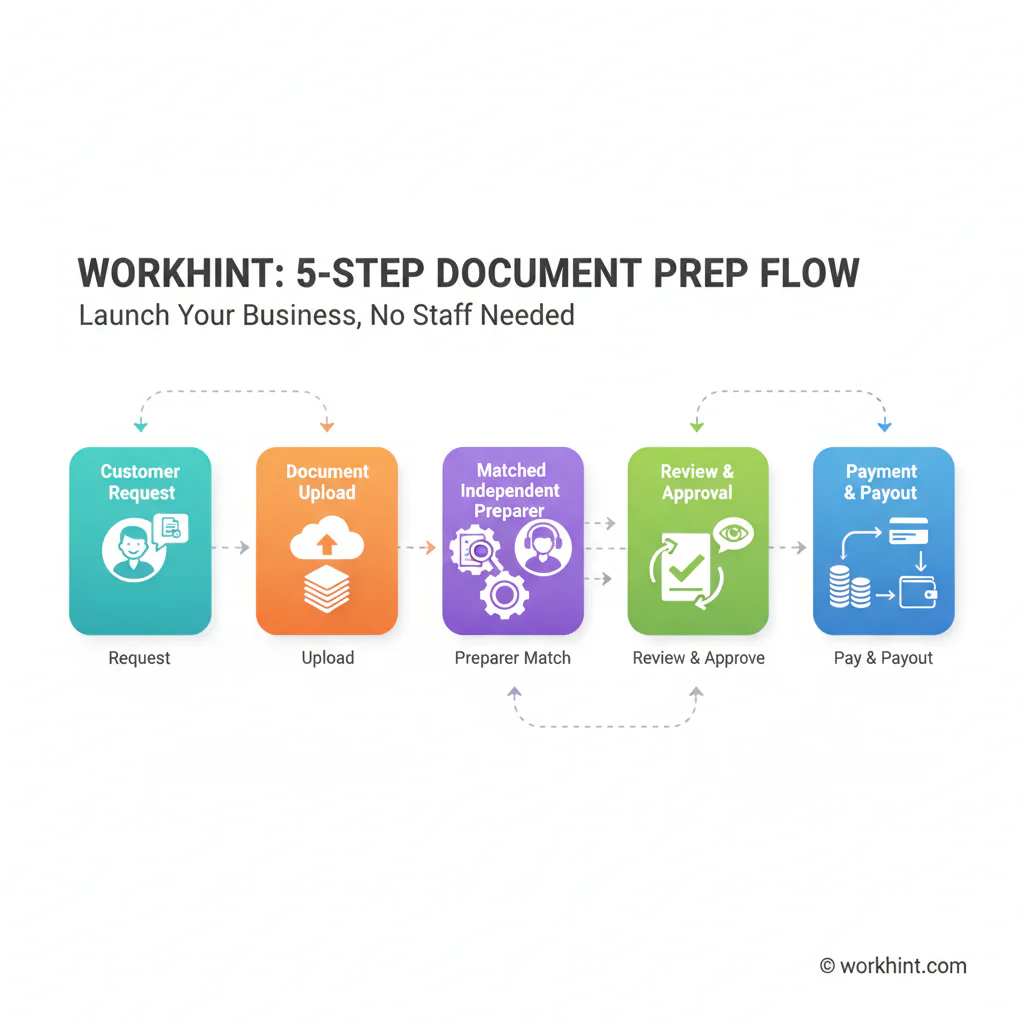
Workhint turns the document prep business into a branded operating platform. A customer submits a request through your branded portal, answers intake questions, uploads files, accepts the scope, and pays. The system routes the job to the right independent preparer or partner based on service type, location, language, availability, and credentials.
The provider receives a task, checklist, due date, requirements, and customer context. You can review the work, request missing information, track approvals, send the completed packet, collect payment, and trigger provider payout without stitching together forms, folders, spreadsheets, email, payment links, and contractor records.
That matters because document prep businesses fail when work is hidden in inboxes. Workhint gives the business one operating system for intake, uploads, assignments, status, quality review, approvals, invoices, payments, payouts, communication, access, and reporting. Validate demand first, then expand after the workflow repeats.
First 7-day launch plan
Day 1: Choose one customer and one document package. Write the promise, exclusions, required inputs, and turnaround time.
Day 2: Check state rules and service boundaries. Decide what you can prepare, what requires a licensed professional, and what notices belong in the intake flow.
Day 3: Set up the branded Workhint platform basics: request form, file upload, payment, approval, provider assignment, and status updates.
Day 4: Recruit two to five providers or referral partners for preparation, notarization, translation, review, or specialized scope.
Day 5: Contact accountants, notaries, landlords, founders, operations managers, and local service businesses with recurring paperwork.
Day 6: Route every conversation through the same intake process. Track where customers hesitate, which documents they ask about, and what inputs are missing.
Day 7: Review demand, pricing, provider readiness, risk boundaries, and turnaround time. Improve the first package before adding another service.
Final launch checklist
- Choose one document prep niche and first package.
- Verify state requirements, licensing rules, notices, and prohibited services.
- Create service boundaries that avoid legal advice unless a licensed professional is involved.
- Register the business and set up basic insurance and payment handling.
- Build the branded Workhint intake, upload, approval, payment, and provider workflow.
- Recruit first independent preparers or referral partners.
- Create a quality checklist for every document package.
- Sell the first package manually before expanding the service menu.
- Validate repeat demand before hiring staff, leasing an office, or building custom software.
FAQ
How much does it cost to start a document prep business?
A lean launch can often start with registration, compliance review, insurance, a branded intake platform, and basic marketing. The first version can be far cheaper than opening an office or hiring staff.
Do I need to be a lawyer to start a document prep business?
Not always, but you must follow state rules and avoid unauthorized practice of law. Administrative preparation is different from legal advice, legal strategy, or regulated filings.
What documents should I start with?
Start with documents that have repeat demand and clear boundaries: business onboarding packets, contractor forms, landlord document organization, or other administrative documents allowed locally.
Can I run the business with independent contractors?
Yes, if the relationship is structured correctly. Use clear scopes, agreements, role-based access, quality review, and payout rules. Check classification requirements before assigning work.
How do I price document prep services?
Use flat fees for predictable packages, rush fees for deadline work, and monthly retainers for recurring business documents. Avoid vague hourly pricing when customers want certainty.
How do I get first customers?
Start with referral partners and one focused landing page. Accountants, notaries, landlords, real estate professionals, and local businesses often see document problems before customers search for help.
What mistakes should beginners avoid?
Avoid giving legal advice, offering too many services, accepting unclear scopes, skipping insurance, losing files in email, or hiring staff before repeat demand exists.
Conclusion
A document prep business is worth starting when you treat it like a focused operating platform, not a vague paperwork side hustle. Choose one package, validate demand, build a screened provider network, and keep every request, file, approval, payment, and payout visible.
Workhint makes that lean launch possible with a branded platform before heavy investment. Start narrow, prove the workflow, then expand when the model repeats.
Leave a Reply