


Use this policy to make attendance expectations clear without turning every absence into a manager judgment call.
An employee attendance policy template helps a company define when employees are expected to work, how absences are reported, what counts as late, how records are kept, and how managers respond when patterns become a problem. The best version is an operating rule that HR, payroll, managers, and employees can follow consistently.
This resource is written for U.S.-based business teams that need a practical starting point. It is not legal advice. Attendance rules can interact with wage and hour law, protected leave, disability accommodation, state paid sick leave, union agreements, local scheduling laws, and industry requirements. Review the final policy with qualified HR or legal support before adopting it.
What is included
This template gives you the core sections most attendance policies need:
- Purpose and scope
- Work schedule expectations
- Absence, lateness, and early departure definitions
- Call-in and notice requirements
- Documentation and recordkeeping rules
- Protected leave and accommodation handling
- Manager review and corrective action steps
- Employee acknowledgment language
How to use this employee attendance policy template
Start by deciding which employee groups the policy covers. A remote team, retail shift team, field crew, and hourly operations center may need different notice windows and escalation paths. Keep one company-wide baseline, then add role-specific rules only where the work requires them.
Next, separate the employee’s schedule, notice obligation, and the company’s response. An employee can be absent for a valid reason and still need to follow a notice process. A manager can document an absence without treating it as discipline. HR can review patterns before deciding whether protected leave, accommodation, performance, or staffing issues apply.
Finally, connect the policy to timekeeping. The U.S. Department of Labor explains that employers covered by the Fair Labor Standards Act must keep certain records for nonexempt employees, including hours worked and wages paid. Your policy should support accurate records, not replace them.
Employee attendance policy template
Purpose
[Company Name] expects employees to attend work as scheduled, arrive ready to work on time, report absences promptly, and follow the procedures in this policy. The purpose of this policy is to support reliable operations, fair scheduling, accurate pay records, and consistent manager follow-up.
Scope
This policy applies to [employee groups covered by the policy]. It should be read together with the company’s PTO, sick leave, holiday, remote work, wage and hour, employment agreement, collective bargaining, and local legal requirements.
Work schedule expectations
Employees are expected to work their assigned schedule unless time off has been approved, protected leave applies, or an emergency prevents advance notice. Employees should be ready at the scheduled start time and available through the scheduled end time, including required meetings, handoffs, customer coverage, and on-call periods where applicable.
Definitions
- Absence: Missing a scheduled workday, shift, assignment, or required work period.
- Tardiness: Arriving or logging in late without prior approval.
- Early departure: Leaving before the scheduled end time without approval.
- No call/no show: Missing scheduled work without notifying the required contact through the required channel.
- Approved absence: Time away approved under company policy or required by applicable law.
- Unexcused absence: Time away that is not approved and is not protected by applicable law or company policy.
Notice procedure
If an employee cannot work as scheduled, the employee must notify [manager, scheduling lead, HR, or designated channel] as soon as possible and no later than [time requirement]. The notice should include the date, expected duration, coverage need, and urgent handoff information.
Documentation
The company may request documentation when allowed by law and company policy, especially for repeated absences, extended absences, safety-sensitive roles, protected leave requests, or return-to-work requirements. Store documentation confidentially.
Protected leave and accommodation
Attendance issues must be reviewed carefully when an absence may involve protected leave, disability accommodation, workers’ compensation, military leave, jury duty, paid sick leave, or another legally protected reason. The Department of Labor’s FMLA employer guide and FMLA fact sheet explain employer obligations for covered leave. The EEOC also provides guidance on reasonable accommodation under the ADA. Managers should escalate potential protected-leave or accommodation issues to HR before corrective action.
Corrective action
When attendance problems are not protected or approved, the company may use coaching, written reminders, formal warnings, schedule review, performance action, or other corrective steps. Consider the pattern, business impact, prior communication, employee history, and whether the rule has been applied consistently.
Acknowledgment
Employees should acknowledge that they have received, read, and understood the policy. The acknowledgment should not prevent protected leave, accommodation requests, concern reporting, or legal rights.
Employee attendance policy workflow
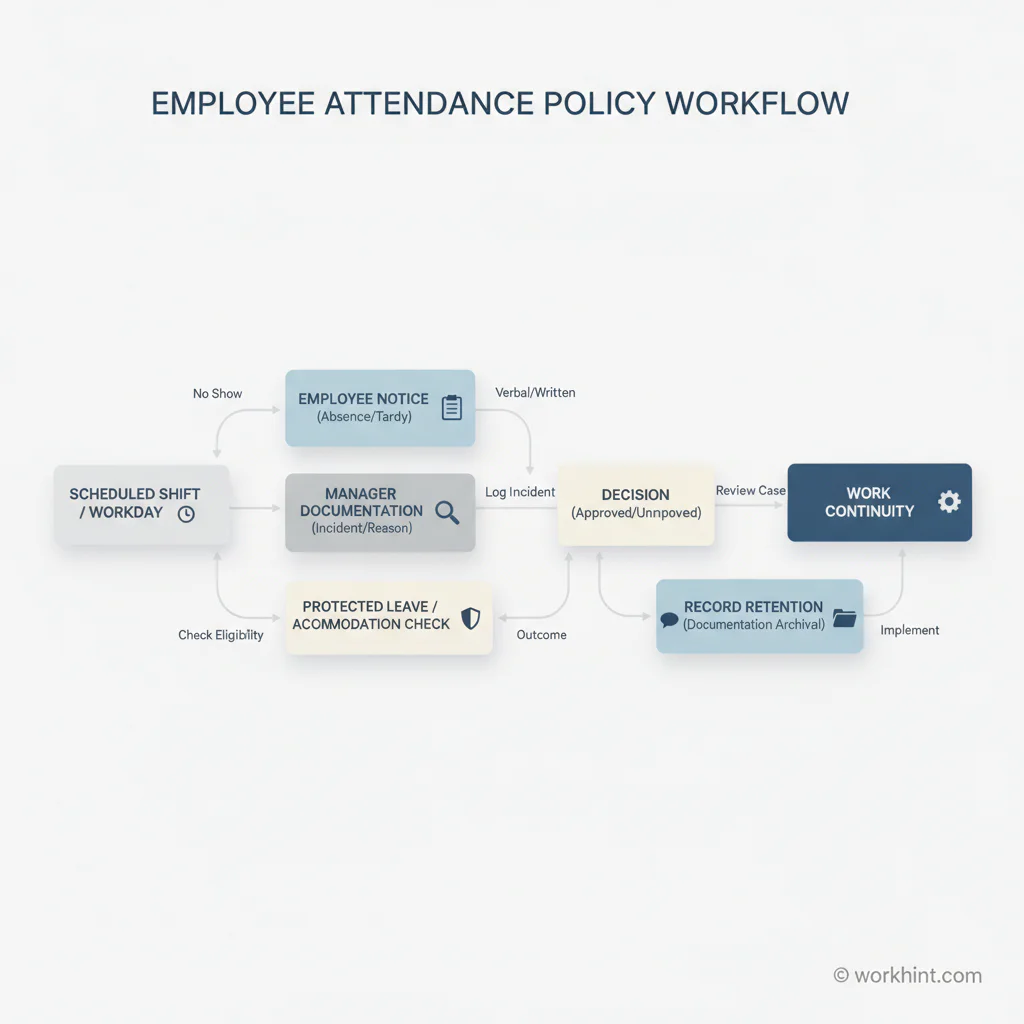
| Step | Owner | What to capture | Decision point |
|---|---|---|---|
| Employee reports absence or lateness | Employee | Date, time, expected duration, coverage need | Was notice given through the approved channel? |
| Manager documents event | Manager | Schedule, actual time, impact, handoff notes | Is this isolated or part of a pattern? |
| HR reviews exceptions | HR | Leave request, accommodation signal, policy history | Could protected leave or accommodation apply? |
| Payroll confirms records | Payroll or HR ops | Hours worked, paid time off, unpaid time, corrections | Are time and pay records complete? |
| Follow-up is assigned | Manager and HR | Coaching note, approval, warning, schedule adjustment | What action is fair, documented, and consistent? |
Common mistakes to avoid
- Using vague language. “Excessive absenteeism” means little unless employees know how notice and review work.
- Treating all absences the same. Ordinary attendance issues, protected leave, disability accommodation, and approved PTO need different handling.
- Letting each manager improvise. Inconsistent enforcement creates employee confusion and business risk.
- Ignoring time records. Attendance documentation should align with payroll and timekeeping records, especially for nonexempt employees. The DOL’s FLSA recordkeeping fact sheet explains federal requirements.
- Making the policy punitive only. Good attendance management also identifies scheduling problems, workload issues, unclear coverage rules, and burnout signals.
Where Workhint fits
Workhint helps organizations turn an attendance policy from a static handbook page into a live operating workflow. A team can define the notice form, manager review steps, HR exception checks, payroll handoffs, document rules, approvals, reminders, and reporting views around the policy. For timesheet and attendance resources, time tracking software can connect hours, exceptions, approvals, records, and reporting.
For example, a field operations team could route absence notices to the right supervisor, trigger coverage tasks, alert HR when a pattern needs review, separate protected-leave review from ordinary coaching, and keep payroll status visible. The policy still sets expectations, but the work around it becomes trackable.
FAQ
What should an employee attendance policy include?
It should include the policy purpose, who is covered, work schedule expectations, definitions for absence and lateness, notice rules, documentation requirements, protected leave handling, corrective action steps, recordkeeping expectations, and employee acknowledgment language.
Can an attendance policy use points?
Some companies use point-based attendance systems, but points should not be applied mechanically without reviewing protected leave, disability accommodation, local sick leave rules, and other exceptions. HR or legal review is especially important before adopting a no-fault attendance policy.
Who should approve exceptions?
Managers can usually approve ordinary scheduling exceptions, but HR should review patterns, protected-leave signals, accommodation requests, return-to-work issues, and any corrective action that could affect employment status.
How often should the policy be reviewed?
Review the policy at least annually and whenever the company changes schedules, work locations, timekeeping systems, leave policies, state coverage, or workforce model. Also review it after recurring disputes or inconsistent manager decisions.
Conclusion
A strong attendance policy does more than tell employees to show up on time. It gives everyone a clear process for notice, documentation, exceptions, records, and follow-up. When the policy is specific and the workflow behind it is reliable, teams can protect operations while treating attendance issues with consistency and care.
Leave a Reply