


A good safety orientation turns outside workers from approved on paper into ready for the actual worksite.
A contractor safety orientation checklist gives managers a practical way to confirm that external workers understand the site, the hazards, the rules, and the reporting path before work begins. It is not a replacement for qualified safety advice, legal review, or site-specific training. It is the operating layer that makes sure the right safety steps happen, are owned, and are recorded.
This matters for construction, facilities, field service, events, logistics, maintenance, healthcare support, manufacturing, and any operation where contractors, vendors, subcontractors, or temporary external crews enter a workplace. Approval to hire a contractor is not the same as readiness to start work.
What’s in this article?
- Why contractor safety orientation matters before work starts.
- The checklist items every business team should adapt by site and scope.
- A workflow for turning orientation into a readiness gate.
- A responsibility table for operations, safety, managers, vendors, and contractors.
- Common mistakes that create preventable gaps.
- Where Workhint fits when safety readiness needs to be tracked across external teams.
Why contractor safety orientation matters
Contractors often arrive with their own employer, tools, training, schedule, and assumptions. The business still needs a consistent way to explain site-specific hazards, emergency rules, access limits, communication paths, and proof requirements. If that information lives in emails, printed packets, and memory, readiness becomes hard to verify.
OSHA’s recommended practices for safety and health programs emphasize management leadership, worker participation, hazard identification, prevention controls, education, and continuous improvement. A contractor orientation checklist should support those basics by converting them into tasks a team can actually complete before work starts.
The goal is simple: no contractor should begin site work until the business can answer three questions. What work are they doing? What hazards and controls apply? What evidence shows they received and acknowledged the right information?
Contractor safety orientation checklist
Use this checklist as a practical starting point. Safety requirements vary by industry, location, site, and work type, so adapt it with qualified safety, legal, HR, or compliance input where needed.
| Checklist area | What to confirm | Owner |
|---|---|---|
| Scope and location | Work description, site, dates, supervisor, restricted areas, and expected working hours. | Business manager |
| Hazards | Site-specific hazards, task hazards, equipment risks, traffic routes, and environmental conditions. | Safety or operations |
| PPE | Required protective equipment, who provides it, replacement rules, and inspection expectations. | Safety owner |
| Emergency procedures | Evacuation routes, muster points, first aid, incident contacts, severe weather, and stop-work authority. | Site lead |
| Permits and controls | Hot work, confined space, electrical, lockout/tagout, vehicle, height, or other permit requirements. | Safety and site lead |
| Hazard communication | Chemical labels, safety data sheet access, storage rules, and exposure reporting. | Safety owner |
| Acknowledgement | Signed or digital acknowledgement, completion date, trainer, contractor company, and version used. | Operations |
| Access release | Badge, system, gate, equipment, or work-order access only after required steps are complete. | IT, facilities, or site lead |
For chemical or hazardous-material exposure, include a clear hazard communication step. OSHA’s Hazard Communication resources are a useful reference for labels, safety data sheets, and worker information requirements.
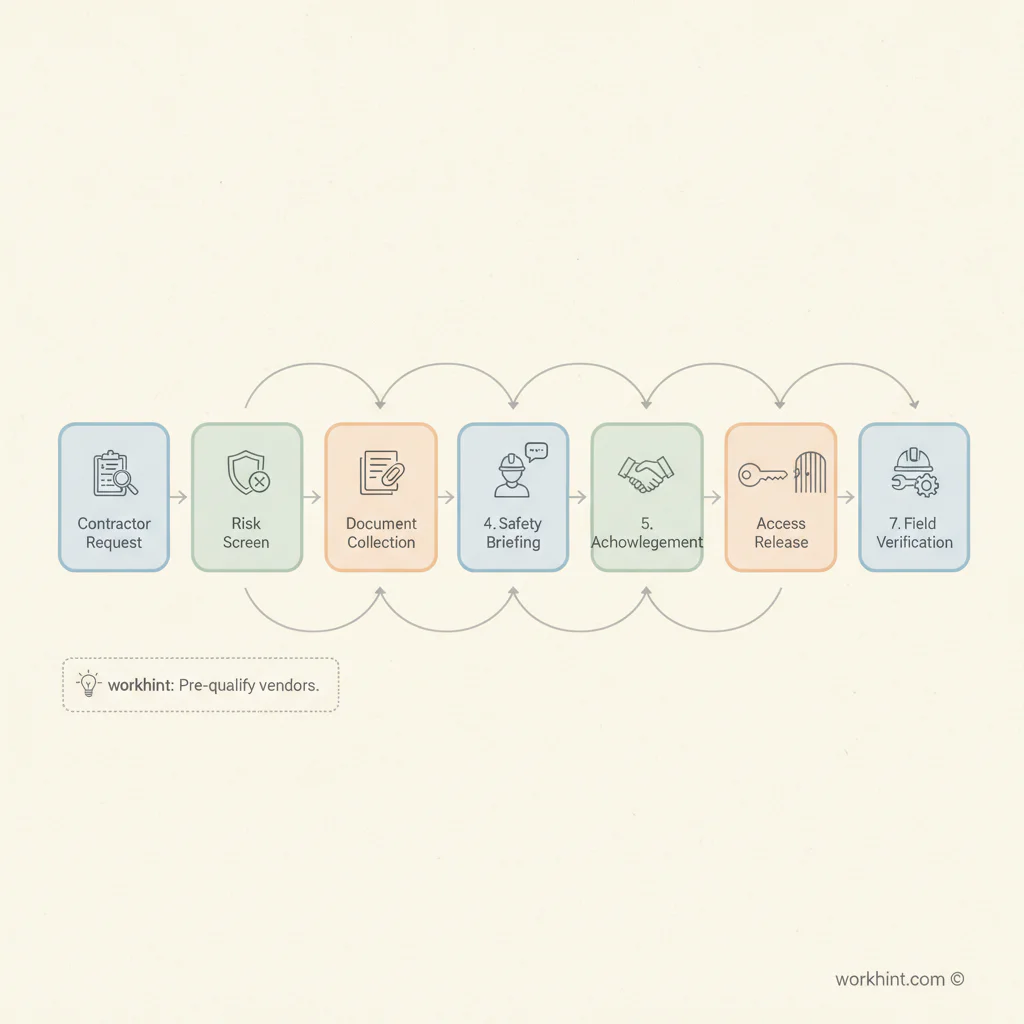
Contractor safety orientation workflow
The checklist works best when it is part of a workflow, not a PDF attached to a calendar invite. Start with the contractor request. The manager describes the work, location, expected dates, tools, access needs, and whether the contractor is working alone, with employees, or under a vendor supervisor.
Next, route the request to the right safety or operations owner. A low-risk remote consultant may need no site safety orientation. A maintenance contractor entering a facility after hours may need emergency procedures, restricted-area rules, PPE, and access control. A subcontractor doing physical work may need a fuller review.
Then collect documents before the briefing. Depending on the work, this may include insurance, licenses, certifications, job hazard analysis, method statements, training records, or vendor safety contacts. The North Carolina Department of Labor’s training orientation checklist example is a useful reminder that checklists should be modified for the organization and worksite rather than copied blindly.
After orientation, require acknowledgement before access is released. That is the readiness gate. The contractor should not receive a badge, dispatch assignment, system access, equipment, or permission to begin site work until the record is complete.
Who should own each step?
Contractor safety orientation is shared work. When ownership is vague, managers assume safety handled it, safety assumes the vendor handled it, and the contractor assumes approval means readiness.
| Role | Primary responsibility |
|---|---|
| Business manager | Defines scope, timing, location, and why the contractor is needed. |
| Safety or compliance owner | Defines orientation requirements, hazard controls, PPE, and evidence rules. |
| Site lead | Explains local rules, emergency procedures, restricted areas, and daily check-in. |
| Vendor or contractor company | Confirms its workers are qualified, trained, insured, and assigned correctly. |
| Contractor | Completes orientation, follows site rules, reports hazards, and stops work when needed. |
| Operations | Keeps the record, monitors status, and prevents work from starting before readiness. |
Common mistakes to avoid
- Using one orientation for every site. Keep a baseline, then add site-specific hazards, contacts, routes, and controls.
- Releasing access before acknowledgement. Access should follow readiness, not create pressure to skip readiness.
- Ignoring vendor-supervised workers. Even if a vendor manages the crew, the site still needs clear local rules and reporting paths.
- Letting expired records stay active. Certifications, insurance, permits, and orientation versions may need renewal triggers.
- Tracking completion in email. Email can prove a message was sent, but it is weak as the operating record for readiness.
Where Workhint fits
Workhint fits when contractor safety orientation needs to become a live workflow across managers, safety owners, vendors, site leads, facilities, IT, and finance. A business can use Workhint to capture contractor requests, assign risk tiers, collect documents, route safety review, deliver orientation tasks, capture acknowledgements, block access release until requirements are complete, and keep readiness visible by site or contractor company.
That does not replace the safety program. It helps the business run the program consistently. The checklist becomes enforceable, the owners are clear, the evidence is stored, and the status can follow the contractor from request to active work, payment readiness, renewal, or offboarding.
FAQ
What should be included in a contractor safety orientation checklist?
Include scope, site rules, hazards, PPE, emergency procedures, incident reporting, permits, restricted areas, hazard communication, acknowledgement, and access release requirements.
Is contractor safety orientation required?
Requirements depend on the jurisdiction, industry, site, and work type. Many businesses require orientation as part of their safety program because it creates a documented readiness step before work begins.
Who should deliver contractor safety orientation?
The right owner depends on the work. Safety, operations, the site lead, or a qualified vendor representative may deliver parts of the orientation, but the business should define who owns completion and evidence.
How often should contractors repeat safety orientation?
Repeat orientation when the site, scope, hazards, rules, or contractor personnel change. Many teams also set periodic renewal rules for active contractors and vendors.
Should orientation happen before or after contractor onboarding?
It should happen after the contractor is approved for the type of relationship, but before site access or work authorization. Treat it as a readiness gate inside contractor onboarding.
Conclusion
A contractor safety orientation checklist helps teams make external work ready before it becomes active. The useful version is specific, owned, documented, and tied to access. It explains the site, the hazards, the controls, the emergency path, and the evidence required to start work.
When the checklist becomes a workflow, safety readiness stops depending on memory. Managers know what to request, safety owners know what to review, contractors know what to complete, and the business can see who is ready before work begins.
Leave a Reply