


You can test pest control demand before buying trucks, hiring technicians, or building custom software.
If you want to know how to start a pest control business with less risk, start with demand, licensing, and operations before equipment. When ants, roaches, rodents, termites, or mosquitoes appear, homeowners and property managers want a fast response, a clear treatment plan, and proof that the problem is handled.
The mistake is assuming you need a full fleet, warehouse, and payroll on day one. A leaner path is to build a branded customer platform, recruit licensed independent providers or partner operators, validate repeat demand, and coordinate work through a reliable operating system. Workhint can become that foundation while you focus on customers and provider quality.
What’s in this article?
- Why a pest control business can work
- What you need to launch without overinvesting
- How to price pest control services
- How to get first customers
- How Workhint helps launch the platform
- A 7-day launch plan, checklist, and FAQ
Why this business works
Pest control works because the customer problem is urgent, recurring, and local. Many customers need one-time treatments, but the stronger business model is recurring prevention: quarterly visits, seasonal mosquito service, rodent monitoring, rental-property turnover checks, and commercial maintenance plans.
The service is also trust-based. Customers care about licensing, safety, punctuality, communication, and follow-up. That creates room for a modern operator that makes booking, documentation, treatment notes, reminders, payment, and customer updates feel simple.
A no-staff launch does not mean ignoring regulation. It means building around licensed capacity before hiring employees. Depending on your state, that may mean becoming certified yourself, partnering with a qualifying operator, or onboarding licensed independent pest professionals.
What you need to launch
Start with the smallest compliant version of the business. Pest control is regulated, so licensing comes before selling treatments. Federal rules require certification for restricted-use pesticides, and states often add applicator, structural pest control, business, supervision, insurance, and recordkeeping requirements.
Your first offer should be narrow. General residential prevention, apartment-turnover pest checks, mosquito service, rodent inspection, or property-manager maintenance routes are easier to validate than every possible pest service. Delay owned trucks, large chemical inventory, and employees until demand supports them.
| Launch item | Lean approach | Typical early budget |
|---|---|---|
| Business registration | Register the entity and local business license | $100-$800 |
| Licensing | State pesticide or structural pest requirements | $200-$1,500 |
| Insurance | General liability, pollution or chemical coverage where needed | $1,000-$4,000 annually |
| Platform setup | Customer portal, intake, scheduling, payments, provider onboarding | Lean software budget |
| Provider network | Recruit licensed independent providers or partner operators | Mostly time and outreach |
| Marketing | Local SEO, flyers, property-manager outreach, referral partners | $300-$2,000 |
| Equipment | Only buy what your own licensed team needs after demand is proven | Delay if using providers |
How to price it
Price around the type of pest, property size, urgency, visit frequency, and whether the customer wants prevention or a one-time fix. Recurring plans are usually better than one-off jobs because they create predictable routes and retention.
| Offer | Common pricing model | Best use |
|---|---|---|
| Initial inspection | Free to $150, sometimes credited to service | Qualifying the issue and building trust |
| One-time treatment | $150-$500+ depending on pest and severity | Urgent residential or rental-property problems |
| Quarterly prevention | $100-$175 per visit | Recurring residential route density |
| Monthly commercial plan | $75-$250+ per location | Restaurants, offices, warehouses, and property managers |
| Specialty service | Quoted after inspection | Termites, bed bugs, exclusion, or complex infestations |
Your margin depends on provider payout, travel time, materials, callbacks, insurance, and marketing cost. Track each job by source, close rate, service type, provider cost, rating, and repeat opportunity.
How to get first customers
Start with customers who already have repeat pest problems. Property managers, short-term rental hosts, apartment owners, restaurants, small offices, storage facilities, and real estate agents need fast coordination and documentation.
Build a simple local offer: inspection, clear quote, licensed service, completion notes, and recurring prevention plan. Then sell through direct outreach, Google Business Profile, local SEO pages, neighborhood groups, referral partners, and follow-up campaigns to landlords and property managers.
The first goal is to prove that customers will request service through your branded platform and that licensed providers can fulfill jobs reliably. After repeat jobs work, decide whether to add employees, owned equipment, or tighter routes.
How Workhint helps launch it
Workhint lets you launch the operating platform for the pest control business before you build custom software or hire a back office. A customer can request service through your branded portal, upload photos, choose property type, describe pests, approve a quote, schedule a visit, pay online, and receive completion notes in one place.
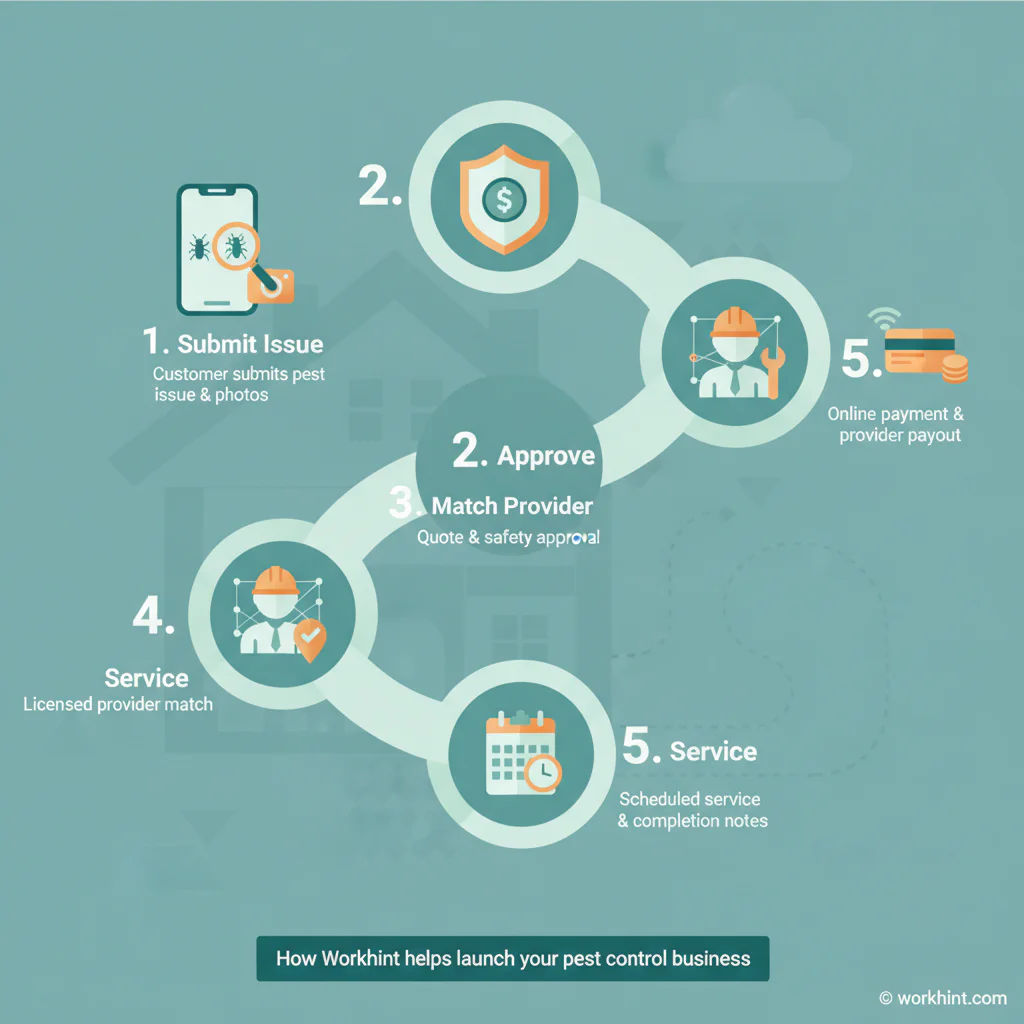
Behind the scenes, you can invite licensed independent providers, collect credentials, assign work by location and service type, manage availability, route job details, require checklists and photos, approve completion, send invoices, collect reviews, and manage provider payouts.
For pest control, trust and compliance are part of the service. Workhint keeps intake forms, provider documents, job notes, approvals, reminders, recurring plans, and payout records connected instead of scattered across texts, spreadsheets, and payment apps.
First 7-day launch plan
- Day 1: Choose one launch market, one pest category, and one customer segment, such as quarterly residential prevention or property-manager turnover service.
- Day 2: Confirm state licensing rules and decide whether you will become certified, partner with a licensed operator, or recruit licensed independent providers.
- Day 3: Set up the branded Workhint platform with intake, quote approval, scheduling, payment, provider onboarding, and job completion forms.
- Day 4: Recruit the first licensed providers or partner operators and verify credentials, insurance expectations, service areas, and payout terms.
- Day 5: Contact property managers, landlords, restaurant owners, real estate agents, and neighborhood referral sources with a narrow launch offer.
- Day 6: Route every interested customer through the platform, test quoting, schedule availability, and provider assignment before accepting more volume.
- Day 7: Review demand, compliance gaps, provider readiness, pricing, callback risk, and customer feedback before investing in owned equipment or hiring.
Final launch checklist
- Choose a narrow pest control offer and launch market.
- Confirm state and local licensing requirements before selling treatments.
- Register the business and secure required insurance.
- Create the branded Workhint customer portal and intake form.
- Build quote approval, scheduling, payment, completion, and payout flows.
- Recruit licensed independent providers or a qualified partner operator.
- Create provider credential and service-quality checks.
- Launch outreach to property managers and local recurring-service prospects.
- Track every lead, job, callback, review, and repeat-service opportunity.
- Validate demand before buying trucks, stocking large inventory, or hiring staff.
FAQ
How much does it cost to start a pest control business?
A traditional launch can require tens of thousands of dollars for vehicles, equipment, licensing, insurance, inventory, marketing, and working capital. A platform-first model can reduce early cash needs by validating demand before buying major assets.
Do I need a license to start a pest control business?
Usually yes. Pest control licensing is state-specific, and restricted-use pesticide application requires proper certification. Some states also require a structural pest control license, qualifying manager, supervision rules, continuing education, and records.
Can I start a pest control business with no employees?
Yes, if the work is legally performed by you, a licensed partner, or properly onboarded licensed independent providers. The no-staff model works only when compliance and provider quality are handled carefully.
What pest control services should I start with?
Start with a narrow service that is easier to sell and fulfill, such as general residential prevention, quarterly maintenance, apartment turnovers, mosquito service, or property-manager routes. Avoid complex specialty work until you have the right credentials and providers.
How do pest control businesses get first customers?
The fastest first channels are property-manager outreach, landlord referrals, Google Business Profile, local SEO, neighborhood groups, real estate agents, restaurants, and partnerships with cleaning, landscaping, and handyman businesses.
Is pest control profitable?
It can be, especially when recurring plans create route density and repeat revenue. Profit depends on pricing, provider cost, materials, callbacks, travel time, insurance, and customer acquisition cost.
Should I buy equipment before getting customers?
Buy only what is required for legal and safe delivery of your first offer. If you are using licensed independent providers, delay trucks, large chemical inventory, and specialized equipment until customer demand and job volume justify them.
Conclusion
The fastest path is to start narrow, stay compliant, recruit licensed capacity, and validate demand before heavy investment. If you can deliver trust, speed, documentation, and follow-up through a branded platform and provider network, you can launch before building a traditional operation.
Leave a Reply