


Dependencies do not break work because they exist. They break work when nobody owns the handoff.
To manage dependencies across teams, treat each dependency as a small operating workflow, not a note buried in a project plan. A dependency should have a clear requester, provider, owner, due date, decision rule, status, risk level, and escalation path. Without that structure, teams discover blockers too late and spend their coordination time asking who was supposed to do what.
This matters for operations, launches, client delivery, finance approvals, compliance reviews, vendor onboarding, and any workflow where one team cannot finish until another team does its part. The goal is not to remove every dependency. The goal is to make dependencies visible early enough that teams can plan around them.
What’s in this article?
- What cross-team dependencies are and why they slow work down.
- A practical dependency workflow for business teams.
- A dependency tracking table you can adapt.
- Common mistakes that turn dependencies into blockers.
- How Workhint fits when dependencies need to become a live work system.
Why dependency management matters
A dependency is a relationship between pieces of work where one task, decision, input, asset, approval, or system action affects another. Atlassian’s guide to project dependencies explains common dependency types and why mapping them helps teams understand the order and impact of work. Asana similarly describes a project dependency as work that relies on another task before it can move forward.
In business operations, the hard part is ownership. A launch depends on legal approval. Legal depends on a complete brief. The brief depends on product details. Product depends on customer requirements. Each team may be doing its own work well, while the overall process still stalls because the dependency is not managed as shared work.
How to manage dependencies across teams
The best way to manage dependencies across teams is to create a repeatable dependency workflow. That workflow should answer six questions before the dependency becomes urgent.
- What is the dependency? Name the input, decision, asset, approval, task, access, data, or deliverable one team needs from another.
- Who owns it? Assign one accountable owner on the providing team and one owner on the receiving team.
- When is it needed? Record the due date, not just the final project deadline.
- What is the acceptance standard? Define what complete means so the receiving team is not surprised by partial work.
- What happens if it slips? Set a trigger for escalation, replanning, or scope tradeoff.
- Where is it tracked? Keep the dependency visible in the same operating system where work status, owners, and decisions are reviewed.
This is especially important for external or distributed teams. A study on coordination strategies for work-from-anywhere teams found that teams adapted coordination based on task clarity and location. When people are not solving dependencies in the same room, the system must carry more of the context.
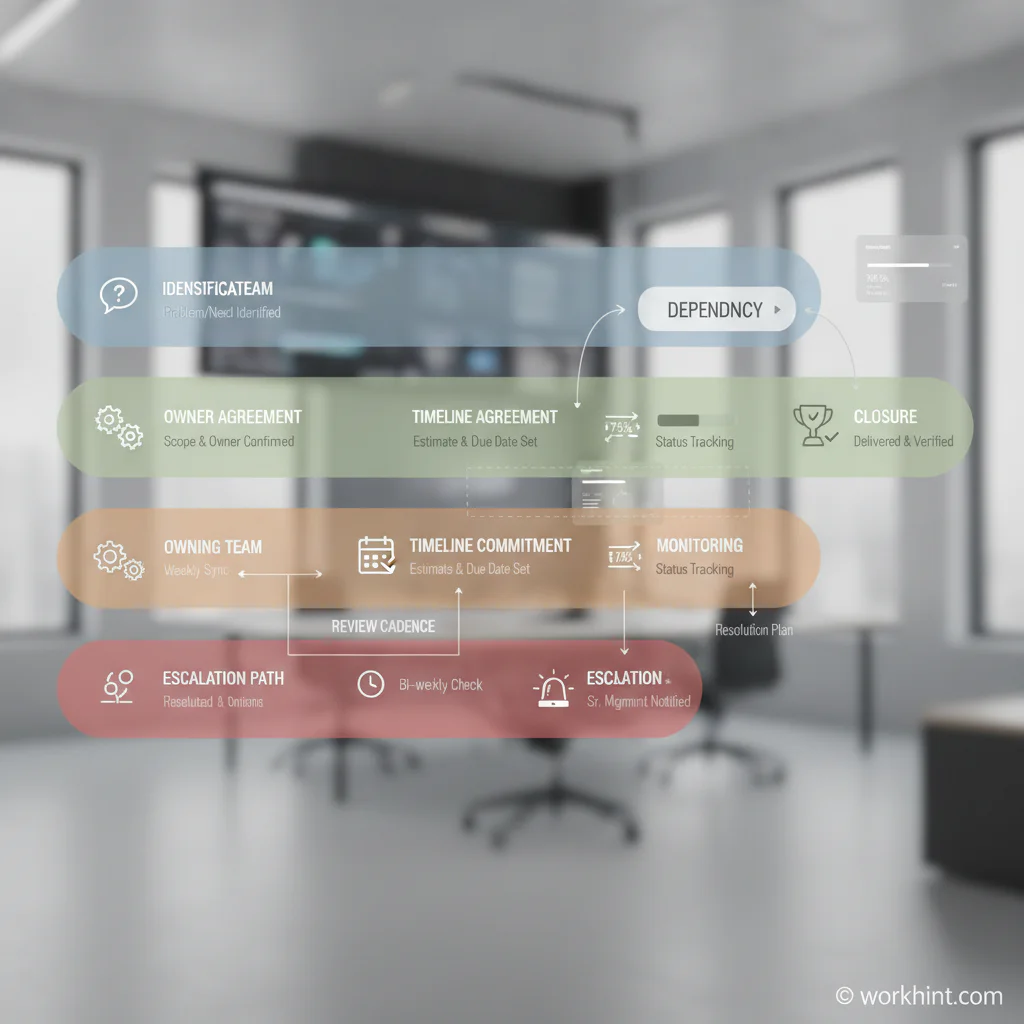
Cross-team dependency workflow
Use this workflow when a dependency crosses departments, vendors, clients, locations, or systems.
| Step | Owner | Output |
|---|---|---|
| Identify the dependency | Requesting team | Dependency record with needed input, reason, and date |
| Confirm feasibility | Providing team | Accepted, rejected, or revised commitment |
| Agree on acceptance criteria | Both teams | Clear definition of complete |
| Track status | Dependency owner | Open, at risk, blocked, delivered, or closed |
| Escalate when needed | Workflow owner | Decision, resource change, date change, or scope tradeoff |
| Close and review | Both teams | Confirmation that downstream work can proceed |
Scrum Alliance guidance on managing dependencies in Scrum recommends getting specific delivery commitments from external contributors and checking whether anything threatens those commitments. That same habit works outside software: do not ask for vague updates. Ask whether the dependency will be ready when the downstream team needs it.
Build a dependency register
A dependency register does not need to be complicated. It needs to be complete enough to prevent ambiguity. Use it for launches, client delivery, recurring approvals, vendor work, implementation plans, finance handoffs, and internal service requests.
| Field | What to capture | Why it matters |
|---|---|---|
| Dependency name | Short description of the needed input or action | Makes the dependency easy to reference |
| Requesting team | Team blocked or affected by the dependency | Shows who needs the outcome |
| Providing team | Team responsible for the input, approval, or deliverable | Clarifies where work must happen |
| Accountable owner | One named person or role | Prevents shared ownership from becoming no ownership |
| Need date | Date the downstream team needs the dependency | Separates dependency timing from the final deadline |
| Status | Open, at risk, blocked, delivered, or closed | Creates a shared operating view |
| Escalation trigger | Missed date, missing owner, unclear scope, or blocked decision | Moves problems before they become emergencies |
Set rules for priority and escalation
Dependencies become political when every team believes its work is most urgent. Set rules before the conflict starts. A high-impact customer launch, compliance deadline, payroll process, safety issue, or executive commitment may deserve faster escalation than a low-risk internal improvement. The dependency record should make that priority visible.
Do not escalate every delay to leadership. Escalate when the assigned owners cannot resolve the tradeoff themselves. Useful escalation triggers include no owner assigned, no commitment date, missed commitment, blocked approval, capacity conflict, customer impact, budget impact, or compliance risk.
Common mistakes
- Tracking dependencies only in meetings. If the dependency is not written down, it will be forgotten between check-ins.
- Using final deadlines as dependency dates. Downstream teams need inputs before the final deadline, not on the final deadline.
- Assigning a team instead of an owner. A team can contribute, but one owner should be accountable for progress.
- Ignoring acceptance criteria. Delivered work is not useful if the receiving team cannot use it.
- Escalating too late. Escalation should protect delivery, not explain failure after the date has passed.
Where Workhint fits
Workhint fits when dependencies need to become a live operating system instead of scattered notes across task tools, documents, messages, and meetings. A team can describe the dependency workflow it wants to run, then use Workhint to structure intake, roles, owner assignment, status tracking, approvals, reminders, escalation paths, dashboards, and reporting.
That is useful when dependencies cross business functions or external contributors. For example, a client implementation can route legal review, data access, training content, vendor setup, finance approval, and launch readiness through one connected workflow. Each team sees only the work it owns, while operations can see the whole dependency map.
FAQ
What is a cross-team dependency?
A cross-team dependency is work that one team needs from another team before it can move forward. It may be an approval, input, asset, decision, system change, data file, review, or completed task.
How do you track dependencies across teams?
Track dependencies in a shared register or workflow with the dependency name, requesting team, providing team, owner, need date, status, acceptance criteria, and escalation trigger. Review the register on a regular cadence.
Who should own a dependency?
Each dependency should have one accountable owner on the providing side and one owner on the receiving side. The providing owner drives the input or deliverable. The receiving owner confirms whether it meets the need.
What is the difference between a dependency and a blocker?
A dependency is a relationship between pieces of work. A blocker is a dependency or issue that is currently preventing progress. Good dependency management catches risks before they become blockers.
Conclusion
Dependencies are normal in any business with specialized teams. They become expensive when they are invisible, ownerless, or discovered too late. To manage dependencies across teams, give every dependency a record, owner, need date, acceptance standard, status, and escalation path.
The point is not more administration. The point is fewer surprises. When dependencies are managed as part of the operating system, teams can stay autonomous without losing the coordination needed to deliver connected work.
Leave a Reply