


Use this practical form to document employee discipline clearly, consistently, and with enough follow-up to make the next step obvious.
An employee disciplinary action form template gives HR teams and managers a consistent way to document workplace conduct, policy violations, attendance problems, safety issues, or repeated performance concerns. The goal is to create a fair record of what happened, what standard applies, what improvement is required, and what happens next.
This resource is a practical starting point for business documentation. It is not legal advice. Discipline can raise employment law, retaliation, union, wage, discrimination, leave, disability, and state-specific issues, so HR or counsel should review final language before use.
What is included
- A copy-ready employee disciplinary action form template
- A field-by-field guide for managers and HR reviewers
- A simple workflow for using the form consistently
- An example disciplinary action record
- Common mistakes to avoid before the form goes into an employee file
- Business-specific FAQ for HR, managers, and operations leaders
How to use this disciplinary action form
Use the form after you have confirmed the basic facts and checked the relevant policy. A disciplinary action form should separate facts from opinions, identify the expectation involved, give the employee a chance to respond, and define the follow-up plan.
SHRM’s written warning form frames a written warning as a formal notice of conduct or performance deficiencies. SHRM’s progressive discipline policy template also treats discipline as a structured corrective process. Consistency protects the employee, manager, and business.
Employee disciplinary action form template
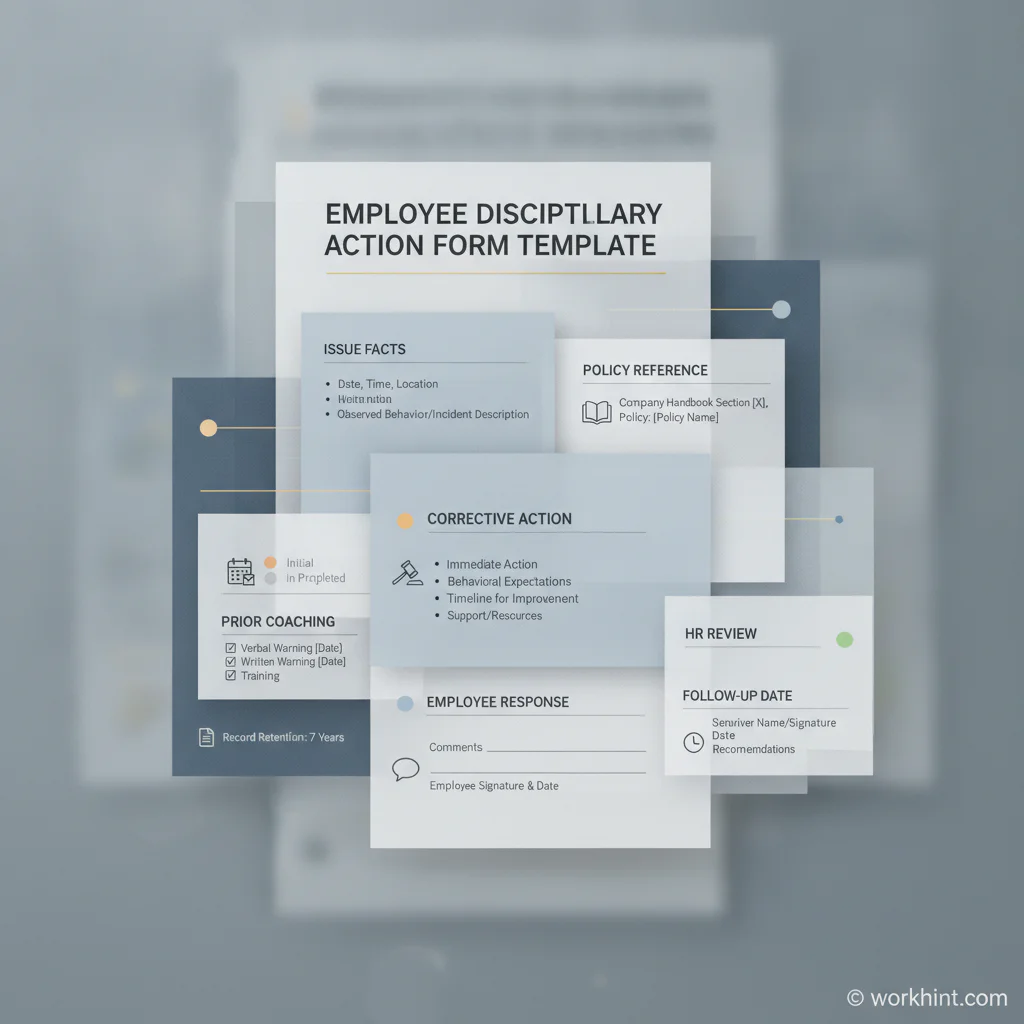
Copy this structure into a document, HR system, shared workflow, or secure employee file. Adjust the fields for your company policy, location, collective bargaining obligations, and review process.
| Section | What to capture | Why it matters |
|---|---|---|
| Employee details | Name, role, department, manager, work location, employee ID | Identifies the record and prevents confusion across teams or locations |
| Action type | Verbal warning summary, written warning, final warning, suspension, other action | Shows where this step sits in the company’s discipline process |
| Issue summary | Specific behavior, event, performance gap, date, time, location, and witnesses | Documents facts instead of labels such as unprofessional or careless |
| Policy or expectation | Handbook section, safety rule, attendance rule, role requirement, manager instruction, or compliance standard | Connects the action to a known standard the employee can understand |
| Prior coaching | Earlier conversations, reminders, warnings, support offered, dates, and outcomes | Shows whether the concern is new, repeated, or escalating |
| Corrective action required | Expected behavior, measurable improvement, deadline, training, support, or documentation needed | Turns the form into a path forward rather than a historical complaint |
| Employee response | Employee comments, disagreement, additional facts, refusal to sign, or request for review | Creates a balanced record and gives the employee a documented voice |
| Follow-up plan | Review date, responsible manager, HR owner, checkpoints, and possible next step | Prevents the form from disappearing without a resolution path |
| Approvals and retention | Manager signature, HR review, employee acknowledgment, file location, retention rule | Controls who approved the action and where the record is maintained |
Template language you can adapt
Issue summary
On [date], at [time/location], [employee name] [specific observed behavior or event]. The concern relates to [policy, expectation, or role requirement]. Supporting details include [documents, attendance records, customer report, system log, witness statement, or manager observation].
Corrective action required
Effective immediately, [employee name] is expected to [specific behavior or result]. The manager will provide [training, written instructions, schedule clarification, equipment, access, coaching, or other support]. Progress will be reviewed on [date]. Failure to meet these expectations may result in further disciplinary action, up to and including termination, depending on company policy and applicable law.
Employee response
The employee may provide comments, corrections, disagreement, or additional context below. Signature confirms receipt of the form, not necessarily agreement with its contents, unless your company policy says otherwise and counsel has approved that language.
Example disciplinary action record
For an attendance issue, a useful record might say: employee arrived more than 20 minutes late on July 2, July 8, and July 15 after coaching on June 24. The attendance policy requires employees to be ready for work at shift start and notify the manager before unavoidable lateness. The corrective action is to arrive ready by the scheduled start time for the next 30 days, with manager and HR review on August 19.
Legal and compliance checks before issuing the form
Before issuing discipline, pause for a short risk review. The EEOC explains retaliation as materially adverse action taken because an employee asserted protected EEO rights. That does not prevent valid discipline, but timing, consistency, evidence, and motive should be reviewed carefully.
Also consider whether the issue involves protected concerted activity. The National Labor Relations Act protects many private-sector employees when they seek better working conditions. For wage and hour matters, the U.S. Department of Labor notes that covered employers must keep certain records for nonexempt workers. This form should not replace required payroll, time, safety, leave, or personnel records.
Workflow for consistent disciplinary action
- Capture the concern with date, source, and evidence.
- Check the handbook, policy, contract, role expectations, and past practice.
- Review whether protected activity, leave, accommodation, safety reporting, wage issues, or discrimination concerns may be involved.
- Decide the appropriate action level with HR, not only the direct manager.
- Prepare the form with specific facts and expected corrective action.
- Meet with the employee, allow a response, and record whether they received the form.
- Assign follow-up ownership and a review date.
- Store the record securely according to company retention rules.
Common mistakes
- Using vague labels. Write what happened, not just that the employee had a bad attitude.
- Skipping policy review. A form is weaker when it cannot point to a real expectation.
- Ignoring prior practice. Similar cases should be handled consistently unless there is a documented reason for a different response.
- Overpromising certainty. Do not write that termination will happen automatically if policy or law requires review.
- Forgetting follow-up. A disciplinary form without a check-in date often becomes stale documentation.
Where Workhint fits
Workhint can help turn a disciplinary action form into a controlled employee relations workflow. A team can route issue intake to HR, require policy selection, attach evidence, assign approvals, schedule follow-up dates, preserve employee responses, and keep reporting visible across locations. The template still needs human judgment, but the workflow helps make the process consistent and trackable.
FAQ
What should an employee disciplinary action form include?
It should include employee details, action type, issue facts, policy reference, prior coaching, required corrective action, employee response, signatures, follow-up date, and secure record location.
Is a disciplinary action form the same as a written warning?
Sometimes. A written warning is one type of disciplinary action form. The same structure can also document final warnings, suspensions, corrective action plans, or other formal steps.
Does an employee have to sign a disciplinary action form?
Company policy controls the process, but many employers use the signature to confirm receipt rather than agreement. If the employee refuses to sign, document the refusal and any witness according to policy.
How long should disciplinary forms be kept?
Retention depends on the record type, jurisdiction, company policy, and any legal hold. HR should define retention rules with counsel instead of relying on a generic template.
Can managers issue the form without HR?
For minor coaching, managers may handle the conversation. For formal written discipline, HR review is safer because it helps check consistency, policy fit, documentation quality, and legal risk.
Conclusion
An employee disciplinary action form template is useful when it creates clarity, not fear. Keep the record factual, tie it to policy, define the expected change, invite the employee response, and assign follow-up. The strongest disciplinary process is not just a form. It is a repeatable workflow that helps managers act fairly and helps employees understand exactly what needs to change.
Leave a Reply