


A referral policy works when every employee knows who qualifies, what gets paid, and how the process is tracked.
An employee referral policy template gives hiring teams a practical starting point for turning informal recommendations into a fair, repeatable hiring channel. Without a policy, referral programs create disputes: one employee says they referred the candidate first, another expects a bonus for a candidate already in the pipeline, and finance is asked to pay an incentive with no approval record.
This template is written for business teams that want a clean referral process before the next hiring push. It is not legal or tax advice. Review the final policy with HR, legal, payroll, and finance.
What is included
- A copy-ready employee referral policy template.
- A table of policy decisions and owners.
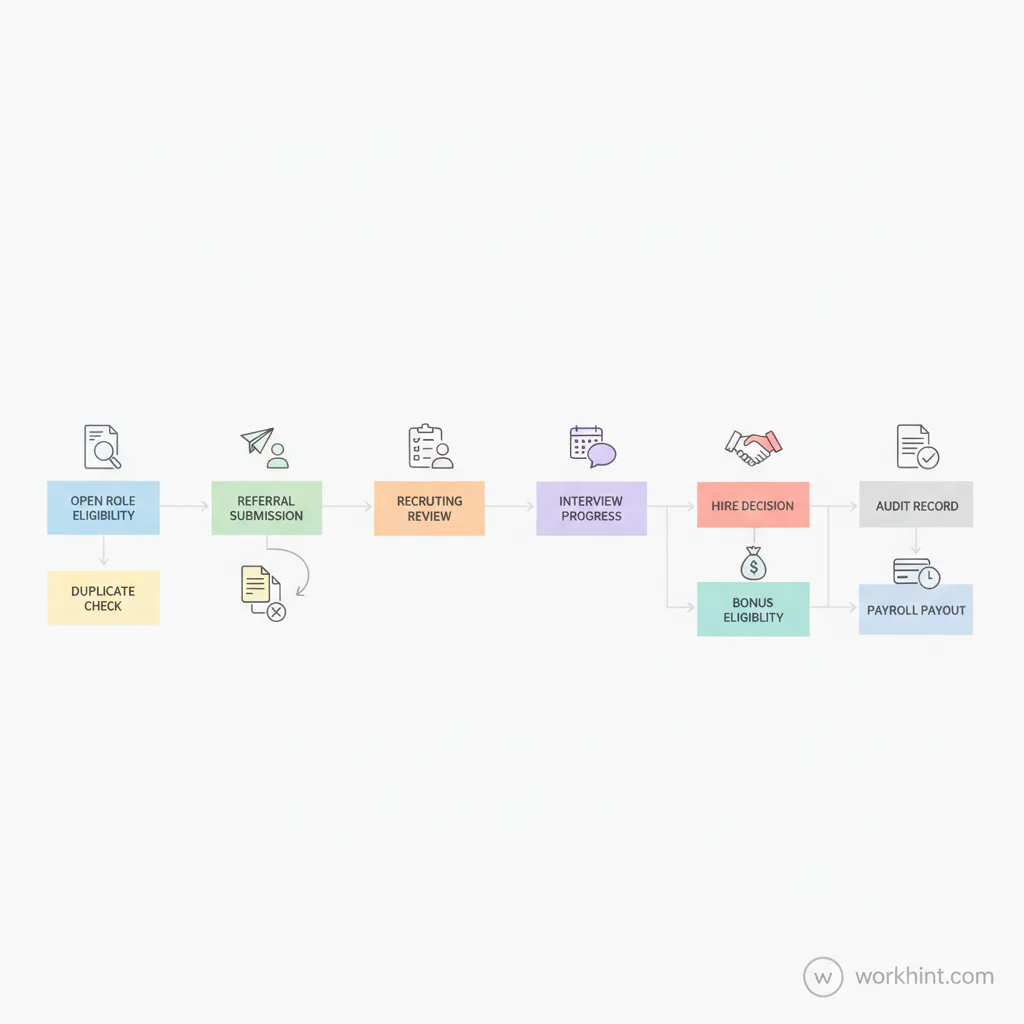
- A simple workflow for referral submission, review, hiring, and payout.
- Common mistakes that create unfairness, disputes, or compliance risk.
- Guidance on where Workhint fits when the policy needs to become a live workflow.
How to use this employee referral policy template
Start by deciding which roles are eligible, who can submit referrals, and what counts as a qualifying referral. Then define the bonus amount, payout trigger, disqualifiers, and review owner. Keep the process consistent with equal employment opportunity rules. The EEOC explains that employment policies and practices cannot discriminate based on protected characteristics or create unjustified discriminatory effects.
Do not launch the policy until payroll knows how the bonus will be treated. In the United States, referral bonuses are commonly handled as wages or supplemental wages; employers should review IRS Publication 15 and their payroll provider’s guidance before promising payout timing or net amounts.
Employee referral policy template
Policy name: Employee Referral Program Policy
Effective date: [Month Day, Year]
Policy owner: [People Operations, Talent Acquisition, HR, or Recruiting]
Purpose: [Company Name] encourages employees to refer qualified candidates for eligible open roles. This policy explains who may participate, how referrals are submitted, when a referral qualifies, how bonuses are approved, and when payments are made.
Scope: This policy applies to referrals submitted by eligible employees for open roles designated as referral-eligible by [Talent Acquisition or HR]. It does not guarantee employment or payment for referrals that do not meet the requirements below.
Eligibility to refer: Current employees in good standing may submit referrals unless excluded by this policy. HR, recruiting team members, hiring managers for the specific role, executives with direct hiring authority, or employees involved in the selection decision may be excluded from earning bonuses for that role.
Qualifying referral: A referral qualifies only if the candidate is submitted through [official referral form, ATS, Workhint workflow, or HR channel] before the candidate applies independently, is not already active in the recruiting pipeline, has not been contacted by the company for the same role within [number] months, and meets the minimum requirements for the role.
Eligible roles: Referral bonuses apply to [all regular full-time roles / selected priority roles / roles listed on the referral program page]. Contract, temporary, internship, executive, agency-submitted, or internal-transfer roles are [eligible / not eligible / handled separately].
Referral bonus: If a referred candidate is hired into an eligible role and satisfies the payout conditions, the referring employee may receive a bonus of [$ amount] or the amount published for that role. Bonus amounts may differ by role level, location, hiring priority, or business need.
Payout timing: Referral bonuses are paid after the referred hire completes [30, 60, or 90] days and both the referred hire and referring employee remain employed on the payout date. Payments are processed through [payroll / accounts payable] and are subject to withholding, deductions, and approval.
Disqualifying conditions: A referral is not eligible for payment if the candidate was already known to recruiting, the submission was incomplete or late, the candidate was submitted by an agency, the referral creates a conflict of interest, the referring employee improperly influenced the hiring decision, the referred hire leaves before payout, or the referral violates policy.
Fair hiring commitment: Referred candidates must move through the standard recruiting process. Hiring decisions must be based on role requirements, qualifications, interview evidence, and business need.
Program administration: [HR or Talent Acquisition] owns referral intake, duplicate checks, eligibility decisions, candidate status updates, and payout approval. [Finance or Payroll] owns payment processing. [Hiring managers] own evaluation against role requirements.
Policy decisions and ownership
| Policy decision | Owner | Record to keep |
|---|---|---|
| Which roles are eligible | Recruiting and hiring leader | Eligible role list and effective dates |
| Who may earn a bonus | HR | Eligibility rules and exclusions |
| Whether the candidate is new to pipeline | Recruiting operations | ATS duplicate check and timestamp |
| Bonus amount and payout trigger | Finance and HR | Bonus table and approval record |
| Hiring decision | Hiring manager | Interview notes and decision rationale |
| Payment processing | Payroll | Payout date, tax handling, and payroll record |
Referral workflow
- Publish eligible roles and bonus amounts before referrals open.
- Require employees to submit referrals through one official channel.
- Timestamp the referral and run a duplicate check against the ATS or candidate tracker.
- Confirm whether the candidate meets basic role requirements.
- Move qualified candidates through the same interview process as other applicants.
- Record the hiring decision and referral eligibility outcome.
- At the payout milestone, confirm the referring employee and referred hire are still eligible.
- Send the approved bonus to payroll and keep the payment record with the referral record.
Common mistakes
The first mistake is promising a bonus without defining what qualifies. A good policy should say whether prior applicants, agency candidates, family members, contractors, interns, and hiring-manager referrals qualify.
The second mistake is leaving payout timing vague. The policy should name the exact milestone and payroll timing after approval.
The third mistake is letting referrals bypass fair hiring practices. Referral candidates can be valuable, but they should still be assessed against the same role requirements. SHRM’s employee referral program procedures highlight the need for clear process rules, and Lattice’s referral policy template shows how eligibility, exclusions, and reward conditions can be documented.
Where Workhint fits
Workhint helps when an employee referral policy needs to become a live hiring workflow instead of a handbook page. A company can use Workhint to publish eligible roles, collect referral submissions, timestamp the source, route duplicate checks, assign interview steps, record hiring decisions, trigger payout eligibility review, and keep HR, finance, payroll, and hiring managers aligned.
That matters because referral programs cross several teams. Workhint gives the policy a shared operating record so a referral can move from submission to payout without relying on scattered messages.
FAQ
What should an employee referral policy include?
It should include eligible roles, who can refer, candidate qualification rules, submission process, duplicate-check rules, bonus amount, payout timing, disqualifiers, hiring standards, approval owners, and payroll handling.
When should referral bonuses be paid?
Many companies pay after the referred hire completes a defined milestone, such as 30, 60, or 90 days. The policy should state the milestone, approval owner, payroll timing, and whether both employees must still be employed on the payout date.
Can hiring managers earn referral bonuses?
Usually not for roles they manage or influence. Excluding hiring managers, recruiters, HR staff, and selection decision-makers helps reduce conflicts of interest and keeps the program fair.
Do referral candidates need the same interview process?
Yes. A referral can help source a candidate, but the candidate should still be evaluated against role requirements through the standard process. That protects consistency and reduces bias.
Conclusion
A strong employee referral policy template does more than announce a bonus. It defines the rules before the referral arrives, gives recruiting a clear intake process, gives finance a payout standard, and gives employees confidence that the program is fair. Use the template above as a starting point, adapt it to your roles and jurisdictions, and connect it to the workflow your hiring team actually uses.
Leave a Reply