


A contractor onboarding checklist should protect the business, prepare the worker, and make the first project easy to start.
An independent contractor onboarding checklist is more than a list of forms. It is the operating path that turns an approved external worker into someone who can begin work with the right scope, documents, access, communication rhythm, payment setup, and accountability.
That matters because contractor relationships move quickly. A team finds a specialist, agrees on a project, and wants work to start immediately. When onboarding is informal, the business often discovers missing tax forms, unclear deliverables, late access requests, undocumented approvals, or payment questions after the contractor has already started.
This guide gives operations, finance, HR, legal, and project leads a practical checklist for onboarding independent contractors in 2026 without turning the process into employee onboarding or slowing down the work.
What’s in this article?
- A practical independent contractor onboarding checklist
- The documents and approvals to collect before work starts
- A workflow for access, kickoff, payment setup, and compliance review
- Common mistakes that create operational and classification risk
- Where Workhint fits when contractor onboarding needs to scale
Why contractor onboarding matters
Contractors are not employees, but they still need a structured start. The goal is not to bring them into every internal system or manage them like staff. The goal is to make the engagement clear, documented, secure, and ready for delivery.
The compliance side is especially important. The U.S. Department of Labor’s independent contractor rule looks at the economic realities of the relationship under the Fair Labor Standards Act, including control, opportunity for profit or loss, investment, permanence, skill, and whether the work is integral to the business. That does not mean every company needs a legal review for every small project, but it does mean onboarding should preserve the evidence that the relationship is truly independent.
Tax documentation matters too. U.S. companies commonly collect IRS Form W-9 from U.S. contractors before payment, while foreign contractor payments may require the appropriate W-8 form, such as Form W-8BEN for certain non-U.S. individuals. The exact requirement depends on the contractor and payment context, so sensitive situations should be reviewed with finance, tax, or legal counsel.
Independent contractor onboarding checklist
Use this checklist as the backbone of your process. Adjust it for jurisdiction, industry, risk level, and project type.
| Step | What to confirm | Owner |
|---|---|---|
| Engagement approval | Business need, budget, hiring manager, project owner, and start date | Operations or department lead |
| Classification review | Contractor status, scope independence, control boundaries, and risk flags | Legal, HR, or compliance |
| Contract packet | Agreement, statement of work, NDA, IP terms, insurance, and data terms | Legal or procurement |
| Tax and payment setup | W-9 or relevant W-8 form, payment method, currency, invoice rules, and pay schedule | Finance |
| Access setup | Only the tools, files, channels, and environments needed for the project | IT or system owner |
| Project kickoff | Deliverables, milestones, acceptance criteria, communication rhythm, and escalation path | Project owner |
| Ongoing tracking | Work status, approvals, invoice readiness, issue handling, and offboarding date | Project owner and operations |
Contractor onboarding workflow
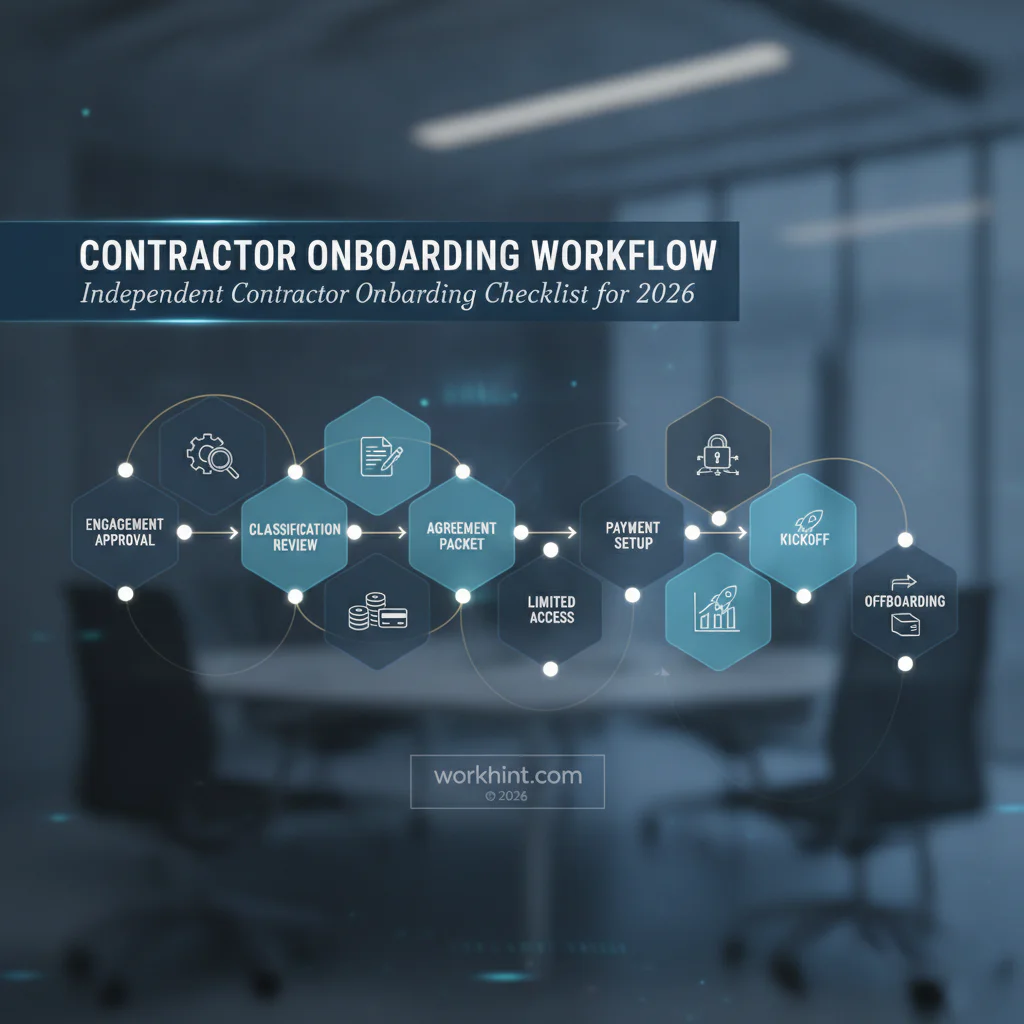
The best onboarding workflows separate approval, documentation, access, kickoff, and payment setup. Each step should have a clear owner and a clear completion signal.
- Approve the engagement before collecting documents. Confirm the business reason, budget, project owner, expected duration, and whether the contractor is new or returning.
- Review classification risk before work begins. Look for issues such as employee-like supervision, indefinite work, required hours, exclusive relationships, or work that should be performed by an employee. Use the Department of Labor guidance as one reference point, then escalate higher-risk cases to counsel.
- Issue the right agreement and scope. The statement of work should define deliverables, milestones, acceptance criteria, fees, payment timing, intellectual property, confidentiality, security responsibilities, and termination terms.
- Collect tax and payment details early. Do not wait until the first invoice is due. Finance should know who will be paid, how they will invoice, which currency applies, and what documentation is required.
- Grant limited access. Contractors should receive the minimum access needed to do the work. Avoid broad employee-style permissions, shared accounts, or access that stays active after the engagement ends.
- Run a focused kickoff. The kickoff should cover the outcome, timeline, definition of done, review process, communication channel, escalation path, and invoice rules.
- Track status until offboarding. Contractor onboarding is not finished until the worker can complete the work and the company knows how the relationship will close.
Documents to collect before work starts
The document packet should match the risk of the work. A low-risk one-time design project may need a simpler packet than a regulated data, finance, healthcare, or field operation engagement.
- Signed independent contractor agreement
- Statement of work or project order
- NDA or confidentiality terms when sensitive information is involved
- IP assignment or license terms when the contractor creates work product
- Security, privacy, or data processing addendum when systems or personal data are involved
- Tax documentation, such as W-9 or the relevant W-8 form
- Payment instructions, invoice requirements, and payment schedule
- Insurance certificate, licenses, background checks, or certifications when required
- Offboarding trigger date or review date
Common contractor onboarding mistakes
The most common mistake is treating contractor onboarding as either too light or too heavy. Too light means work starts before the business has the agreement, payment setup, and access controls in place. Too heavy means the company copies employee onboarding, assigns internal training unrelated to the project, and blurs the distinction between contractor and employee.
Other failure points include letting hiring managers onboard contractors outside the approved process, collecting documents in email threads, granting broad system access, skipping invoice instructions, failing to name a project owner, and forgetting to remove access when the engagement ends.
The fix is a workflow that is structured but narrow. Ask only for what the engagement needs, keep the contractor independent, and make every handoff visible.
Where Workhint fits
Workhint helps teams turn this checklist into a live contractor onboarding system. A team can describe the contractor workflow it needs, then use Workhint to structure intake, roles, document collection, approval routing, task assignments, access requests, kickoff steps, invoice readiness, payment status, reminders, and reporting. For ongoing contractor operations, contractor management software can connect onboarding, assignments, access, records, performance, and offboarding in one operating system.
That is useful when multiple departments touch the process. Operations needs visibility, finance needs payment readiness, legal needs the agreement trail, IT needs access boundaries, and project owners need contractors ready to work. Workhint keeps those steps connected without forcing contractors into a generic employee onboarding process.
FAQ
What should be included in contractor onboarding?
Contractor onboarding should include engagement approval, classification review, signed agreements, scope of work, tax forms, payment setup, limited system access, kickoff instructions, and an offboarding plan.
Do independent contractors need employee onboarding?
No. Contractors need project-specific onboarding, not employee onboarding. The process should prepare them to deliver the contracted work while preserving the independence of the relationship.
Should a contractor start work before signing an agreement?
Usually no. Starting before the agreement is signed can create confusion about scope, payment, confidentiality, intellectual property, and liability. Higher-risk work should not begin until the required approvals and documents are complete.
Who owns contractor onboarding?
Ownership is usually shared. Operations or procurement manages intake, legal handles agreement standards, finance manages payment setup, IT controls access, and the project owner handles kickoff and delivery expectations.
Conclusion
An independent contractor onboarding checklist works best when it is practical, narrow, and enforceable. The company should know why the contractor is needed, what they will deliver, which documents are complete, what access they have, how they will be paid, and who owns the relationship.
Once that workflow is in place, contractor onboarding stops being a scramble before the first invoice and becomes a repeatable operating system for external work.
Leave a Reply