


A medical scribe business can start as a lean network of trained remote scribes, not a traditional staffing company.
If you want to start a medical scribe business, the opportunity is simple: clinicians still need accurate documentation without always hiring, training, scheduling, and managing scribes internally.
You can launch with a branded platform, a small group of trained independent scribes, clear compliance standards, and a narrow first offer for clinics that need support without adding employees.
The smart version is not to build a large healthcare BPO on day one. Validate demand with a few practices, build repeatable onboarding and scheduling, and expand the scribe network after customers are willing to pay.
What’s in this article?
- Why a medical scribe business works
- What you need to launch
- How to price medical scribe services
- How to get the first clinic customers
- How Workhint can run the operating platform
- A 7-day launch plan
- Final checklist and FAQ
Why this business works
Medical scribes help clinicians reduce documentation load. The buyer already feels the pain: after-hours charting, incomplete notes, delayed billing, physician burnout, and time lost inside the electronic health record.
Demand is strongest when the clinic has high visit volume, repeatable appointment types, and providers who want human support alongside or instead of AI scribe tools. Primary care, urgent care, specialty clinics, therapy practices, and independent physician groups can all be practical starting markets.
The business works best when you sell a managed service, not random hourly labor. Clinics care about trained scribes, secure workflows, coverage, reliability, documentation quality, and fast onboarding.
The low-risk path is remote or hybrid scribe support. You do not need an office, a large payroll, or a full-time internal team before proving demand.
What you need to launch
The first version should be narrow. Pick one customer type and one service model, such as remote live scribing for small clinics, asynchronous chart preparation, or visit-note cleanup under provider review. Avoid promising every specialty, every EHR, and 24/7 coverage from the start.
You will need business registration, insurance guidance, client contracts, contractor agreements, HIPAA-aware policies, secure access rules, and a training process. Confirm state, client, and healthcare compliance requirements with a qualified advisor before handling protected health information.
| Launch item | Lean starting range | Why it matters |
|---|---|---|
| Business registration and legal templates | $200-$1,000 | Creates the basic structure, contracts, and provider agreements. |
| Insurance and compliance review | $500-$2,500 | Helps reduce risk before serving healthcare clients. |
| Scribe training resources | $250-$3,500 | Supports terminology, EHR workflow, documentation, and HIPAA training. |
| Secure tools and operations platform | $300-$1,500 | Runs intake, onboarding, scheduling, approvals, invoices, and payouts. |
| Website and local outreach | $200-$1,000 | Helps clinics understand the offer and book a discovery call. |
| Initial contractor recruiting | $0-$500 | Builds a small bench of trained scribes before pilots begin. |
A realistic lean launch can happen in the low thousands if you avoid office leases, full-time hiring, and broad software buildouts. Spend first on credibility, compliance, training, and customer acquisition.
How to price it
Medical scribe pricing usually depends on the model. Live virtual scribing is commonly sold by the hour, shift, provider, or monthly retainer. Asynchronous documentation support can be priced per note, per provider, or as a monthly package.
Clinics are not buying keystrokes. They are buying fewer documentation bottlenecks, faster chart completion, better provider experience, and a managed process they do not have to operate themselves.
| Offer | Example price | Best fit |
|---|---|---|
| Pilot package | $1,500-$3,000 per provider for 30 days | Clinics testing scribe coverage before a longer contract. |
| Hourly virtual scribe support | $25-$45 per service hour | Practices with variable visit schedules. |
| Monthly provider retainer | $2,000-$5,000 per provider | Clinics that want recurring coverage and predictable cost. |
| Documentation cleanup package | $4-$12 per note | Lower-acuity workflows with provider review before completion. |
Keep your first pricing simple. A 30-day pilot with defined hours, one provider, one documentation workflow, and a clear success review is easier to sell than a complex enterprise contract.
How to get first customers
Start with clinics where the owner, practice manager, or physician leader can make a fast decision. Independent practices are often easier to approach than large hospital systems because the buying process is shorter.
Use direct outreach that speaks to documentation pressure. Strong angles include after-hours charting, delayed note closure, provider burnout, onboarding new clinicians, and the cost difference between internal hiring and a managed scribe service.
Partnerships can also work. Build relationships with practice consultants, billing companies, EHR consultants, medical virtual assistant firms, and healthcare operations advisors.
Your first goal is five serious clinic conversations, two pilot proposals, and one paid pilot that proves whether your offer, pricing, and scribe network can work.
How Workhint helps launch it
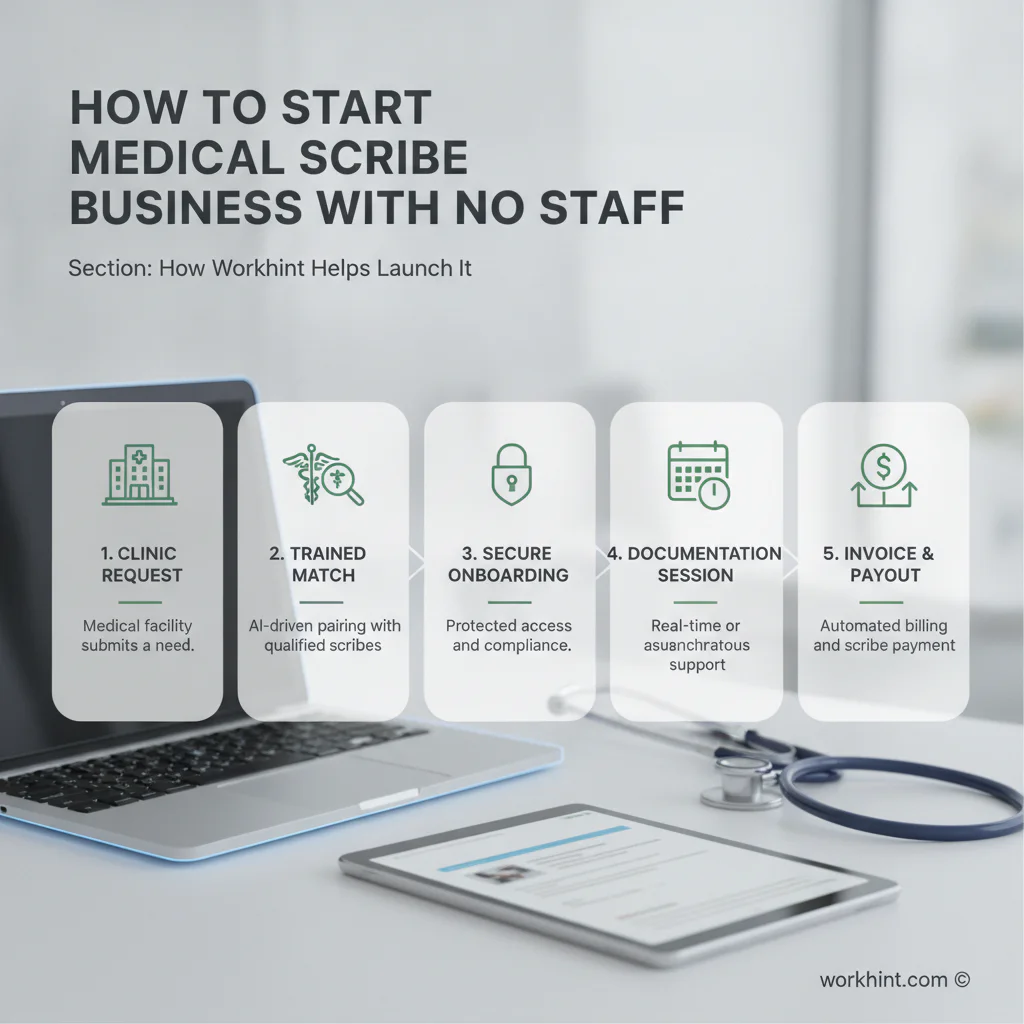
Workhint can become the branded operating platform for the medical scribe business before you build custom software or hire internal coordinators.
A clinic can submit a request through your branded portal, choose the provider or specialty, share scheduling constraints, and upload onboarding details. Your operations view can route the request to approved scribes, track training completion, schedule coverage, collect client approvals, and keep the pilot moving.
For scribes, Workhint can handle contractor invitations, onboarding forms, availability, assignments, documentation checklists, shift confirmations, and payout records. For clients, it can manage quote approval, service agreements, scheduling updates, invoices, payment status, and satisfaction checks.
The hard part is coordinating clinics, providers, schedules, compliance steps, secure documentation workflows, and contractor payouts without operational chaos. Workhint lets you launch the business platform first, then add more scribes and clinics as demand proves itself.
First 7-day launch plan
- Day 1: Choose one clinic niche, one service model, and one launch geography or remote market.
- Day 2: Define the pilot offer, minimum compliance requirements, client intake form, and success metrics.
- Day 3: Set up the branded Workhint platform for clinic requests, scribe onboarding, scheduling, invoices, and payouts.
- Day 4: Recruit 3 to 5 trained or trainable scribes and document screening, training, and availability rules.
- Day 5: Contact independent clinics, practice managers, physician owners, and healthcare operations consultants.
- Day 6: Run discovery calls, quote one paid pilot, and route the opportunity through the platform.
- Day 7: Review demand, provider readiness, compliance gaps, and pricing before investing in broader recruiting or tooling.
Final launch checklist
- Choose the first clinic segment and service model.
- Register the business and get legal and insurance guidance.
- Create HIPAA-aware policies, client agreements, and scribe agreements.
- Define the training standard for each scribe.
- Configure your branded Workhint portal, intake, scheduling, assignment, invoice, and payout flows.
- Recruit a small bench of trained independent scribes.
- Create a 30-day pilot offer with clear outcomes.
- Contact independent clinics and healthcare operations partners.
- Validate demand before hiring employees or building custom software.
FAQ
How much does it cost to start a medical scribe business?
A lean launch can often start in the low thousands if you avoid offices and full-time staff. The main early costs are setup, contracts, insurance guidance, compliance review, training, operations, and customer acquisition.
Do medical scribes need certification?
Certification requirements vary by client and service model. Many clients care most about training, medical terminology, EHR workflow knowledge, documentation quality, and HIPAA awareness.
Can medical scribes work as independent contractors?
Some businesses use contractor scribes, but classification rules depend on control, schedule, tools, supervision, and local law. Get legal guidance before relying on contractors.
Do I need HIPAA compliance to run this business?
If your service handles protected health information, HIPAA and related security expectations matter. Create policies, training, access controls, audit habits, and client agreements before serving clinics.
How should I price medical scribe services?
Start with a simple pilot, hourly coverage, or monthly provider retainer. Price based on managed coverage, training, reliability, and documentation outcomes.
How do I get the first clinic client?
Target independent practices with documentation pressure. Offer a clear 30-day pilot that reduces charting burden without forcing the clinic to hire internally.
Should I use AI scribes or human scribes?
Many clinics compare both. Human scribes can fit workflows that need judgment, specialty context, real-time support, and provider preference.
Conclusion
A medical scribe business is worth considering when you treat it as a focused operating platform, not a big staffing company from day one. Start narrow, validate demand, recruit a small provider network, and build a process clinics can trust.
Workhint helps you launch that operating foundation quickly: branded clinic intake, scribe onboarding, scheduling, assignment tracking, approvals, invoices, payments, and contractor payouts in one place.
Leave a Reply