


The right agency model depends less on title and more on who owns the worker, workflow, and risk.
Recruiting agency vs staffing agency is a practical decision for employers. The wrong choice can slow hiring, confuse accountability, create billing surprises, or leave managers unsure who owns onboarding, timesheets, performance issues, and conversion decisions.
Recruiting agencies help companies find candidates for permanent roles. Staffing agencies more often fill temporary, contract, temp-to-hire, seasonal, or flexible workforce needs. The real difference is operational: who employs the worker, how fast the role must start, how long the work will last, and what controls the business needs after work begins.
What’s in this article?
- How recruiting agencies, staffing agencies, and temp agencies differ.
- A workflow for choosing the right model.
- Common cost and coordination mistakes.
Why the distinction matters
Many companies use the terms loosely because agencies overlap. A staffing agency may offer direct hire, a recruiting agency may support contract roles, and a temp agency may be part of a broader staffing firm. Employers still need clear language before opening a request.
Indeed’s recruiting firm overview describes recruiting firms as focused on finding and vetting candidates for open roles, while staffing agencies commonly support temporary roles that need to be filled quickly. CXC Global’s staffing vs recruiting comparison makes a similar distinction: both connect employers with workers, but they serve different hiring models.
For employers, the distinction affects the whole operating process. A permanent hire flows through interviews, offer approval, employee onboarding, payroll, benefits, and manager ownership. A temporary or contract worker may require agency terms, markup review, access limits, timesheets, invoice matching, safety coordination, and end-date management.
Recruiting agency vs staffing agency
A recruiting agency is usually best when the company wants a long-term employee and needs help sourcing, screening, or closing candidates. The employer typically hires the selected candidate directly. The agency is paid for the placement, often as a percentage of compensation or through a retained search arrangement.
A staffing agency is usually best when the company needs labor capacity without making every worker permanent on day one. The agency may employ the worker, assign them to the client, handle payroll, and bill the client.
| Decision point | Recruiting agency | Staffing agency | Temp agency |
|---|---|---|---|
| Best use | Permanent or hard-to-fill roles | Contract, temp-to-hire, seasonal, or flexible roles | Short-term coverage or fast labor needs |
| Worker employment | Usually employer hires directly | Often agency employs during assignment | Usually agency employs during assignment |
| Speed | Moderate to slow, depending on role | Fast for known skill pools | Fastest for short-term needs |
| Internal workflow | Interview, offer, employee onboarding | Request, assignment, onboarding, timesheets, billing | Request, confirmation, shift or assignment tracking |
| Success measure | Quality of hire and retention | Fill speed, assignment quality, cost, compliance | Coverage, attendance, safety, shift completion |
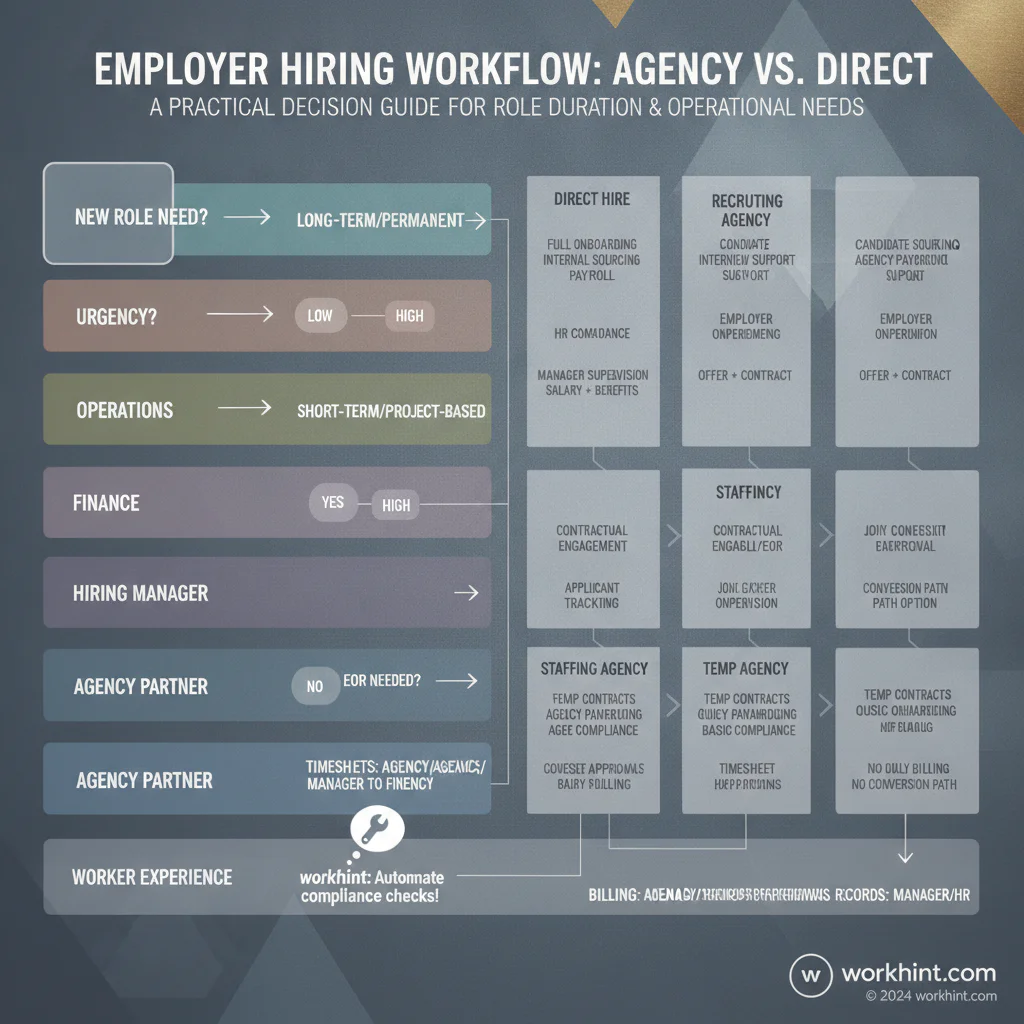
A practical decision workflow
Start with the work, not the agency category. A hiring manager may say they need a staffing agency because they are overloaded, but the real need may be a permanent recruiter, a temporary labor supplier, a freelancer, a managed service provider, or a direct hire.
- Define the work outcome. Write the result needed, not just the job title. Include timeline, location, skills, access needs, and whether the role touches customers, systems, money, or regulated work.
- Decide whether the role should become permanent. If the business needs a long-term employee, use a recruiting agency or internal recruiting process. If the need is uncertain, seasonal, project-based, or coverage-based, use staffing.
- Confirm who should employ the worker. If the agency will employ the worker, clarify payroll, benefits, taxes, workers’ compensation, timesheets, conversion fees, and end rules before work starts.
- Map shared responsibilities. Temporary staffing does not remove all responsibility from the host employer. OSHA and NIOSH state in their temporary worker guidance that staffing agencies and host employers both have responsibility for safety. OSHA also explains in a standard interpretation that training, hazard communication, and recordkeeping duties depend on the assignment facts.
- Set approval and payment rules. Decide who approves the request, rate, markup, timesheet, invoice, extension, conversion, and offboarding. If those decisions are unclear, the agency relationship will feel fast at first and messy later.
- Review after the first assignment cycle. Compare cost, fill speed, quality, attendance, manager satisfaction, worker experience, and administrative load. Use that evidence to continue, convert, renegotiate, or change models.
When each model fits
Use a recruiting agency when the role is strategic, permanent, difficult to source, or requires a targeted candidate search. This is common for leadership, specialized technical, sales, and operator roles where the company wants long-term ownership.
Use a staffing agency when the business needs flexible capacity, temp-to-hire optionality, seasonal coverage, project support, or a faster path to screened workers. This can work well for administrative coverage, warehouse peaks, support surges, healthcare support, events, field operations, and repeat needs.
Use a temp agency when the need is short, urgent, and coverage-focused. If the work is complex, compliance-heavy, or likely to become permanent, treat “temp agency” as one lane inside the broader staffing decision.
Common mistakes
- Choosing based only on speed. Fast coverage is useful, but the business still needs onboarding, supervision boundaries, access rules, and payment controls.
- Ignoring conversion terms. If a temporary worker may become permanent, conversion fees and timing should be known before the assignment starts.
- Letting every manager choose their own agency. This creates inconsistent rates, weak reporting, duplicate vendors, and uneven worker experience.
- Skipping assignment records. Keep a record of role, dates, rate, location, approvals, access, safety requirements, timesheets, and issue history.
- Treating agency workers like regular employees without review. Understand the agency model, legal responsibilities, and supervision boundaries before managers improvise.
Where Workhint fits
Workhint fits when the agency decision needs to become a repeatable external workforce workflow. A company can use Workhint to structure the request, route approvals, compare recruiting, staffing, temp, freelancer, or direct-hire options, collect terms, assign owners, limit access, manage assignment records, connect approvals to payment readiness, and report on spend.
The value is not replacing the agency. The value is giving HR, operations, finance, legal, hiring managers, agency partners, and workers one visible process for how external work is requested, approved, started, extended, converted, or closed.
FAQ
Is a staffing agency the same as a recruiting agency?
No. They can overlap, but the usual difference is that recruiting agencies focus on helping employers hire permanent employees, while staffing agencies often provide temporary, contract, temp-to-hire, or flexible workers.
Is a temp agency the same as a staffing agency?
A temp agency is often a type of staffing agency focused on short-term assignments. A broader staffing agency may also support temp-to-hire, contract, project, direct-hire, and managed workforce needs.
Which is better for employers?
Neither is automatically better. Use a recruiting agency when the business wants a long-term employee. Use a staffing agency when the business needs flexible labor capacity, faster coverage, temporary assignments, or a temp-to-hire path.
Who manages a worker from a staffing agency?
Responsibility is shared. The agency may employ and pay the worker, while the host employer often controls assignment details, worksite expectations, access, safety conditions, and performance feedback.
What should employers decide before using an agency?
Decide the work outcome, assignment length, employment model, rate and markup, approval owners, onboarding, access rules, safety requirements, timesheets, invoice approval, conversion terms, and offboarding.
Conclusion
The practical difference is the operating model behind the hire. Recruiting agencies help employers find people they intend to employ directly. Staffing agencies help employers access flexible labor capacity through assignments. Temp agencies usually sit inside the staffing world for short-term coverage.
Employers make better choices when they define the work relationship before calling the agency. Clarify the role, duration, ownership, approval path, compliance responsibilities, payment flow, and success measure. Then choose the partner model that matches the work instead of forcing every workforce need through the same hiring channel.
Leave a Reply