


A RACI matrix template turns unclear ownership into a visible operating map for projects, approvals, and cross-functional work.
A RACI matrix template helps a team define who is responsible, accountable, consulted, and informed for each task, deliverable, or decision. It is useful when work crosses functions, decisions stall, or everyone agrees something matters but no one is clearly on the hook.
This resource is designed for business teams that need a practical responsibility matrix they can copy into a document, spreadsheet, project system, or workflow builder. Use it for project launches, vendor onboarding, hiring workflows, compliance reviews, finance approvals, customer implementations, operations handoffs, or any process where ownership needs to be explicit.
What Is Included In This RACI Matrix Template?
This template includes the core fields most teams need to clarify roles before work starts:
- Workflow, project, or process name
- Task, deliverable, or decision
- Responsible role
- Accountable role
- Consulted roles
- Informed roles
- Output or completion criteria
- Due date or trigger
- Status and review owner
Cornell defines a RACI chart as a responsibility matrix that maps roles against tasks, deliverables, or decisions. PMI describes the responsibility assignment matrix as a way to spell out stakeholder roles and support communication planning. The practical value is simple: the team can see who does the work, who owns the result, who must be consulted, and who only needs updates.
How To Use The RACI Matrix Template
Start with the work, not the org chart. List the tasks or decisions that create confusion, delay, rework, or repeated follow-up. If the matrix tries to cover every tiny task, people will ignore it. If it covers only big milestones, it may miss the handoffs where work actually breaks.
Then list roles across the top. Use roles before names when possible: hiring manager, finance approver, IT owner, legal reviewer, project lead, operations manager, vendor manager, customer success lead. Names can be added later, but role clarity should survive staffing changes.
Assign each task one accountable owner. That is the person or role answerable for the outcome. Cornell’s RACI definition notes that accountable ownership should be limited to one per task. Multiple responsible contributors are fine, but multiple accountable owners usually means no one has final ownership.
Finally, review the matrix with the people named in it. A RACI chart should not be created in isolation and announced as truth. It should expose disagreements early: who approves, who needs input, who receives updates, and where a decision gets escalated if owners disagree.
RACI Role Definitions
| Role | Meaning | Business Rule |
|---|---|---|
| Responsible | Does the work or leads execution. | There can be more than one, but each should know the specific contribution expected. |
| Accountable | Owns the final result and confirms completion. | Use one accountable owner per task, approval, or deliverable. |
| Consulted | Provides input before work or decisions are finalized. | Consulted roles should have real expertise or approval relevance, not passive interest. |
| Informed | Receives updates after progress, decisions, or completion. | Keep this group lean so updates do not become noise. |
Microsoft’s RACI guidance uses the same structure: list tasks, list roles, and assign responsible, accountable, consulted, and informed values for each task. That sequence matters because RACI is most useful when it is attached to actual work, not abstract titles.
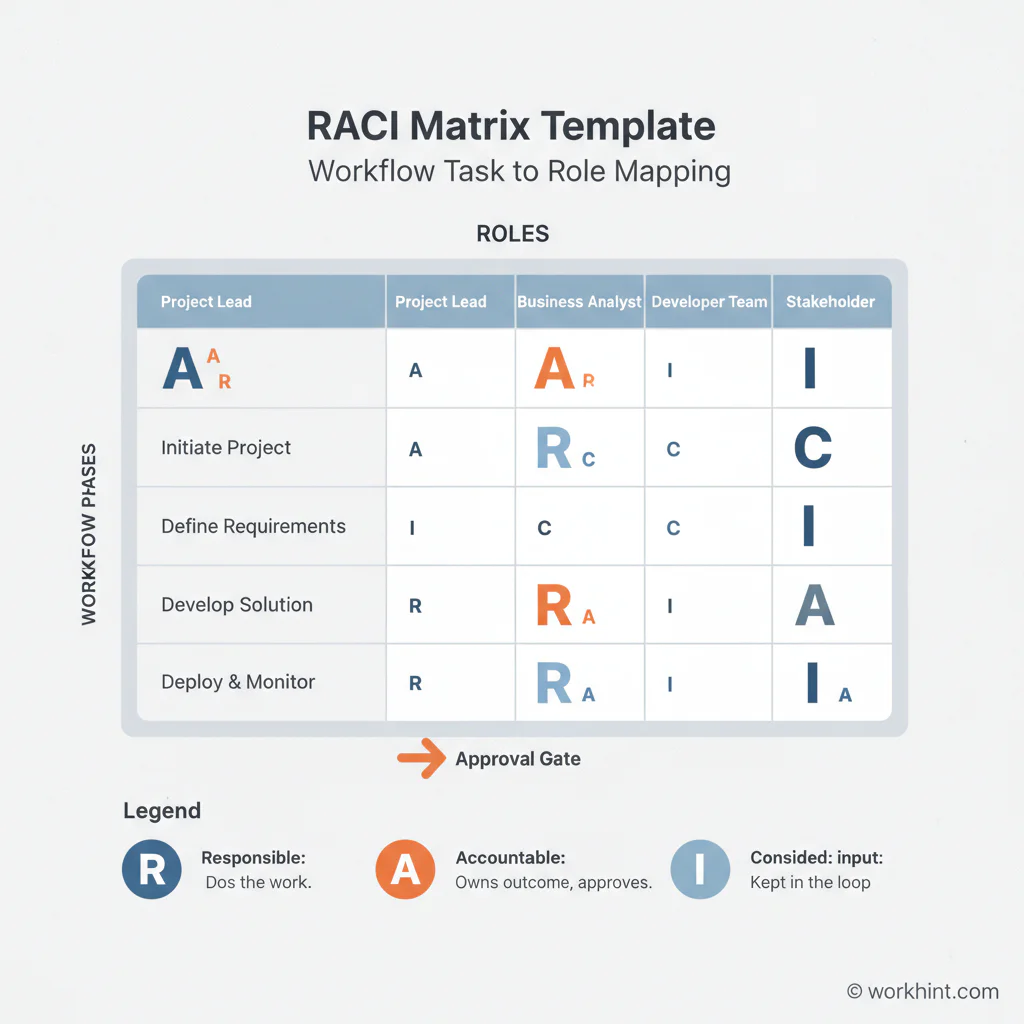
RACI Matrix Template
| Task Or Decision | Responsible | Accountable | Consulted | Informed | Output | Status |
|---|---|---|---|---|---|---|
| Confirm business need | Project lead | Sponsor | Finance, operations | Team leads | Approved problem statement | Not started |
| Define requirements | Operations owner | Project lead | End users, IT, compliance | Sponsor | Requirements list | In progress |
| Review risk | Compliance reviewer | Legal or compliance lead | IT, finance | Project lead | Risk decision | Pending |
| Approve launch | Project lead | Sponsor | Operations, support, finance | All stakeholders | Launch approval | Pending |
| Track follow-up actions | Operations coordinator | Project lead | Task owners | Sponsor | Updated action log | Open |
Example RACI Matrix For Vendor Onboarding
Here is how the template might look for a vendor onboarding workflow. The exact roles will change by company, but the pattern is useful: each step has one accountable owner, clear contributors, and a defined output.
| Vendor Onboarding Step | Responsible | Accountable | Consulted | Informed |
|---|---|---|---|---|
| Collect vendor details | Requesting manager | Vendor operations | Procurement | Finance |
| Review contract and risk | Legal | Legal lead | Procurement, security | Requesting manager |
| Set payment terms | Finance | Finance lead | Procurement | Vendor operations |
| Approve system access | IT | Security owner | Requesting manager | Vendor operations |
Common RACI Mistakes
The first mistake is making everyone accountable. That feels collaborative, but it removes ownership. Use one accountable owner and name consulted roles separately.
The second mistake is treating consulted and informed as the same thing. Consulted people provide input before a decision. Informed people receive updates after something happens. Mixing the two creates unnecessary meetings and approval drag.
The third mistake is building the matrix once and never reviewing it. Atlassian’s RACI guidance frames the chart as a way to reduce confusion and surface bottlenecks during planning. That only works if the matrix stays aligned as scope, roles, and timelines change.
Where Workhint Fits
A RACI matrix is a strong starting point, but many teams need it to become an operating workflow. Workhint helps organizations turn responsibility matrices into live work systems: intake forms, role-based permissions, assigned tasks, approval steps, document collection, reminders, status views, and reporting.
For example, a vendor onboarding RACI can become a workflow where procurement receives the request, legal reviews the contract, finance approves payment setup, IT controls access, and the requester sees status without chasing updates. The template defines ownership; Workhint helps teams digitize, automate, and manage the workflow around that ownership.
FAQ
What is a RACI matrix template?
A RACI matrix template is a reusable table for assigning responsible, accountable, consulted, and informed roles to each task, deliverable, or decision in a project or workflow.
What should a RACI matrix include?
It should include tasks or decisions, roles, responsible owners, one accountable owner, consulted stakeholders, informed stakeholders, completion criteria, timing, and status.
Can more than one person be responsible in a RACI matrix?
Yes. More than one role can be responsible for execution. The important rule is to keep accountability clear, with one accountable owner for the final result.
When should a team use a RACI chart?
Use a RACI chart when work crosses teams, approvals are unclear, handoffs are slow, or stakeholders disagree about who owns the next step.
Conclusion
A RACI matrix template gives teams a simple way to make ownership visible before work gets messy. Start with the tasks that create confusion, assign one accountable owner per item, separate consulted from informed stakeholders, and review the matrix whenever the workflow changes.
The best RACI charts do not sit in a forgotten spreadsheet. They guide how work moves, who approves, who contributes, and who needs to know what changed.
Leave a Reply