


A good handoff does not move a deal forward until operations has enough context to deliver the promise.
A sales to operations handoff process turns a closed deal into deliverable work. It defines when the handoff starts, what information moves with it, who accepts ownership, what happens when context is missing, and how the team measures the transition.
Without that system, the customer hears one story from sales and another from delivery. Operations starts with partial context. Sales gets pulled back into follow-up questions. The cost is not just delay. It is broken trust at the exact moment the customer expects momentum.
What’s in this article?
- What a sales to operations handoff process should include
- How to define the trigger, context packet, owner, and acceptance check
- A practical handoff workflow teams can adapt
- Metrics that show whether the handoff is working
- Where Workhint fits when the process needs to become a live operating system
Why the sales to operations handoff process matters
The handoff is where a commercial promise becomes an operating commitment. Sales may have discussed goals, constraints, approvals, stakeholders, pricing, timelines, exceptions, and risks. Operations needs that context before it can schedule work, assign roles, collect documents, plan onboarding, or prepare kickoff.
High-reliability environments have long treated handoffs as a system design problem. The AHRQ TeamSTEPPS handoff guidance defines a handoff as a standardized transfer of information, authority, and responsibility. Business teams can borrow the principle: the receiving owner should know what happened, what matters now, what could go wrong, and when responsibility changes hands.
A weak handoff usually fails in one of four places: the trigger is vague, the required context is incomplete, the receiving owner is unclear, or no one checks whether the customer experience matched the promise. A strong process designs all four deliberately.
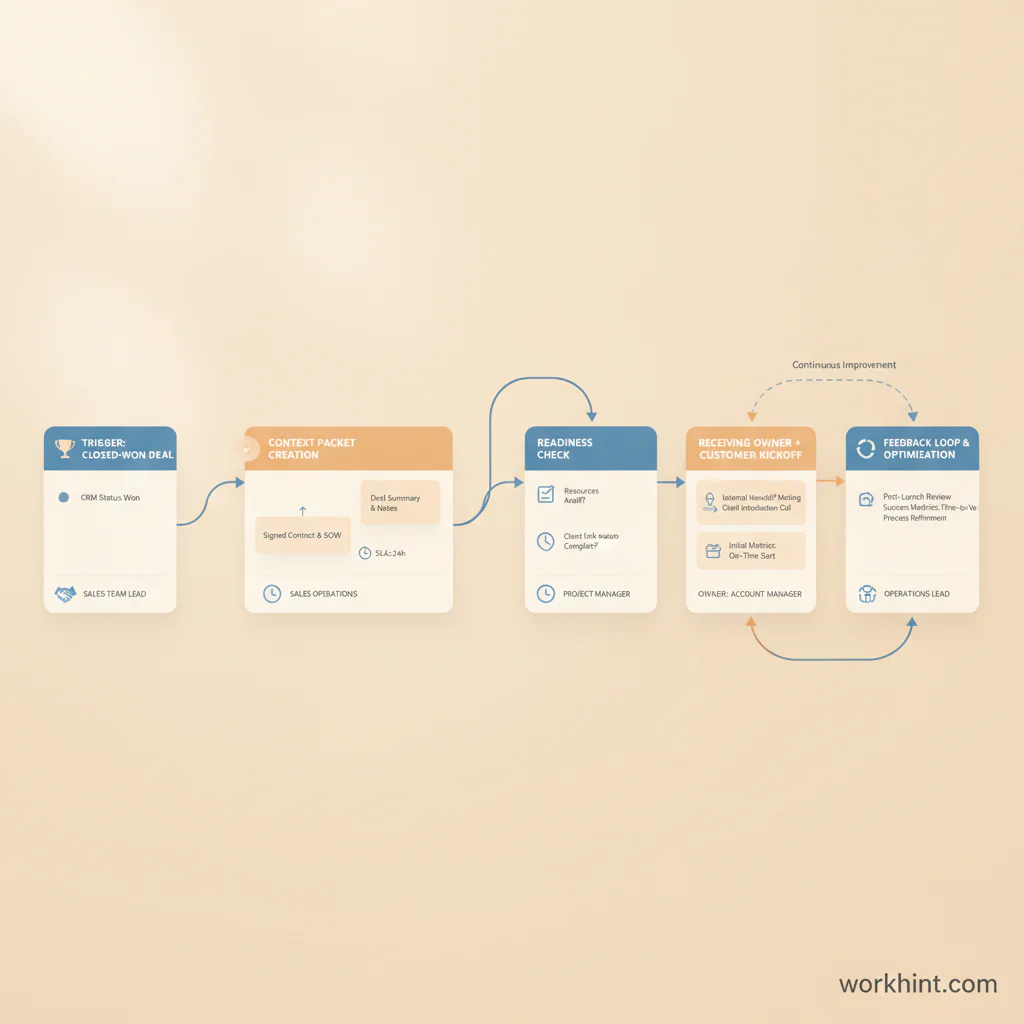
Sales to operations handoff workflow
Build the workflow around acceptance, not notification. A Slack message, CRM status change, or meeting invite may start the process, but the handoff is not complete until operations accepts ownership with the required context.
| Stage | System question | Output |
|---|---|---|
| Trigger | What event starts the handoff? | Closed-won deal, signed agreement, paid deposit, or approved scope |
| Context packet | What must sales provide? | Customer goals, scope, commitments, stakeholders, constraints, risks, and next dates |
| Acceptance check | Can operations start without guessing? | Accepted, returned for missing context, or escalated |
| Ownership transfer | Who owns the customer now? | Named delivery, onboarding, implementation, or account owner |
| Feedback loop | Did the handoff support delivery? | Issue log, handoff score, and process improvements |
This structure separates activity from readiness. A deal can be closed and still not be ready for operations. The workflow should make those gaps visible before the customer feels them.
Step 1: Define the handoff trigger
The trigger should be objective and system-driven. Avoid “when sales is ready” or “after the AE sends notes.” Better triggers include contract signed, deposit paid, procurement approved, legal redlines complete, implementation package received, or deal stage changed to closed-won.
Use one primary trigger and a short list of exceptions. A complex enterprise deal may need a pre-close operations review. A smaller service contract may begin when payment clears. The point is to remove judgment from the start line.
Step 2: Create the required context packet
The context packet is the heart of the handoff. It should be short enough that sales will complete it and specific enough that operations can act on it. A practical structure follows the same logic as SBAR communication: situation, background, assessment, and recommendation.
- Situation: What did the customer buy, and what outcome do they expect?
- Background: What problem, timeline, stakeholders, prior tools, and constraints shaped the sale?
- Assessment: What risks, dependencies, gaps, or expectations could affect delivery?
- Recommendation: What should operations do first, and what should be confirmed with the customer?
Add fields for contract terms, billing status, implementation scope, promised dates, custom commitments, customer contacts, internal owner, and unresolved questions. Call recordings are evidence, not the handoff.
Step 3: Add an acceptance check
Operations should be able to reject an incomplete handoff without making it political. Define acceptance criteria in advance: scope is clear, billing status is confirmed, customer goals are written, stakeholders are listed, custom promises are flagged, and the first delivery step has an owner.
If the packet is incomplete, route it back to sales with the missing fields. If the gap affects timeline, margin, compliance, or customer expectations, escalate before kickoff. This is how the process protects delivery instead of documenting confusion.
Step 4: Assign one receiving owner
A handoff can involve many teams, but one person should accept ownership. That owner may be customer success, implementation, project operations, service delivery, or account management. Their job is to make sure the transition is complete, the customer knows what happens next, and internal teams are coordinated.
Customer onboarding guidance often starts before the welcome email or kickoff. HubSpot’s customer onboarding checklist includes internal tasks such as assigning the customer success manager and verifying billing and contract details. The customer-facing moment should happen after the operating basics are ready.
Step 5: Measure handoff quality
Measure whether the system is producing clean transitions. Useful metrics include handoff completion time, percentage of handoffs returned for missing context, number of post-kickoff scope clarifications, time from close to kickoff, first-value milestone completion, and handoff-related escalations.
Review failures regularly. PMI’s guidance on lessons learned emphasizes capturing learning throughout work, not only at the end. When a delivery issue traces back to the sale, update the handoff packet, trigger rule, acceptance check, or enablement material.
Common mistakes that break handoffs
- Treating the meeting as the process: A handoff meeting can help, but it should review the packet, not replace it.
- Leaving promises unstructured: Custom commitments need fields, owners, and review rules.
- Skipping acceptance: If operations cannot reject incomplete context, the checklist becomes performative.
- Assigning a team instead of an owner: Group ownership creates silent gaps.
- Measuring speed only: A fast handoff that causes rework is not efficient.
Where Workhint fits
Workhint fits when the sales to operations handoff process needs to become a live work system instead of another checklist. A team can describe the handoff challenge, then use Workhint to generate the roles, intake fields, routing rules, permissions, acceptance checks, escalations, customer transition steps, and reporting views needed to run the process. A sales-to-operations handoff becomes more dependable when workflow automation software captures the trigger, routes ownership, assigns tasks, and keeps status visible.
That matters because handoffs usually cross CRM, contracts, billing, scheduling, onboarding, documents, and customer communication. Workhint helps structure the operating layer so the handoff is tracked, assigned, measurable, and adaptable as the business changes.
FAQ
What should be included in a sales to operations handoff?
Include customer goals, purchased scope, contract terms, pricing or billing status, stakeholders, promised dates, custom commitments, risks, unresolved questions, next steps, and the named receiving owner.
When should the handoff happen?
It should start at a defined trigger such as closed-won, signed agreement, payment received, or approved scope. Complex deals may need an operations review before close so delivery risk is visible earlier.
Who owns the handoff after sales?
One receiving owner should accept the handoff. The exact role depends on the business, but it is often customer success, implementation, account management, service delivery, or operations.
How do you know the handoff process is working?
Track returned handoffs, missing-field rates, time from close to kickoff, post-kickoff scope clarifications, first-value timing, customer escalations, and delivery issues traced back to sales context.
Conclusion
A sales to operations handoff process should make the transfer of context, authority, and responsibility explicit. The goal is not more documentation. The goal is a cleaner transition from promise to delivery.
Start with the trigger, define the context packet, require acceptance, name one receiving owner, and measure the quality of the transition. Once those rules are clear, the handoff can be automated, reported on, and improved like any other operating system.
Leave a Reply