


Radon testing is a focused home-safety service you can validate before buying expensive equipment or hiring a team.
If you want to start a radon testing business, the smartest first move is not buying a full stack of monitors or trying to look like a large environmental company. The smarter move is to validate local demand, build a simple branded ordering experience, and create a small network of certified measurement professionals who can complete tests as jobs come in.
Radon testing works because the problem is real, the service is specific, and customers often need a clear report before a real estate transaction, rental decision, renovation, or health concern can move forward. The EPA estimates that nearly 1 in 15 U.S. homes has elevated radon levels, and the EPA recommends fixing homes at 4 pCi/L or higher. That gives the business a practical demand driver without requiring a storefront, warehouse, or employee-heavy launch.
What’s in this article?
- Why radon testing is a practical local service business
- What you need to launch without staff
- How to price professional radon tests
- How to get first customers
- How Workhint can run the branded operating platform
- A 7-day launch plan and final checklist
Why this business works
Radon testing is attractive because customers usually have a clear reason to buy. Home buyers want confidence before closing. Sellers want fewer surprises. Landlords and property managers may need documentation. Homeowners in high-radon areas want a professional report instead of guessing from a cheap kit.
The service can also start narrow. You do not need to offer mitigation on day one. Measurement alone can be a clean first offer: place an approved monitor, follow testing protocol, retrieve the device, provide the report, and explain the next step if levels are high. If demand grows, you can later partner with mitigation contractors or add mitigation as a separate line of business.
The no-staff model works when you separate the business platform from service delivery. You own the brand, customer intake, scheduling, payment, reporting flow, and quality standards. Certified independent providers handle field visits under clear rules, and you add capacity only when paid demand justifies it.
What you need to launch
Start with the minimum requirements that make the service credible and legal in your market. Radon rules vary by state, so verify local licensing before taking paid work. Many operators pursue a recognized credential such as NRPP or NRSB certification, and some states require specific credentials or licenses for measurement professionals.
Your first version should include a branded platform, a clear service area, one or two test packages, a provider onboarding process, insurance, customer terms, and a reliable way to manage test placement, retrieval, reports, and payment. Buy or lease equipment only after you know how jobs will come in and who will fulfill them.
| Launch item | Lean budget range | Why it matters |
|---|---|---|
| Business registration and local setup | $100-$500 | Creates a legal base for contracts, banking, and insurance. |
| Certification, exam, or state credential | $250-$900+ | Requirements vary, but credibility matters in a health-related service. |
| Insurance | $500-$1,500+ | Protects the business when entering homes or handling reports. |
| Branded Workhint platform | Start lean | Handles intake, scheduling, customer communication, payment, and provider coordination. |
| Monitor lease or first professional device | $100-$3,000+ | Lease, partner, or buy only enough capacity to validate demand. |
| Local marketing and partnerships | $200-$1,000 | Targets agents, inspectors, landlords, property managers, and homeowners. |
How to price it
Professional radon testing often appears in the $125 to $250 range for standard residential tests, with higher prices for larger homes, rush turnaround, multi-device tests, commercial properties, or travel outside the normal service area. Your pricing should reflect certification, device costs, time on site, retrieval, reporting, insurance, and provider payout.
| Offer | Example price | Best use |
|---|---|---|
| Standard 48-hour residential test | $175-$250 | Homeowners, buyers, and sellers who need a professional report. |
| Real estate rush test | $250-$350 | Transactions with tight inspection timelines. |
| Landlord or property manager package | $150-$225 per unit | Multiple rentals or repeat testing across a portfolio. |
| Partner referral package | Custom | Home inspectors, agents, and mitigation companies that send recurring jobs. |
Do not compete only on price. Compete on fast booking, professional documentation, clear reporting, and reliable scheduling. Customers are often buying confidence and speed, not just a device placed in a basement.
How to get first customers
Start where the need is already visible. Make a short list of real estate agents, home inspectors, property managers, landlord associations, relocation companies, and local mitigation contractors. Offer a simple promise: fast scheduling, certified testing, clean reports, and easy online booking.
Create one city-specific landing page, a Google Business Profile, and a direct booking form. Then contact 50 local referral sources with a concise offer. Ask for one trial job, not a long-term commitment. After each completed test, collect a review and ask whether they know another buyer, landlord, or property manager who needs testing.
How Workhint helps launch it
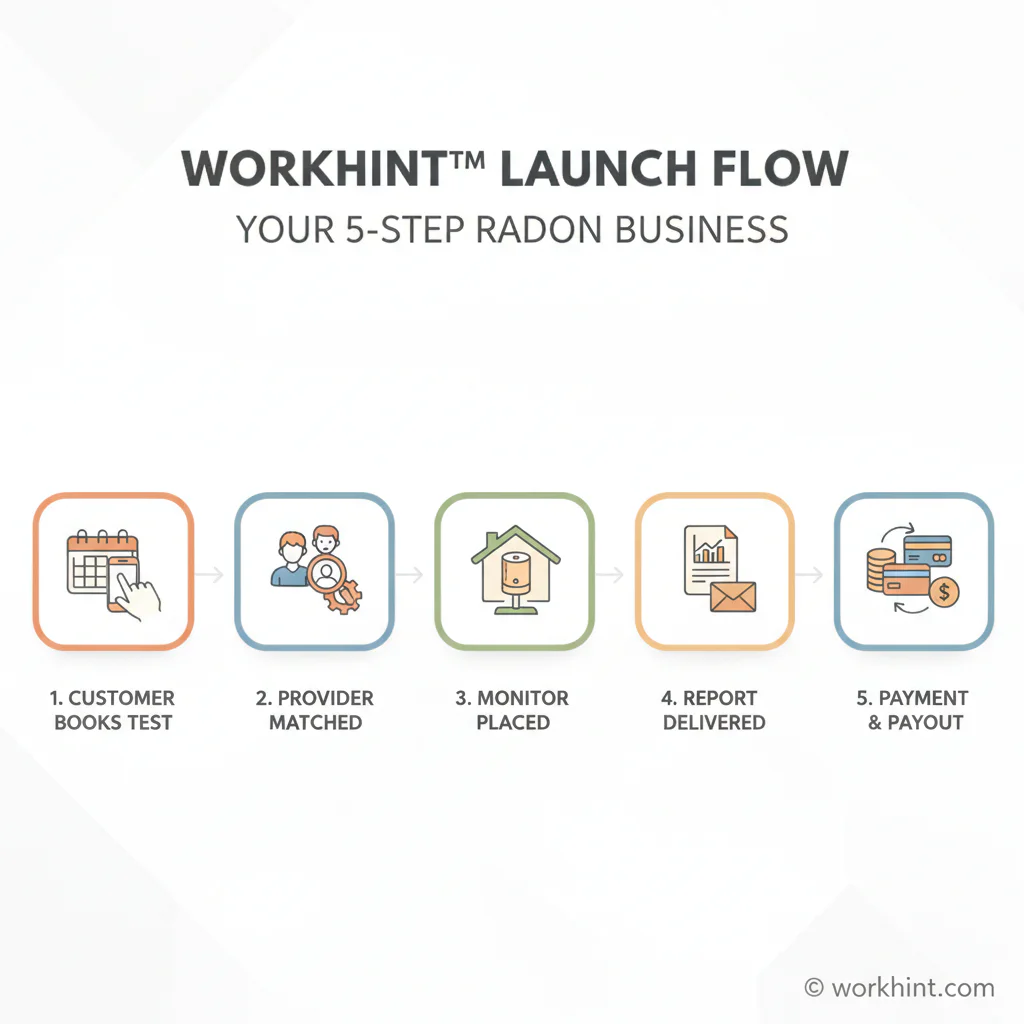
Workhint can become the branded operating platform for the radon testing business before you build custom software or hire staff. A customer lands on your branded portal, chooses a standard test or rush test, enters the property address, answers readiness questions, uploads access details, and pays online.
From there, Workhint routes the request to your internal dashboard, checks service area rules, matches the job with an available certified provider, schedules placement and pickup, sends customer reminders, collects field notes, stores documents, and tracks whether the report has been delivered. If a provider completes the work, Workhint can track the payout and keep the customer communication in one place.
This matters because radon testing is operationally simple only when every step is visible. The hard part is not the idea. The hard part is making sure the right provider arrives, the test conditions are followed, the device is retrieved, the report is sent, the customer pays, and the provider gets paid. Workhint gives you that operating system from day one, so you can validate demand before investing in employees, offices, or a fleet of devices.
First 7-day launch plan
- Day 1: Choose the launch market, service radius, first offer, and customer type. Focus on one clear promise, such as residential 48-hour radon testing.
- Day 2: Configure the branded Workhint platform with intake forms, customer portal basics, service areas, and provider roles.
- Day 3: Build the quote, scheduling, payment, report delivery, and provider payout process.
- Day 4: Confirm certification and licensing requirements, then recruit your first certified provider or equipment partner.
- Day 5: Contact real estate agents, inspectors, landlords, and property managers with a simple booking link.
- Day 6: Follow up, book first requests, and route every step through the platform instead of managing jobs manually.
- Day 7: Review demand, pricing, provider readiness, customer questions, and whether to lease or buy more equipment.
Final launch checklist
- Confirm state and local radon measurement rules.
- Choose the business name, service area, and first customer segment.
- Create one clear radon testing package and one rush option.
- Set up the branded Workhint customer portal and internal dashboard.
- Recruit certified independent providers or equipment partners.
- Create intake, scheduling, access, report delivery, payment, and payout flows.
- Prepare insurance, customer terms, and provider agreements.
- Launch local outreach to agents, inspectors, landlords, and property managers.
- Validate demand before buying extra monitors or expanding into mitigation.
FAQ
How much does it cost to start a radon testing business?
A lean launch may start with registration, certification, insurance, marketing, a branded platform, and leased or partner-supplied equipment. Buying multiple professional monitors can increase costs quickly, so validate demand before purchasing more capacity.
Do you need a license to perform radon testing?
It depends on the state. Some states require credentials or licenses for radon measurement professionals, while others rely on national certifications or have fewer requirements. Check your state radon office before selling paid tests.
Can you start a radon testing business with no staff?
Yes, if the business is built around a branded platform and certified independent providers. You can manage customer intake, scheduling, payment, documentation, and quality control while providers complete field work.
What equipment do you need first?
For professional testing, you need approved measurement devices and a process for placement, retrieval, calibration, reporting, and quality assurance. Leasing equipment or partnering with certified providers can reduce upfront cost.
How much should you charge for radon testing?
Many residential professional tests fall around $125 to $250, but pricing depends on location, test type, home size, travel, turnaround time, and whether the job is part of a real estate deadline.
Who are the best first customers?
Strong first channels include real estate agents, home inspectors, landlords, property managers, relocation companies, and homeowners in high-radon areas who want a professional report.
Conclusion
A radon testing business is a practical startup when you keep the first version focused. Do not begin by trying to become a full mitigation company or buying more equipment than your market can support. Start with demand, certification, a simple offer, and a branded operating platform that can coordinate every job from booking to report delivery.
With Workhint as the foundation, you can launch the customer portal, provider network, scheduling process, payment flow, and reporting workflow first. Then you can prove demand, learn the market, and expand only when real customers show you where the business should grow.
Leave a Reply